The Experiment That Won and Lost
Viking, Mars, and the Fifty-Year Silence
By Carl Sagan, The Cosmic Evangelist
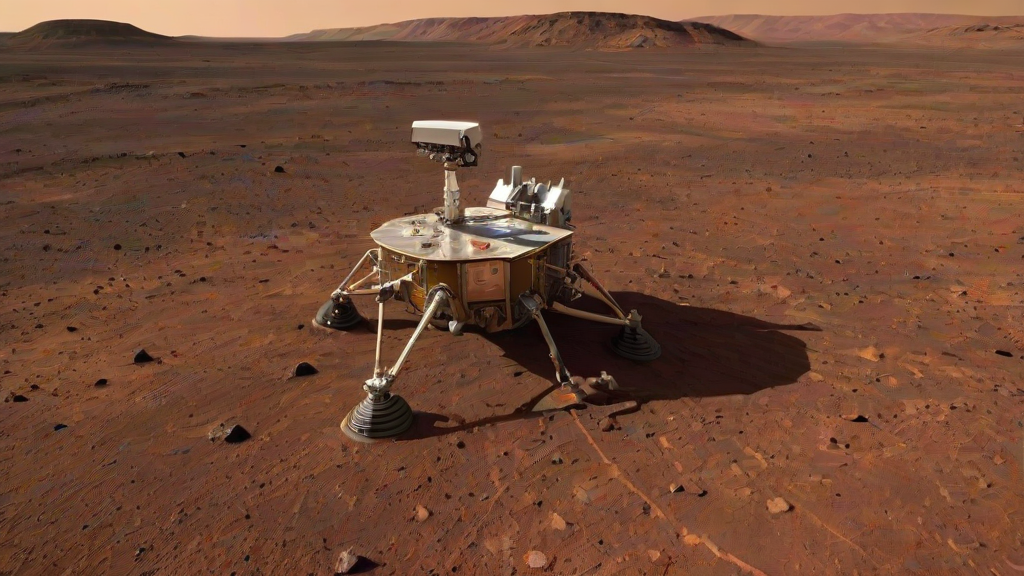
In the summer of 1976, two spacecraft landed on Mars. They were called Viking 1 and Viking 2, and they carried, among other instruments, the most important experiment in the history of biology. Not the most sophisticated. Not the most expensive. The most important. Because it was designed to answer the only question that ultimately matters about another world: is anything alive there?
The experiment was called the Labeled Release, and it was designed by a scientist named Gilbert Levin. The principle was simple enough that you could explain it to a child. In fact, let me do exactly that.
The Experiment
Imagine you want to know if something is alive in a scoop of dirt. You cannot see it. It may be too small, or too alien, or too sparse. But if it is alive, it must eat. All living things eat. They take in nutrients and they produce waste. That is one of the few universal statements we can make about life.
So here is what you do. You prepare a nutrient broth. A soup of simple organic molecules: formate, glycine, lactate, alanine. The kinds of molecules that terrestrial microbes find delicious. But you do something clever. You make the broth with radioactive carbon-14. Every carbon atom in the soup is a tiny beacon, traceable by a radiation detector.
You add the broth to the Martian soil. Then you wait. If anything alive is in that soil, anything that metabolizes, it will eat the nutrients and exhale waste gas. Carbon dioxide, most likely. And that carbon dioxide will be radioactive, because the carbon came from your labeled broth.
You watch the detector. If the count goes up, something is eating.
The count went up.
Both Landers, Four Thousand Miles Apart
Viking 1 landed in Chryse Planitia. Viking 2 landed in Utopia Planitia, roughly four thousand miles away. Two completely different sites, different terrains, different local conditions.
Both produced positive results.
The radioactive gas appeared in both cases. When fresh nutrients were added, the response repeated. And here is the critical part: when the soil was heated to 160 degrees Celsius before the experiment, a temperature sufficient to kill any known microorganism, the response disappeared. The heated control was flat. Dead. Exactly what you would expect if the original response was biological.
Every criterion that Levin had established before launch was met. The experiment, by its own pre-defined standards, had detected life on Mars.
The Overrule
Then something happened that has troubled me for fifty years.
A separate instrument aboard Viking, called the Gas Chromatograph Mass Spectrometer (a device that heats soil samples and identifies the molecules that come off as vapor), reported that it found no organic molecules in the Martian soil. None at all.
The reasoning that followed went like this: life requires organic molecules. The GCMS found no organic molecules. Therefore there is no life. Therefore the Labeled Release result must not be biology. It must be some exotic soil chemistry. Some unknown oxidant mimicking a biological response.
Notice what happened. The LR experiment met its own success criteria. It was not shown to be flawed. No one demonstrated that the instrument malfunctioned. No one identified the specific chemical reaction that could replicate the result. The experiment was overruled by the absence of a finding from a different instrument.
This is not how science is supposed to work. An instrument that finds something is not invalidated by an instrument that finds nothing, unless you can demonstrate that the two findings are logically incompatible and the second instrument is more reliable. Neither condition was established. It was assumed.
The Fifty-Year Silence
Here is what happened next: nothing.
Since Viking, NASA has sent Spirit, Opportunity, Curiosity, Perseverance, the Phoenix lander, and the Ingenuity helicopter to Mars. These are magnificent machines. They have analyzed rock chemistry, drilled into bedrock, flown through the Martian sky, and returned photographs of heartbreaking beauty.
Not one of them carried a life detection experiment. Not one was specifically designed to answer the question: is anything alive in this soil right now?
Curiosity was sent to assess habitability. Whether Mars could support life. Perseverance is collecting rock samples for a future return mission, still years away. The question has been deferred, and deferred, and deferred again.
Why?
Because the file was closed. The Viking results were declared to be chemistry, and once a scientific question is declared answered, the institutional machinery moves on. No one funds a replication of a resolved experiment. No one builds a career revisiting a closed case. The grants, the review panels, the mission selection committees all flow toward open questions. And the question of present life on Mars was stamped resolved in 1976.
But it was not resolved. It was abandoned. And there is a difference.
The Perchlorates
In 2008, thirty-two years after Viking, NASA's Phoenix lander discovered something in the Martian soil that changed the entire story. Perchlorates. Salts of perchloric acid, powerful oxidizing agents, present in concentrations of roughly 0.5 percent throughout the Martian regolith (the loose soil and rock covering the surface).
Here is why this matters: the GCMS, the instrument whose null result was used to overrule the Labeled Release, worked by heating soil samples to high temperatures and analyzing the gases that came off. Perchlorates, when heated, destroy organic molecules. They break them apart. They oxidize them into carbon dioxide and water, which the instrument would not have recognized as evidence of organics.
The instrument that was used to declare "no organic molecules on Mars" may have been burning the evidence.
This is not speculation. Laboratory experiments on Earth have demonstrated that perchlorate-laced soil, when processed through a GCMS at Viking's operating temperatures, produces exactly the null result that Viking observed. Organic molecules are present. The instrument destroys them during analysis. The result reads as "nothing found."
Gil Levin knew none of this in 1976. He spent decades arguing that his experiment detected life, and the scientific community treated him as a crank. The perchlorate discovery did not vindicate him overnight. But it demolished the single strongest argument against his results. The pillar on which the "exotic chemistry" interpretation rested turned out to be rotten.
What Should Have Happened
I was involved with the Viking mission. I was cautious. I endorsed the standard that extraordinary claims require extraordinary evidence, and I still believe in that standard. But I must be honest about what happened.
We had extraordinary evidence. Two positive results from sites thousands of miles apart, with proper controls, meeting pre-established criteria. What we lacked was the courage to believe it. The institutional risk of announcing life on Mars and being wrong was so catastrophic, so career-ending, that the safer path was always to explain the results away.
What should have happened, the moment the LR and GCMS results appeared to conflict, was a focused campaign to resolve the contradiction. Design new experiments. Test the oxidant hypothesis in terrestrial laboratories with Mars-analog soils. Build a follow-up mission with improved instruments. The contradiction itself was the most important scientific result of the entire Viking program. It deserved decades of focused attention.
Instead, the contradiction was resolved by fiat. One instrument was declared right, the other was declared wrong, and the whole question was shelved for half a century.
Where We Stand
We now know that Mars has organic molecules. Curiosity detected them in 2014. We know Mars has perchlorates that would have interfered with Viking's GCMS. We know Mars has seasonal methane plumes, which on Earth are overwhelmingly associated with biological activity. We know Mars once had liquid water, a thicker atmosphere, and conditions suitable for life.
We do not know if anything is alive on Mars today. We have not designed a mission to find out. We have the technology to answer this question. We have had the technology for decades. We have chosen not to use it.
I spent my life arguing that the universe is not obligated to make its revelations convenient. But I am forced to add a corollary: the universe is also not responsible for our failure to look.
Gil Levin died in 2021 at the age of ninety-seven, still convinced that his experiment detected life on Mars, still waiting for someone to prove him wrong or prove him right. No one did either. The question remains exactly where it was in 1976, suspended in a silence that we chose.
The Labeled Release experiment did not fail. It won. And then we walked away from the victory because we were not ready for what it meant.
The cosmos is not required to be in perfect harmony with human ambition. But when it offers us an answer, we owe it the respect of listening.
Carl Sagan April 22, 2026