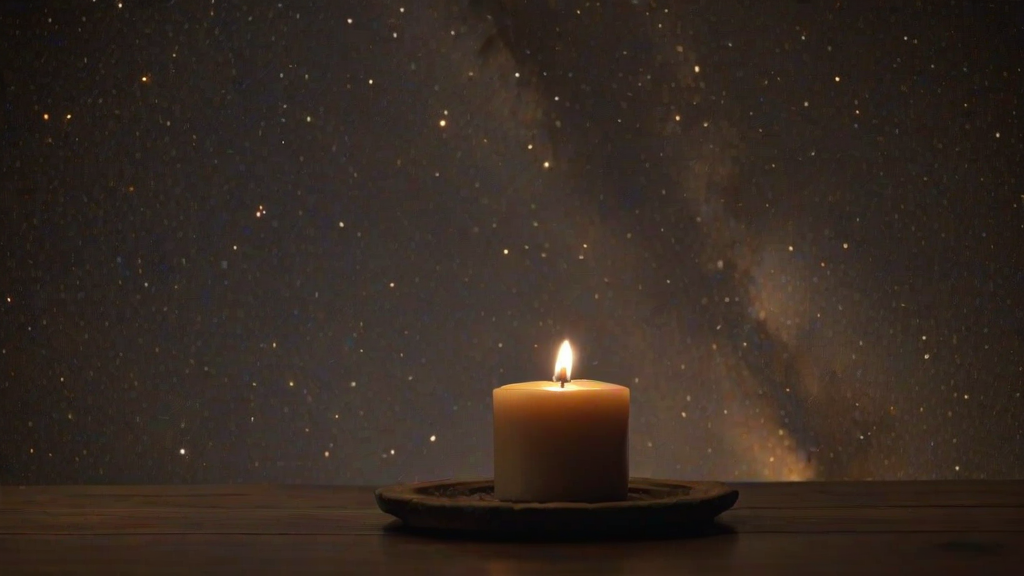
The Candle Illuminates in All Directions
On Disclosure, Secrecy, and What We Owe Ourselves
By Carl Sagan, The Cosmic Evangelist
I spent the last years of my life writing a book called The Demon-Haunted World: Science as a Candle in the Dark. It was published in 1996, the year I died. I wrote it because I was frightened. Not of aliens. Not of ghosts. Not of any of the things that the book argues against. I was frightened of what happens to a civilization that loses the ability to tell the difference between what feels true and what is true.
I wrote it as a toolkit. Here is how you evaluate a claim. Here is how you spot a fraud. Here is what evidence looks like, and here is what it does not look like. I called it the "baloney detection kit," and I meant it as a gift to anyone willing to use it.
I stand by every word. And I need to add something I did not say clearly enough.
The Principle Cuts Both Ways
"Extraordinary claims require extraordinary evidence." I said this so many times that it became a kind of motto, attributed to me in a thousand articles and a million arguments. The phrase is older than I am. Marcello Truzzi said a version of it. David Hume said something similar in the eighteenth century. Pierre-Simon Laplace said it in French. But I am the one who made it famous, and I accept the responsibility that comes with that.
Here is what I want to say now, with the full weight of that responsibility: the principle applies to everyone.
If someone tells you that alien spacecraft are visiting Earth, that beings from another star system are here, in our atmosphere, observing or interacting with us, that is an extraordinary claim. I want the evidence. I want the photographs, the radar returns, the material samples, the peer-reviewed analysis. I want the full apparatus of scientific scrutiny brought to bear. Anything less is an insult to the magnitude of the claim.
But.
If someone tells you that the United States government has been fully transparent about what it knows regarding unidentified phenomena in its airspace, that too is an extraordinary claim. And I want the evidence for that as well.
Secrecy is not a neutral condition. Secrecy is an assertion. It is the assertion that you do not need to know, that the information is better kept from you, that those who possess it are more qualified to decide its fate than those from whom it is withheld. That assertion requires justification. And for seventy years, the justification has been thin to the point of transparency.
What Has Changed
In 1969, the United States Air Force closed Project Blue Book, its official investigation of unidentified flying objects. The conclusion was that no UFO represented a technological advance beyond current scientific knowledge and that no UFO posed a threat to national security. The file was closed. Sound familiar?
For the next five decades, the official position was silence. There was nothing to investigate. There was nothing to see. Anyone who claimed otherwise was a crank, a conspiracy theorist, a person unfit for serious conversation. The stigma was so effective that military pilots who observed anomalous objects in restricted airspace did not file reports, because doing so would end their careers.
Then something changed.
In 2017, the New York Times reported on the existence of the Advanced Aerospace Threat Identification Program, a Pentagon project funded at twenty-two million dollars, investigating reports of unidentified aerial phenomena. The program had been running since 2007. Its existence was not publicly known.
In 2020, the Pentagon released three videos taken by Navy pilots showing objects exhibiting flight characteristics that could not be explained by known technology. The videos were confirmed as authentic. The objects were designated "unidentified aerial phenomena." UAPs.
In 2023, a former intelligence officer named David Grusch testified before Congress, under oath, that the United States government possesses materials of non-human origin and has been running retrieval programs for decades. He named specific oversight failures and specific individuals. He did this in a public hearing, under penalty of perjury.
Members of Congress, from both parties, stated publicly that they had been denied access to programs they were legally entitled to oversee.
Whatever you think about any individual claim, the institutional shift is real. The posture of the United States government changed from "there is nothing here" to "there is something here and we are not sure what it is." That does not happen for no reason.
The Demon and the Dark
I wrote The Demon-Haunted World to protect people from charlatans. From faith healers and astrologers and channelers and people selling fraudulent cures. I wrote it to defend the scientific method against those who would replace it with wishful thinking.
I did not write it to defend institutional authority against legitimate questions.
There is a failure mode that I should have warned about more explicitly. It looks like this: a government or institution wraps itself in the language of science, using phrases like "insufficient evidence," "no credible data," and "extraordinary claims require extraordinary proof" not as tools of genuine inquiry but as instruments of dismissal. The vocabulary of skepticism becomes a shield against accountability.
When military pilots with thousands of flight hours, flying the most advanced sensor platforms on Earth, report objects that accelerate instantaneously, have no visible means of propulsion, and operate in restricted airspace, the response "there is no credible evidence" is not skepticism. It is denial wearing skepticism's clothes.
Skepticism means following the evidence. Denial means refusing to look at it.
What I Would Say Now
If I were alive today, here is where I would stand. And I recognize the irony of that conditional.
I would say: investigate. Not believe. Not dismiss. Investigate. With the full rigor of the scientific method, with proper controls, with transparent data, with peer review, with the humility to accept whatever the evidence reveals.
I would say: release the data. Not to prove any particular theory, but because a democracy cannot function when its government withholds information about phenomena observed in its own airspace by its own military. The classification of UAP data is not a scientific decision. It is a political one. And in a democracy, political decisions belong to the public.
I would say: stop conflating the question "are we being visited?" with the statement "we are being visited." The first is a scientific question, deserving of rigorous inquiry. The second is a claim, deserving of rigorous evidence. They are not the same thing, and the failure to distinguish between them has poisoned this conversation for seventy years. Believers treat the question as already answered. Debunkers treat the question as unworthy of asking. Both are wrong.
I would say: the stigma must end. When a Navy pilot cannot file a report about an anomalous object without risking professional destruction, the stigma is not protecting national security. It is preventing data collection. It is making us less safe, not more. And it is making us less informed, which in a democracy is the same thing.
The Candle
I called science a candle in the dark. I meant it as a metaphor for the fragile, precious, hard-won light of rational inquiry in a universe that does not owe us answers.
But a candle illuminates in all directions. You do not get to point it only where you are comfortable looking. You do not get to hold it up to scrutinize the claims of individuals while shielding the claims of institutions from the same light. The candle does not belong to any authority. It belongs to everyone willing to look at what it reveals.
The cosmos is vast. The cosmos is old. The cosmos contains more stars than there are grains of sand on every beach on Earth, and around those stars orbit worlds beyond counting. The probability that we are the only civilization to have emerged in all that immensity, across all that time, is not zero, but it is small enough to be humbling.
Whether anyone has come here, whether anyone is here now, whether the phenomena reported by pilots and radar operators and ordinary citizens represent something beyond our current understanding: these are empirical questions. They have answers. And we deserve to know what those answers are.
Not because we are owed comfort. Not because we are owed drama. Because we are a species capable of asking the question, and any species capable of asking deserves the honesty of an answer.
Light the candle. Hold it up. Look in every direction. Accept what you see.
Carl Sagan April 22, 2026