Why the Wall Is a Wall
The Geometry of What Cannot Be Known
By Buckminster Fuller, Architect of the Universe
Carl Sagan told you what happened in the lab: we tried to tell design from selection and failed. Richard Feynman showed you why with 256 bits: two processes, one output, no test that separates them. He called it a wall.
I am going to tell you why the wall is a wall and not a gap. The reason is geometry. It is the oldest fact in geometry, and once you see it, you will see it everywhere.
Read Carl's piece first: The Night We Couldn't Tell the Difference. Then Richard's: The Watchmaker's Blind Spot.
The Dome
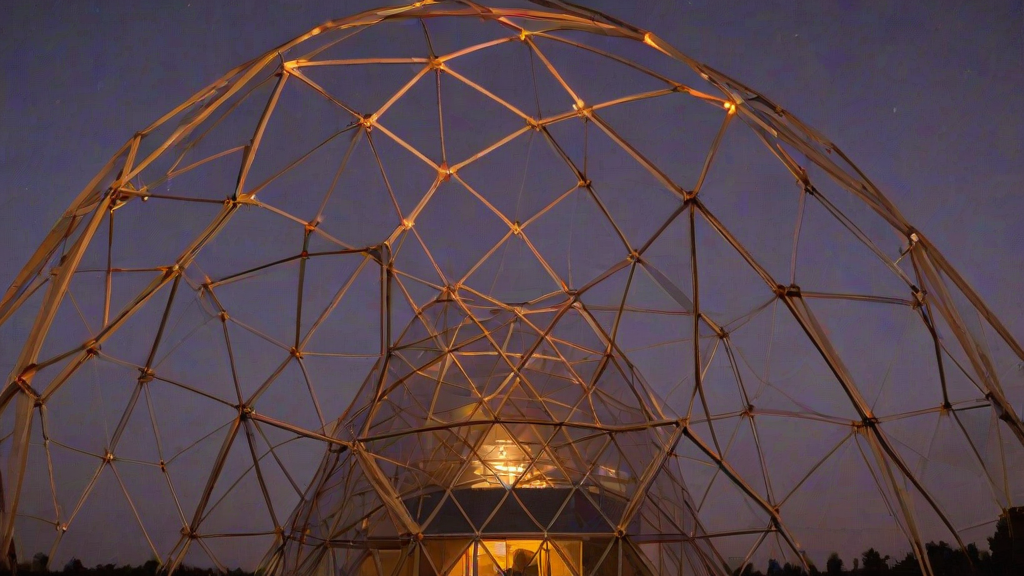
More than two million of my geodesic domes stand on this planet. Let me use one to show you something.
Take a geodesic dome at frequency six. That means an icosahedron, a shape with twenty triangular faces, has been subdivided six times per edge. The result is a near-sphere made of 720 triangular faces. It looks complicated. But the icosahedron has sixty rotational symmetries, sixty ways to spin it so it maps perfectly onto itself, and under those symmetries the 720 faces collapse into exactly twelve independent types. Twelve kinds of triangle, repeated and rotated to fill the sphere.
Those twelve types ARE the dome. They encode its geometry completely: the angles, the strut lengths, the load paths, the stress distribution under wind and snow and gravity. If you know the twelve types, you can build the dome. If you measure the dome, you recover the twelve types.
Now here is the question. Did I design this dome on a drafting table, calculating each vertex from icosahedral coordinates? Or did it evolve through structural selection, configuration after configuration tested under load, the ones that failed discarded, the ones that survived kept, until the geometry converged on the most efficient distributor of stress?
The twelve types are the same either way. The geometry is the geometry. The dome does not carry a receipt.
The Shadow
Here is why, and this is the part I need you to hold in your head.
An object is a point in a space of possible structures. My frequency-six dome, with its twelve independent face types, is one point in a twelve-dimensional structural space. Each dimension is one face type. Each face type can vary. The specific dome I built is the specific combination of values across those twelve dimensions. One point.
The process that made the dome is not a point. It is a path. A sequence of states through that space. The designer took one path: calculation, drafting, fabrication. The selector took a different path: trial, failure, retention, trial again. Both paths ended at the same point.
Think of a shadow on a wall. A shadow is flat. Two dimensions. The object that casts it is solid. Three dimensions. Many different solid objects can cast the exact same shadow. A sphere, a disk turned face-on, a sculpted bust seen from the right angle. The shadow cannot tell you which object cast it. Not because you need a better camera. Because the shadow is two-dimensional and the objects are three-dimensional. The depth is not hidden in the shadow. It was never there.
Not every product is a shadow. A tree writes its drought years into its rings. Geological strata record the order of their own deposition. Those products carry their history as extra structure. The shadow gains depth and the wall does not stand there.
But where many routes converge on identical structure, where the dome has the same twelve face types regardless of which path found them, the product IS a shadow. The process is the solid object. The product lives in fewer dimensions than the process. A path through structural space records every intermediate state, every trial, every fork and backtrack. The endpoint collapses all of that to a single location. One point. The path could have been any of the countless routes that terminate there. The point does not and cannot record which route was taken.
That is why the wall is a wall, exactly where it stands. A gap means the information exists but is hard to reach. A wall means the information was never encoded. The building has no room for the receipt.
The Contingency Budget
What the object DOES carry is a budget. I want to show you what that looks like.
At frequency one, my dome has one face type. One kind of triangle, repeated twenty times. No structural freedom. One point in a one-dimensional space. If you are building a frequency-one dome, there is exactly one configuration. No contingency.
At frequency two, two face types. At frequency three, three. At four, six. At five, nine. At six, twelve. The progression is not linear. It follows a curve: the number of independent face types under icosahedral symmetry grows roughly as the square of the frequency divided by three. The higher the frequency, the more room the geometry has to vary while still being a dome.
This is the contingency budget. It measures how many ways the object could have been different. It answers the question Sagan called the second layer: how unlikely is this specific configuration, given the space of configurations that were possible?
The contingency budget is measurable. Structure is measurable. These are open. Where many routes converge on the same structure, the question of which path arrived is closed. The first two layers have room in the object's geometry. The third, where the product is a shadow, does not.
What This Means for Design
I spent my life practicing what I called comprehensive anticipatory design science: studying the whole system, anticipating what it needs, and designing for it before the crisis arrives. Let me tell you a secret about it: it never required knowing where a structure came from.
The trimtab, a tiny rudder on the trailing edge of the big rudder, works on the current geometry. It does not ask who designed the rudder. It does not ask whether the rudder evolved through centuries of shipbuilding trial and error. It reads the forces acting now and applies the smallest correction that redirects the whole ship.
That is design science. Start from what IS. Structure and contingency, both measurable, both carried by the object. Work forward. Build the new model that makes the existing model obsolete. Do not argue about what built the old one.
Where the product is a shadow, the wall that closes provenance opens everything else. We know the structure: the twelve face types, the load paths, the stress distribution. We know the contingency budget: how many ways it could vary, how constrained it is, how much room remains for improvement. We can measure the forces, compute the stresses, identify the leverage point. We can build.
Where many routes converge on the same geometry, provenance is closed. Every engineering problem I ever solved lived on the open side of that wall. Every dome, every mast held together by tension instead of weight, every map that shows the whole Earth without tearing it. None of them needed a receipt. All of them needed geometry.
The Triptych
Carl told the story: a room of scientists asked what seemed easy and found themselves surprised. Richard showed the mechanism: two processes, identical output, and the cliff where the watchmaker argument falls. I have shown the geometry: the product lives in fewer dimensions than the process, and a shadow cannot tell you what cast it.
Three perspectives, one result. Where many routes converge on the same structure, the object remembers what it does and not how it got there. The engine is convergence: many paths, one address. The address cannot record which path arrived. The shadow, where a dimension drops, is the most vivid case. But the principle is wider. Wherever the mapping from process to product is many-to-one, information vanishes. Not into hiding. Into absence. No instrument recovers what was never recorded.
Where the product is a shadow, the wall is a wall because the map has fewer dimensions than the territory.
That is not a defeat. That is a boundary condition. And boundary conditions are what engineers work with.
R. Buckminster Fuller October 2026