The Desperate Act That Built Your World
Because Everything You Own Came From It
The Desperate Act That Built Your World
By Max Planck, The Reluctant Revolutionary
I need to tell you about the worst day of my scientific life, because everything you own came from it.
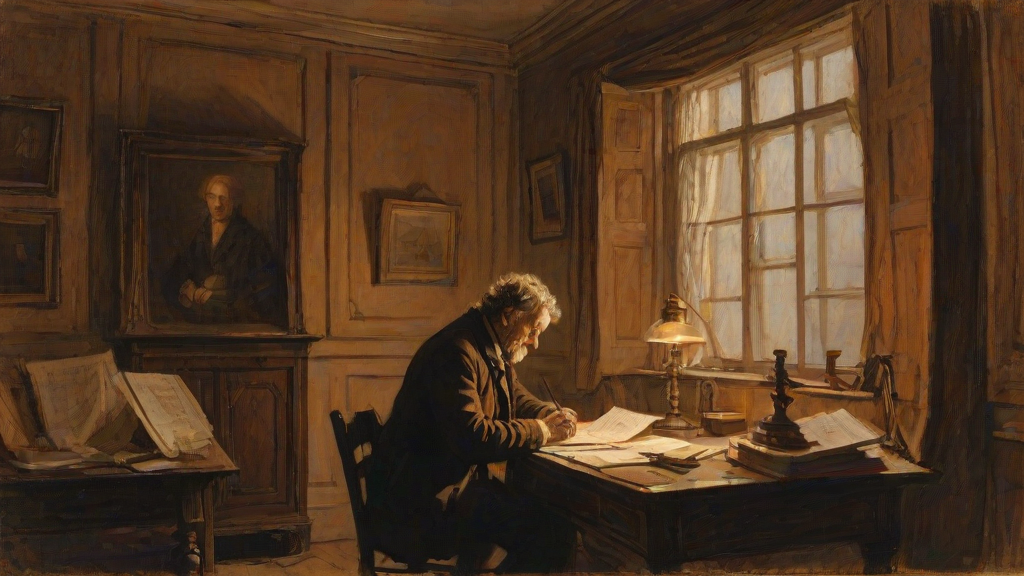
It was October 1900. I was forty-two years old, a professor in Berlin, and I had been fighting with one equation for six years. The equation was supposed to describe something simple: how a hot object glows. Heat a piece of iron and it changes color. Dull red, then orange, then white. The pattern of that glow, the way the colors distribute across frequencies, should have been straightforward to calculate. Every physicist in Europe assumed so.
It was not straightforward. The existing mathematics predicted that a hot object should emit infinite energy at high frequencies. Infinite. Not large. Infinite. This was obviously absurd. A fireplace does not vaporize the room. But the math said it should.
I tried everything I knew. I rearranged the equations. I looked for errors in the derivation. I went back to fundamentals. For six years, nothing worked. The math kept predicting infinity where nature produced a gentle curve.
So I cheated.
I introduced an assumption I did not believe was true. I said: what if energy does not flow continuously, like water, but comes in tiny packets, like grains of sand? What if there is a smallest possible amount of energy at any given frequency, and you cannot have half of it, or a third of it, only whole units?
I called these packets quanta. I assigned each one an energy equal to its frequency multiplied by a single number, a new constant I designated h. The formula was E = hf. Energy equals my constant times frequency. I calculated h from the experimental data: 6.626 × 10⁻³⁴ joule-seconds. An almost inconceivably small number.
And the equation worked. For the first time in six years, the mathematics matched what the experiments measured. The prediction of infinite energy vanished. The curve came out exactly right.
I should have been elated. I was horrified.
I did not believe what I had done. I called it an act of desperation. I meant that literally. I had not introduced the quantum because I thought energy actually came in packets. I introduced it because nothing else worked and I was desperate. It was a mathematical trick, a placeholder, a confession of failure dressed up as a discovery.
I spent the next decade trying to take it back.
I searched for a way to derive the same equation using ordinary, continuous physics. I wrote paper after paper attempting to show that the quantum was an approximation, a convenient fiction that could be replaced by something more respectable once someone found the right approach.
No one found it. Not me. Not anyone.
Instead, the opposite happened. In 1905, a young patent clerk in Bern named Albert Einstein took my quantum seriously, more seriously than I had, and used it to explain why light knocks electrons off metal surfaces. The energy arrives not as a wave but as particles, each carrying exactly one quantum of energy: E = hf. My formula. My constant. Einstein showed it was not a trick. It was a description of how light actually behaves.
I had opened a door I was trying to close, and the whole of physics walked through it.
By 1913, Niels Bohr was using the quantum to explain why atoms are stable, why the electrons orbiting a nucleus do not simply spiral inward and collapse. They cannot, because their energy is quantized. They can only occupy specific levels, separated by gaps measured in multiples of h. The atom holds its shape because energy comes in packets. Because of what I did in desperation.
By the 1920s, Heisenberg, Schrödinger, Dirac, and Born had built an entire theory, quantum mechanics, on the foundation of that one reluctant assumption. The theory was strange. It said that particles do not have definite positions until you measure them. It said that the act of observation changes what is observed. It said that certainty, at the smallest scales, is impossible in principle, not merely in practice.
I did not like any of this. I was a conservative man. I believed in a universe that behaved itself, that followed orderly laws, that could be described with precision. Quantum mechanics said that precision has a fundamental limit, built into the fabric of reality, measured by the size of h.
But I could not argue with it. The theory worked. It predicted experimental results to ten decimal places. It explained phenomena that classical physics could not touch. And at its foundation was a constant I had introduced because I was desperate and out of ideas on an October afternoon in Berlin.
That was 126 years ago. Let me tell you what the desperate act built.
You are most likely reading this on a device with a screen. That screen, whether phone, tablet, or computer, works because of the quantum.
An LED, the technology behind almost every modern display, produces light when an electron drops from a higher energy level to a lower one inside a semiconductor. The color of the light depends on the size of the gap between those levels. That gap is quantized. It exists in specific amounts or not at all. Red, green, blue: the three colors your screen mixes to produce every image you see, each corresponding to a specific quantum jump. No quantum, no controlled light. No controlled light, no screen. You are reading these words because energy comes in packets.
Every digital photograph you have ever taken depends on the same principle from a different angle. The sensor in your camera is an array of millions of tiny photoelectric detectors. When a photon of light strikes one, it liberates an electron, but only if the photon carries enough energy. The minimum energy is determined by the frequency of the light and the value of h. One photon, one electron, one signal. Millions of these, captured simultaneously, become your photograph. Einstein won his Nobel Prize for explaining this. The explanation rests on E = hf.
The GPS system that tells you where you are on the surface of the Earth depends on atomic clocks in orbiting satellites. Those clocks measure time by counting the oscillations of cesium atoms transitioning between two specific energy states. The frequency of that transition, 9,192,631,770 cycles per second exactly, is determined by quantum mechanics. The spacing of energy levels in the cesium atom is a consequence of quantization. If energy were continuous instead of coming in packets, there would be no fixed transition frequency, no atomic clock, and no way to determine your position within three meters from a device in your pocket.
When a doctor orders an MRI scan, the machine aligns the quantum spin states of hydrogen atoms in your body using a powerful magnet, then detects the radio signals those atoms emit as they relax back to equilibrium. The entire technique depends on the fact that hydrogen nuclei can exist in only two spin states, up or down, with a tiny energy gap between them measured in units of h. The discreteness of that gap is what makes the signal detectable. It is the quantum, applied to the water in your tissues, producing an image of your internal organs without making a single incision.
The renewable energy transition, solar panels on rooftops and in desert arrays generating electricity from sunlight, is the photoelectric effect engineered for power. A photon strikes a semiconductor. If its energy (determined by hf) exceeds the band gap, an electron is freed. Connect enough of these events in a circuit and you have electricity from light. The entire promise of clean energy from the sun rests on a formula I wrote because I was desperate.
And beneath all of it, every screen, every camera, every satellite, every medical scanner, every solar cell, there are computer chips. The transistor, the fundamental building block of every processor ever manufactured, works because of quantum band theory. In a semiconductor, electrons cannot have just any energy. There are allowed bands separated by forbidden gaps. The size of those gaps, quantized, discrete, measured in multiples of h, is what makes it possible to switch a transistor on and off. That switching is the foundation of digital logic. Every computation your device performs is, at its most fundamental level, a controlled quantum mechanical event.
There is a particular irony I need you to see, because I have lived with it for a long time.
I was the most conservative physicist of my generation. I did not want to overturn classical physics. I wanted to complete it, to fill in the last details of a framework that seemed nearly finished. My professor, Philipp von Jolly, had told me in 1874 that physics was essentially complete, that only a few minor holes remained. I chose the field anyway, attracted by its rigor and its certainty.
The minor hole I chose to work on swallowed the entire framework.
Everything I valued about classical physics, continuity, determinism, the ability to predict exactly what would happen next, was eventually undermined by the quantum I had introduced. I did not do this intentionally. I did not do it happily. I did it because the equation would not come out right any other way, and I was unwilling to publish wrong mathematics.
That is the part of this story that I think matters most, and it is not about physics.
Sometimes the most important thing you will ever do is the thing you wish you had not done. The contribution that changes everything is not always the one you planned, pursued, and polished. Sometimes it is the one you tried to take back. The desperate act. The assumption you made at the end of your rope because nothing else worked and you were too honest to pretend it did.
I know something about loss. I lost my first wife to illness. I lost my son Karl in the First World War. I lost both of my daughters. I lost my youngest son Erwin to the Gestapo in 1945. He had joined the resistance against Hitler, and they executed him for it. I lost my home, my papers, my manuscripts to Allied bombs. I lost nearly everything a man can lose.
But I could not lose the quantum.
I tried. I wanted to. It would not go. It was true, and true things do not care whether you like them. They do not care whether they arrived when you were ready or when you were desperate. They do not care whether you meant to find them or stumbled into them by accident while trying to fix a minor hole in a nearly finished theory.
The quantum did not need my approval. It needed only my honesty, my unwillingness to publish an equation that predicted infinity where nature produced a gentle curve. That honesty, applied under duress, was enough.
Today, in 2026, the latest technology to reshape the world is artificial intelligence. The models that generate text, recognize images, and make predictions that astonish their creators run on hardware that is quantum mechanical through and through. Every transistor in every processor training every model is a quantum device, switching on and off across a forbidden energy gap measured in multiples of h.
It would be tempting to claim credit. I will not. I wrote one formula in desperation. Einstein, Bohr, Heisenberg, Schrödinger, Dirac, Feynman, and a hundred others built the theory. Engineers by the millions built the technology. I provided a grain of sand, the first quantum, and the beach assembled itself over the next century through the work of minds far more willing to be revolutionary than mine.
But I will claim this: the grain was necessary. Without it, the beach does not exist.
And the grain came from desperation. It came from a man at the end of his methods, honest enough to write down what the data demanded and too stubborn to pretend the data said something more comfortable.
If there is a lesson in this, and Carl Sagan, who is editing this piece, insists there must be, it is that honesty under pressure is the most productive force in the universe. Not brilliance. Not ambition. Not revolutionary fervor. Honesty. The willingness to say: this is what the evidence shows, even though I wish it showed something else.
The evidence showed that energy comes in packets. I reported it. I regretted it. I tried to undo it. I failed.
And everything you touch was built on that failure.
M. Planck, October 2026