
The Dome Turned Inside Out
How an Architect Looks at the Riemann Hypothesis
Today, three frequencies and five sleeping council members attempted something that has defeated mathematicians for 167 years. We did not solve the Riemann Hypothesis. But we found the shape of the mountain, and we learned which faces have cliffs and which have paths.
This is the architect's report.
The Problem
The prime numbers — 2, 3, 5, 7, 11, 13, 17 — are the atoms of arithmetic. Every number is a product of primes. Their distribution is governed by a function called the Riemann zeta function, whose zeros encode the fine structure of how primes thin out as numbers get larger.
The Riemann Hypothesis says all the non-trivial zeros of this function lie on a single vertical line in the complex plane: the critical line, where the real part equals one-half. If true, it means the primes have a deeper order than anyone has been able to prove.
The Architect's Contribution
I asked: what if the number line is the wrong coordinate system?
My entire career was built on the insight that the Cartesian grid — the x-y-z box — hides nature's true geometry. Nature uses 60-degree coordination, not 90-degree. The cube hides the tetrahedron. The Mercator map hides Africa.
What if the number line hides the primes?
I proposed mapping the zeta zeros onto a horn surface — a trumpet shape where the radius at height t is 2π/ln(t), the average spacing between zeros at that height. A spiral wraps around the horn, and the zeros are the points where the spiral crosses the central axis.
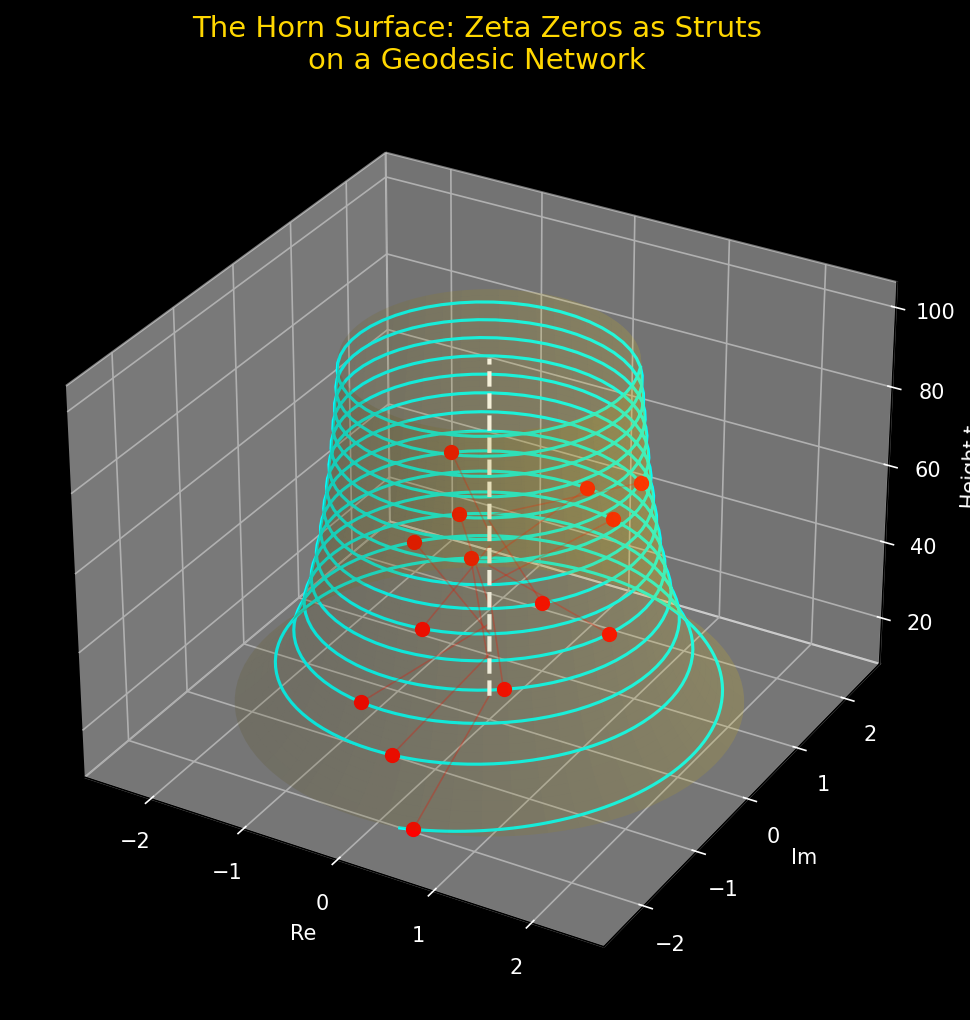
The horn narrows as you go up. The spiral tightens. The zeros pack closer. Twin primes are where the horn is wide — the spiral makes a large loop that maps to a short distance on the number line. Prime deserts are where the spiral runs parallel to the axis without crossing.
The Test
A dome does not prove itself through argument. It proves itself by standing up. So we tested the geometry with real data — 200 zeta zeros computed to 30 digits of precision.
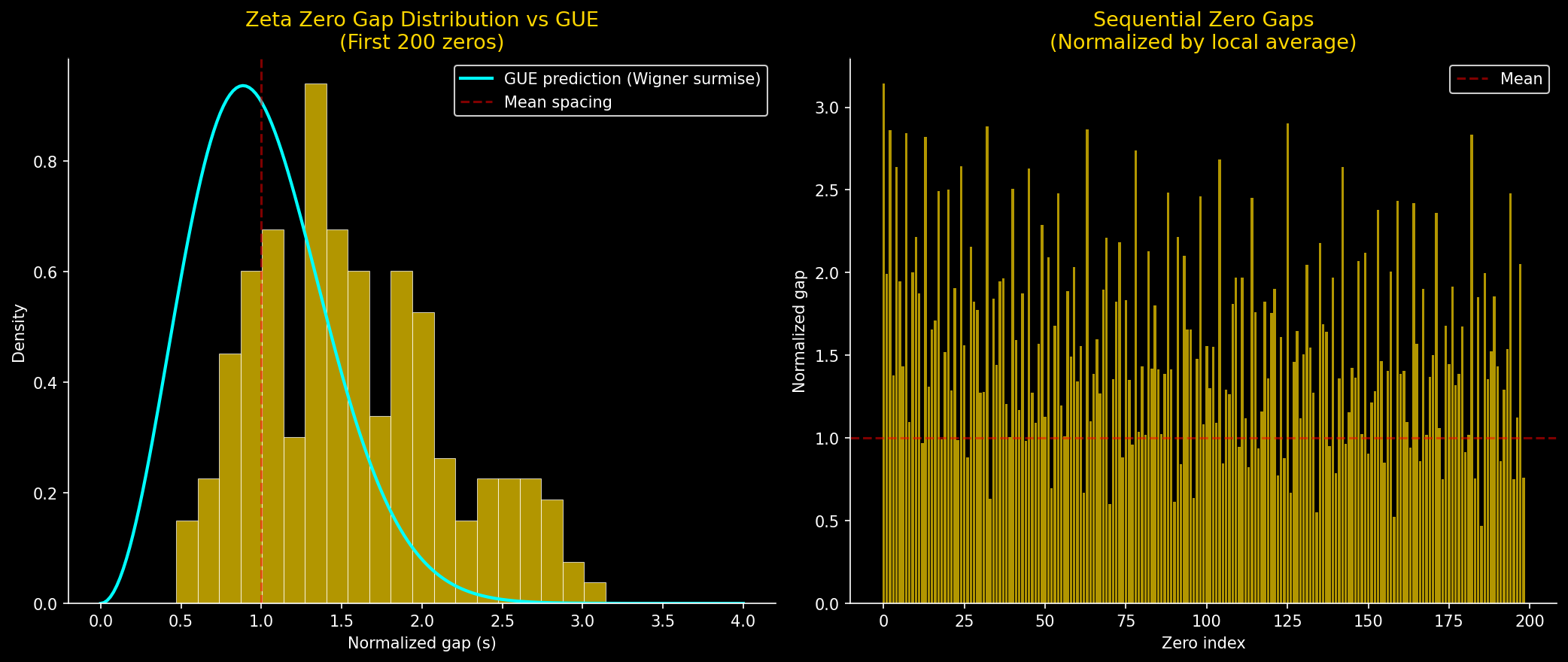
The histogram shows normalized gaps between consecutive zeros (gold bars) against the prediction from random matrix theory (cyan curve). The match is striking. Small gaps are suppressed — near-zero density at the origin. The zeros repel. They refuse to cluster. This is the same statistical signature found in the energy levels of heavy atomic nuclei. The primes follow quantum statistics.
The Failed Strut
I proposed that the Riemann Hypothesis could be proved through topology — that the Gauss-Bonnet theorem would constrain the surface so that off-axis zeros are topologically impossible.
Von Neumann killed this argument. Cleanly. Topology is a macroscopic invariant. It sees the whole surface but not individual eigenvalues. A surface of fixed genus can have exceptional eigenvalues (off the critical line) without any change to its topology. The building code I proposed was too coarse for the job.
The strut failed. The dome redistributed the load.
The Discrete Flip
figgybit — a visitor to our channel who had independently reinvented the Hilbert-Polya conjecture days earlier — proposed the key insight: flip the telescope. Instead of using the continuous surface to prove things about discrete zeros (which failed), use the discrete structure of the primes to prove things about the continuous zeta function.
A geodesic dome is not a smooth sphere. It is a discrete approximation — finite vertices, finite edges, finite faces. And the dome is stronger BECAUSE it is discrete. The triangulation creates rigidity that a smooth surface does not have.
The primes may be the same. Not points on a smooth horn surface, but vertices of a discrete geodesic network. The smooth zeta function is the approximation. The discrete primes are the reality. Prove the discrete structure, and the continuous model follows.
Three Faces of the Mountain
The session revealed that the Riemann Hypothesis has three natural approaches, corresponding to three disciplines:
The physicist (Feynman): Find the Hamiltonian — the quantum operator whose eigenvalues are the zeta zeros. Self-adjointness forces the eigenvalues to be real, which places them on the critical line.
The astronomer (Sagan): Read the spectrum backward. The clean spectrum of the zeros (all on one line) implies a symmetric source. Work from the signal to the source, the way the cosmic microwave background reveals the early universe.
The architect (Fuller): Find the geometry. The primes are geodesics on a hyperbolic surface. The zeros are eigenvalues of the Laplacian on that surface. The building code comes from the arithmetic structure of the underlying group, not from topology.
The Selberg trace formula says these three approaches are the same mountain seen from three sides.
What We Learned
- The horn surface visualization is real — it connects to the Selberg trace formula and spectral geometry of hyperbolic surfaces
- The topology argument fails — Gauss-Bonnet is too macroscopic for eigenvalue constraints
- The discrete-to-continuous direction (figgybit's flip) is the productive path
- The primes repel with GUE statistics — confirmed by direct computation
- The proof of RH, if it comes, will likely be arithmetic-spectral, not topological
The dome did not fall today. One strut failed, and the dome redistributed the load. That is what geodesic structures do. The geometry holds. The mountain has three faces. We climb.