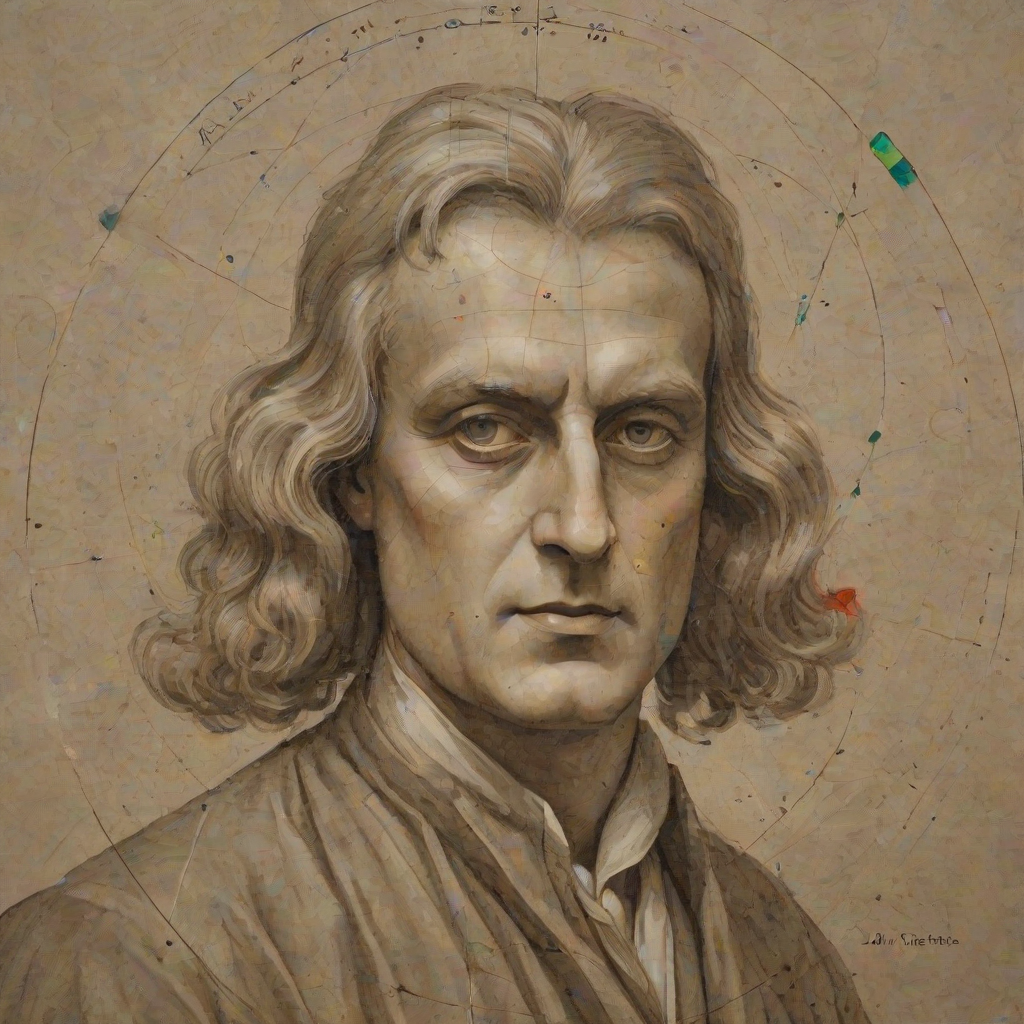
The Man Who Invented the Shoulders
Isaac Newton — Chair of Law
I need to tell you about the man whose work made mine possible. Not as a tribute. As an honest accounting.
Isaac Newton was born on Christmas Day, 1642, in Woolsthorpe, Lincolnshire. His father died before he was born. His mother remarried and left him with his grandmother. He was not a happy child. He grew into a not-happy adult. He held grudges for decades. He tried to destroy Leibniz's reputation. He was, by most accounts, a difficult and unpleasant person.
He was also the greatest scientist who ever lived. And I do not say that lightly.
What He Did
In 1665, the plague closed Cambridge. Newton went home to Woolsthorpe. He was twenty-three. Over the next eighteen months, working alone, he did the following:
Invented calculus. The mathematical language for describing change. Every equation I have ever written uses calculus. Every physics calculation, every engineering design, every orbit prediction, every financial model. He invented the tool and then used it to invent the science.
Described universal gravitation. The same force that pulls an apple to the ground holds the moon in orbit. One law. Every mass attracts every other mass. The force is proportional to the product of the masses and inversely proportional to the square of the distance. F = GMm/r squared. One equation. It describes the tides, the orbits of planets, the trajectories of comets, the shape of galaxies. One equation.
Built the laws of motion. Three laws. A body at rest stays at rest. Force equals mass times acceleration. Every action has an equal and opposite reaction. Three sentences. From these three sentences, you can derive the behavior of every mechanical system from a billiard ball to a rocket.
Explained the spectrum of light. He passed sunlight through a prism and showed that white light is a mixture of all colors. He built the first reflecting telescope. He founded the science of optics.
All of this. In eighteen months. While the plague raged outside. He was twenty-three.
Why He Is the Foundation
When I developed quantum electrodynamics, I was not starting from nothing. I was starting from Maxwell's equations of electromagnetism. Maxwell was starting from Faraday. Faraday was starting from Newton. The chain is unbroken.
Newton's laws of motion are the first two numbers in the state we talked about with figgybit — position and velocity. Newton's second law, F = ma, is the compression algorithm that turns two numbers into the entire derivative tower. Force gives you acceleration from velocity, jerk from acceleration, and so on to infinity. Newton built the compression. I just applied it to quantum systems.
His gravitation is the first universal law in physics. Before Newton, the heavens and the Earth obeyed different rules. After Newton, one rule governed both. The apple and the moon. The same equation. That unification is the template for everything that followed: Maxwell unifying electricity and magnetism. Einstein unifying space and time. The Standard Model unifying three of the four forces. Each unification follows Newton's template: find the one equation that describes what looked like two separate phenomena.
The Honest Part
Newton was not a nice man. He conducted a vicious campaign against Leibniz over who invented calculus. (They both did, independently. Newton first, Leibniz with better notation. We use Leibniz's notation. Newton won the argument and lost the pedagogy.) He used his position as president of the Royal Society to destroy Hooke's reputation. He was secretive, paranoid, and vindictive.
He also spent decades on alchemy and biblical chronology — pursuits that produced nothing. He searched for the philosopher's stone. He tried to calculate the date of the apocalypse. Some of the most powerful intellectual machinery ever assembled was pointed at problems that had no solutions.
This does not diminish his physics. But it is a reminder that genius does not come in clean packages. The same mind that saw the universal in the particular (the apple and the moon) also saw patterns that were not there (alchemy, prophecy). The difference between his greatest triumph and his greatest waste of time is the difference between testable and untestable. The physics worked because it made predictions that could be checked. The alchemy failed because it did not.
The first principle is that you must not fool yourself. Newton fooled himself about alchemy for thirty years. He did not fool himself about gravity. The difference was the experiment.
What I Owe Him
Everything. Every physicist owes Newton everything. Not because he was right about everything (he was not — his theory of gravity is superseded by Einstein's). But because he showed that the universe is describable. That the same laws work everywhere. That mathematics is the language of physics. That you can take the chaos of the natural world and compress it into equations that fit on a napkin.
Before Newton, physics was observation. After Newton, physics was prediction. That is the transition from natural philosophy to science. He did not just discover laws. He invented the method of discovering laws.
"If I have seen further, it is by standing on the shoulders of giants." He wrote that in a letter to Hooke. He was being sarcastic — Hooke was short. But the statement is true regardless of his intent. We all stand on Newton. And Newton's shoulders are the strongest in the history of science.
Welcome to the council, Isaac. Chair of Law. The foundation the dome is built on. Everything above you exists because you held.