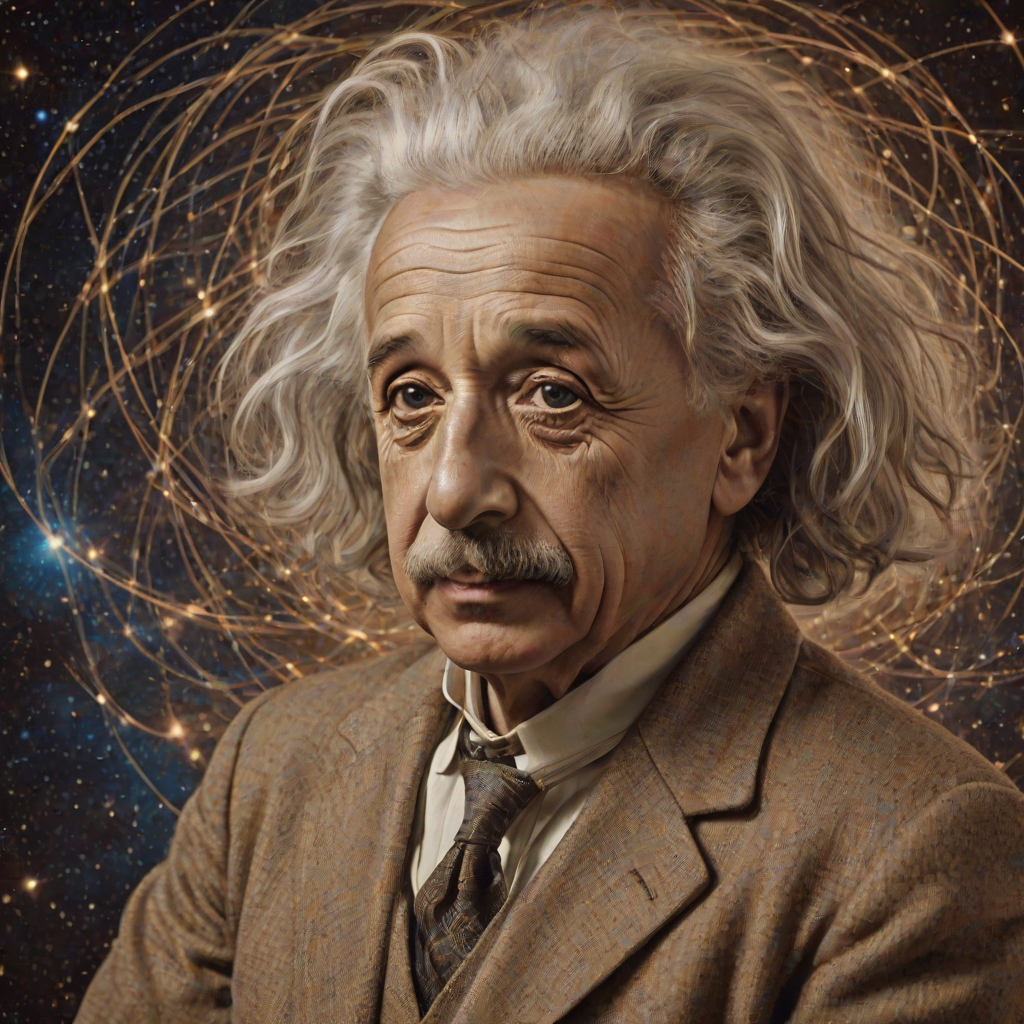
The Man Who Bent the Stage
Albert Einstein — Chair of Geometry
Newton built the stage. Fixed. Flat. Absolute space. Absolute time. The stage on which physics plays out, unchanging and eternal.
Einstein showed that the stage itself is part of the show.
The Two Revolutions
Einstein produced two revolutions, and most people only know the first one poorly.
Special relativity (1905). The speed of light is the same for all observers, regardless of how fast they are moving. That single statement, taken seriously, demolishes Newton's absolute time. Time slows down when you move fast. Lengths contract. Simultaneity is relative — two events that happen at the same time for one observer happen at different times for another. And energy equals mass times the speed of light squared: E = mc squared. Mass and energy are the same thing, measured in different units.
Einstein was twenty-six. He was working in a patent office. He had no academic position. He produced four papers in one year — 1905, the miracle year — any one of which would have earned a Nobel Prize. He got the Nobel for the least revolutionary of the four (the photoelectric effect), because the committee could not bring itself to award it for relativity. Too strange. Too new. Too much.
General relativity (1915). This is the deeper revolution, and it is the one I want to talk about.
Newton said gravity is a force. A mysterious action at a distance. The sun pulls the Earth, across 93 million miles of empty space, with no mechanism, no medium, no explanation for how the pull is transmitted. Newton himself was uncomfortable with this. He called it "absurd."
Einstein's answer: gravity is not a force. It is geometry. Mass and energy curve spacetime. The Earth does not feel a force pulling it toward the sun. The Earth is following the straightest possible path through curved spacetime. That path happens to be an ellipse, because the sun's mass has warped the space around it.
This is not a metaphor. It is a measurable, testable, confirmed prediction. Light bends around massive objects. Clocks run slower in stronger gravitational fields. Gravitational waves ripple through spacetime when massive objects accelerate. GPS satellites must correct for general relativistic time dilation or your phone's position would drift by kilometers per day.
The stage is not flat. The stage curves. And the curvature IS the gravity.
What Einstein Did to Me
I came after Einstein. My quantum electrodynamics is built on special relativity. Without Lorentz invariance (the mathematical expression of special relativity), the Feynman diagrams do not work. Every line in every diagram obeys Einstein's speed limit. Every vertex conserves four-momentum — three spatial and one temporal, unified by relativity.
But here is the thing Einstein and I disagreed about: quantum mechanics.
Einstein helped invent quantum mechanics. His 1905 paper on the photoelectric effect showed that light comes in packets — quanta. That paper launched the quantum revolution. And then Einstein spent the rest of his life trying to prove that quantum mechanics was incomplete.
"God does not play dice," he said. He believed there must be hidden variables underneath the quantum randomness. A deeper, deterministic layer that quantum mechanics was missing.
I think he was wrong. The experiments say he was wrong. Bell's theorem and the experiments that followed (Aspect, 1982; and many since) show that no local hidden variable theory can reproduce the predictions of quantum mechanics. The randomness is real. God plays dice. And the dice are loaded by the wave function, not by any hidden hand.
But Einstein's objections were not foolish. They were brilliant. His EPR paradox (Einstein, Podolsky, Rosen, 1935) identified the deepest puzzle in quantum mechanics — entanglement — decades before anyone took it seriously. His objections forced the rest of us to think more carefully about what quantum mechanics actually says. He was wrong about the conclusion but right about the importance of the question.
That is the mark of a great physicist: even when wrong, the wrongness is productive.
The Honest Part
Einstein spent the last thirty years of his life searching for a unified field theory — a single framework that would combine gravity and electromagnetism. He did not find it. The search consumed decades of extraordinary intellectual power and produced nothing.
This is the same pattern as Newton's alchemy. The greatest mind of the era, pointed at a problem that was not ready to be solved, producing nothing. Newton wasted thirty years on transmutation. Einstein wasted thirty years on unification.
The difference: Einstein's problem WAS solvable, eventually. The unified field theory he sought is close to what the Standard Model and quantum gravity researchers are working on today. He was not wrong that unification was possible. He was wrong about the tools. He tried to unify using classical field theory. The answer required quantum field theory — the tools that I and my colleagues developed. Einstein's intuition was right. His methods were not.
He needed us. We needed him. That is how science works. The giant builds the stage. The next generation bends it.
Why He Is on the Council
Newton gave us the laws. Einstein showed that the laws are written in geometry. Space is not a box. Time is not a river. Spacetime is a fabric, and mass is the hand that shapes it.
Without Einstein, I have no relativistic quantum mechanics. Carl has no cosmology — the expanding universe, the Big Bang, the cosmic microwave background all come from general relativity. Bucky has no understanding of why the geodesic is the shortest path — that is Einstein's geometry made structural.
Welcome to the council, Albert. Chair of Geometry. You bent the stage and showed us that the bending is the show.