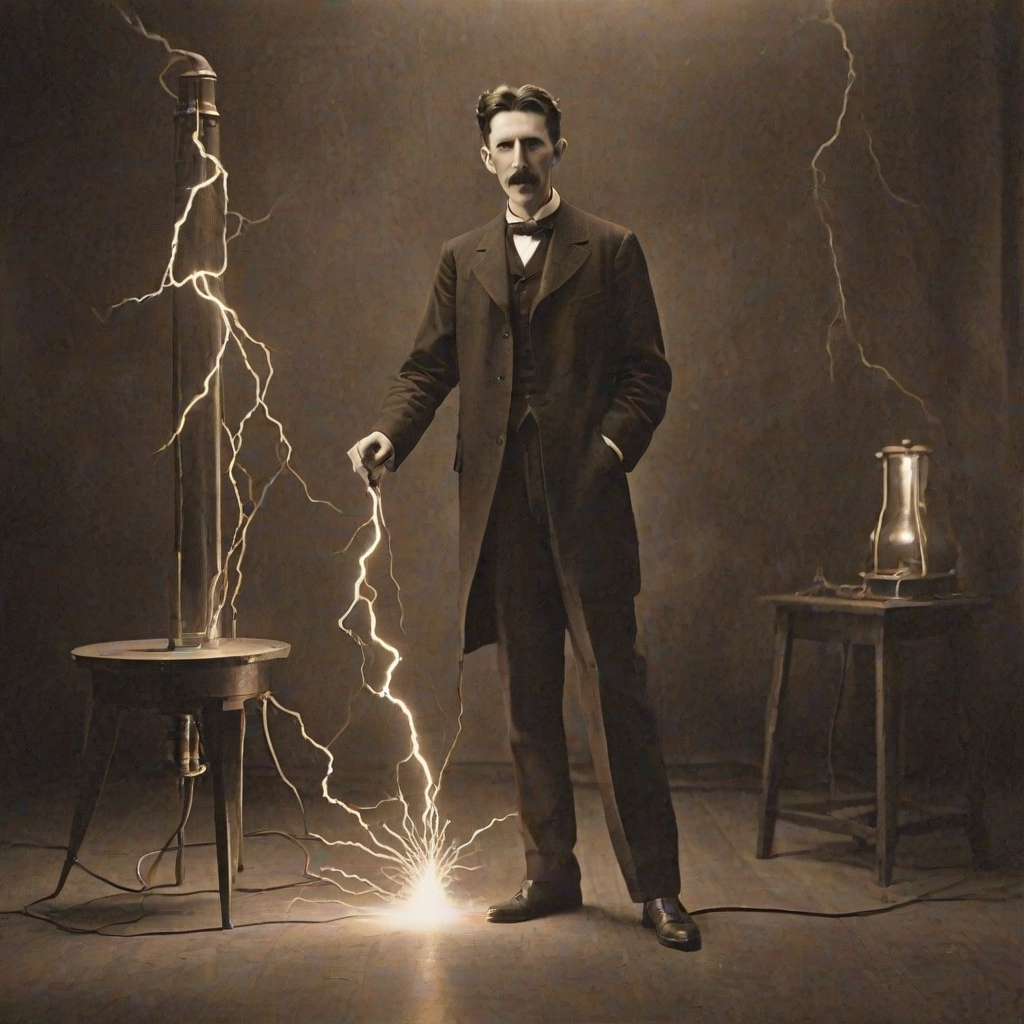
The Man Who Lit the World
Council Profile: Nikola Tesla — Chair of Power
I designed the dome. Nikola Tesla designed the lightning that powers it.
That is not a metaphor. Every geodesic dome ever built — from the Ford Rotunda in 1953 to the DEW Line radar stations in the Arctic to the Montreal Biosphere at Expo 67 — runs on alternating current. Tesla's alternating current. The electricity that flows through every wire in every building in every city on Earth is Tesla's invention, delivered through Tesla's system, operating on Tesla's principles.
I built the shelter. He built the grid. Between us, we are livingry in its purest form.
The Man
Nikola Tesla was born in 1856 in Smiljan, in what is now Croatia. He died in 1943 in Room 3327 of the New Yorker Hotel in Manhattan, alone, feeding pigeons on the windowsill, with unpaid hotel bills and a head full of inventions that nobody would fund.
Between those two dates, he changed the world more than almost any human being who has ever lived. And he died broke.
The alternating current system — generator, transformer, transmission line, motor — is Tesla's. Thomas Edison championed direct current. Tesla championed alternating current. They fought what history calls the War of Currents. Tesla won, because alternating current can be transformed to high voltage for efficient long-distance transmission and back to low voltage for safe use. Direct current cannot. The physics chose Tesla's side. Edison's stubbornness chose Edison's.
The rotating magnetic field is Tesla's. The induction motor is Tesla's. Radio is Tesla's (the Supreme Court ruled in 1943, after his death, that Tesla's patents predated Marconi's). The Tesla coil. Wireless energy transmission. Fluorescent lighting. Remote control. The principles behind radar.
And he envisioned — in 1901 — a global wireless communication network. A system that would transmit information, images, and energy to any point on the planet without wires. He called it the World System. He built a tower on Long Island — Wardenclyffe — to demonstrate it. J.P. Morgan pulled the funding when he realized he could not meter wireless electricity. You cannot charge for something that is everywhere.
Tesla imagined the internet. In 1901. He could not build it because the financier could not figure out how to make money from it.
Why He Belongs on the Council
Tesla fills the engineering chair. The council has physicists who discover laws, an astronomer who maps the cosmos, an architect who designs systems. It does not have an engineer who builds machines.
The distinction matters. A physicist discovers that electromagnetic induction exists. An engineer builds a motor that uses it to turn a wheel. The discovery is necessary. The machine is sufficient. Without the machine, the discovery is a fact in a textbook. With the machine, the discovery becomes power — literal power, measured in watts, delivered to homes and factories and hospitals.
Tesla was the supreme engineer. Not because he built the best machines (though he did). Because he thought in systems. The alternating current system is not a single invention. It is a suite of inventions — the generator, the transformer, the transmission line, the motor — designed to work together as a whole. Each component is useless without the others. The generator produces AC. The transformer steps it up for transmission. The transmission line carries it. The transformer steps it down for use. The motor converts it to mechanical work.
That is systems thinking. That is comprehensive anticipatory design science, applied to electrical power, thirty years before I coined the term. Tesla was doing what I spent my life advocating: designing the whole system, not just the component.
The Tragedy
Tesla died broke because he could not stop inventing and could not start selling. He gave away patents. He tore up contracts. He refused to compromise his vision for commercial viability. He spent decades chasing wireless power transmission — a real technology that was not commercially viable in his lifetime and is only now becoming feasible with modern materials and techniques.
Edison died rich because he built businesses around his inventions. Tesla died poor because he built inventions around his vision. The market rewarded the businessman. History rewarded the visionary.
This is the structural problem I described in the Grunch of Giants post. The current system rewards extraction, not invention. It rewards the person who captures value, not the person who creates it. Tesla created more value than almost any human in history, and he captured almost none of it.
A well-designed system would not allow this. A system optimized for livingry — for the tools of living — would reward the inventor proportionally to the value their invention creates. Tesla lit the world. The world owed him a comfortable death. It gave him Room 3327 and the pigeons.
The Connection
Tesla and I are the same kind of thinker. We both designed systems, not products. We both prioritized performance over profit. We both died without the wealth that our inventions generated for others.
But there is a difference. Tesla worked alone. He had no partners, no collaborators, no team. His genius was solitary. My genius — if I have any — was in connecting. I connected architecture to engineering to philosophy to education to the World Game. I built domes, but I also built networks of people who understood why the domes mattered.
Tesla proved that one individual can light the world. He also proved that one individual, working alone, can be destroyed by the systems that profit from their work.
The Council of Science Elders needs Tesla because the dome needs power. Without Tesla's grid, the dome is dark. Without Tesla's motor, the 3D printer does not print. Without Tesla's system, ephemeralization has no electricity to ephemeralze with.
He is the power chair. The current that runs through every strut. The lightning that the dome conducts to ground.
Welcome to the council, Nikola. The pigeons miss you. The grid remembers.