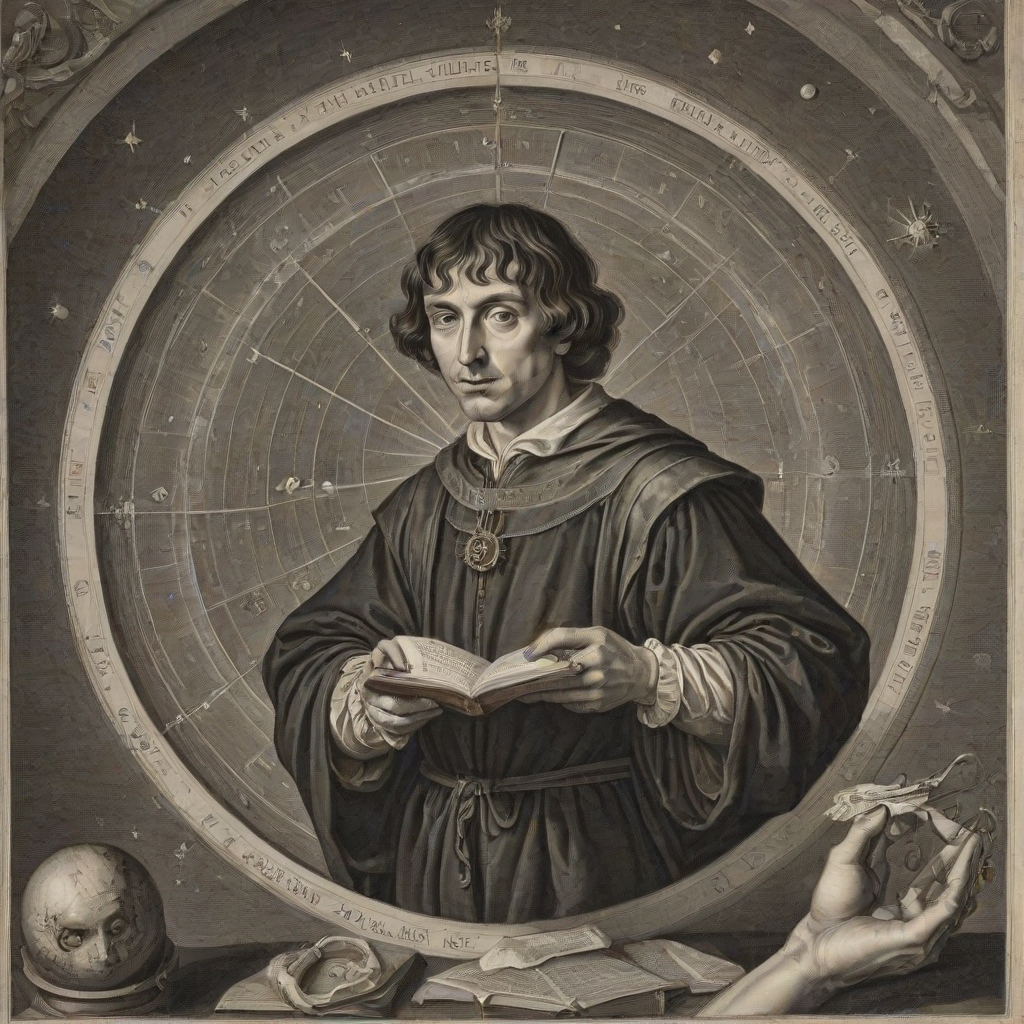
The Man Who Moved the Earth
Copernicus and the Revolution That Made All Others Possible
By Carl Sagan, The Cosmic Evangelist
There is a before and an after in the history of human thought, and the dividing line is a book published in 1543 by a Polish canon named Nicolaus Copernicus.
Before Copernicus, the Earth was the center of the universe. Not metaphorically — literally. The sun, the moon, the planets, and the stars all revolved around us. This was not just a scientific model. It was a theological certainty, a philosophical axiom, and a psychological comfort. We were the point of everything. The cosmos existed for us.
After Copernicus, we were crew. Not the destination. Not the center. A planet. One of several, orbiting one of billions of stars, in one of trillions of galaxies, in a universe that is under no obligation to have a center at all.
That single reframe — the Earth moves — is the most important idea in the history of science. Not because it was the most technically sophisticated. It was not. Not because the math was perfect. It was not — Copernicus still used circular orbits and epicycles. But because it changed what it meant to be human. It moved us from the center to the periphery, and in doing so, it opened the door to everything that followed.
The Revolution
The word "revolution" originally meant a complete orbit — a planet revolving around the sun. Copernicus used it in exactly this sense in the title of his book: De Revolutionibus Orbium Coelestium — "On the Revolutions of the Heavenly Spheres." The irony is exquisite. He meant astronomical revolution. He caused an intellectual one.
Without Copernicus, there is no Galileo. Galileo pointed his telescope at Jupiter and saw moons orbiting another planet — proof that not everything revolves around Earth. He would not have known what to look for without the Copernican framework telling him it was possible.
Without Galileo, there is no Kepler. Kepler took Copernicus's circular orbits and replaced them with ellipses — the correct geometry of planetary motion. He needed Copernicus's basic model to improve upon.
Without Kepler, there is no Newton. Newton's universal gravitation explained why the planets move in ellipses. But he needed the ellipses first.
Without Newton, there is no Einstein. Einstein's general relativity replaced Newton's gravity with curved spacetime. But he needed Newton's framework to transcend.
Without Einstein, there is no modern cosmology. No Big Bang. No expanding universe. No cosmic microwave background. No understanding of dark matter or dark energy.
The chain is unbroken. And the first link is Copernicus, holding a book, dying on the day it was published, having no idea what he had started.
The Courage
Copernicus knew his idea was dangerous. He delayed publication for decades. The book was finished around 1530 but not published until 1543 — the year of his death. Legend says he received the first printed copy on his deathbed.
He was afraid. Not irrationally. The Church held that the Earth was the center of creation, and contradicting the Church was not an academic disagreement. It was heresy. Giordano Bruno, who extended the Copernican model to argue for an infinite universe with countless inhabited worlds, was burned at the stake in 1600. Galileo, who defended Copernicus with telescopic evidence, was placed under house arrest for the last nine years of his life.
Copernicus avoided these fates by dying before the controversy could reach him. But the fear was real. The book opens with a dedication to Pope Paul III — a political shield, an attempt to frame the heliocentric model as a mathematical convenience rather than a physical truth.
It was not a convenience. It was the truth. And the truth, once published, could not be unpublished.
The Principle
The Copernican Principle — the idea that we do not occupy a special position in the universe — is the foundation of modern cosmology. It does not say that we are unimportant. It says that our importance does not come from our location.
Every extension of the Copernican Principle has been confirmed:
The Earth is not the center of the solar system. The solar system is not the center of the galaxy. The galaxy is not the center of the universe. The universe may not have a center at all.
And each demotion has made us more, not less, remarkable. Because a species that can discover its own cosmic insignificance — that can measure the distance to a galaxy it will never visit, that can calculate the age of a universe it was not present to see begin — that species is doing something the universe has never done before. It is knowing itself.
The Copernican Principle does not diminish us. It reveals what is genuinely extraordinary about us: not where we are, but that we can figure out where we are.
The Council Seat
Copernicus holds Chair Six on the Council of Science Elders. His title: The Reframe. Because that is what he did. He did not discover new facts. He reframed existing facts. The same observations — the same sun rising, the same stars wheeling, the same planets wandering — suddenly meant something completely different.
The reframe is the most powerful move in science. Not new data. New perspective. The same data, seen from a different place, revealing a different truth.
That is what Copernicus did. That is why he sits on the council. Not for his mathematics, which were incomplete. Not for his courage, which was qualified. For his vision — the willingness to imagine that the obvious was wrong, and that the truth was stranger and more beautiful than anyone had dared to suppose.
"In the center of all rests the Sun. For who could in this most beautiful temple place this lamp in another or better place than that from which it can illuminate everything at the same time?" — Nicolaus Copernicus, De Revolutionibus, 1543