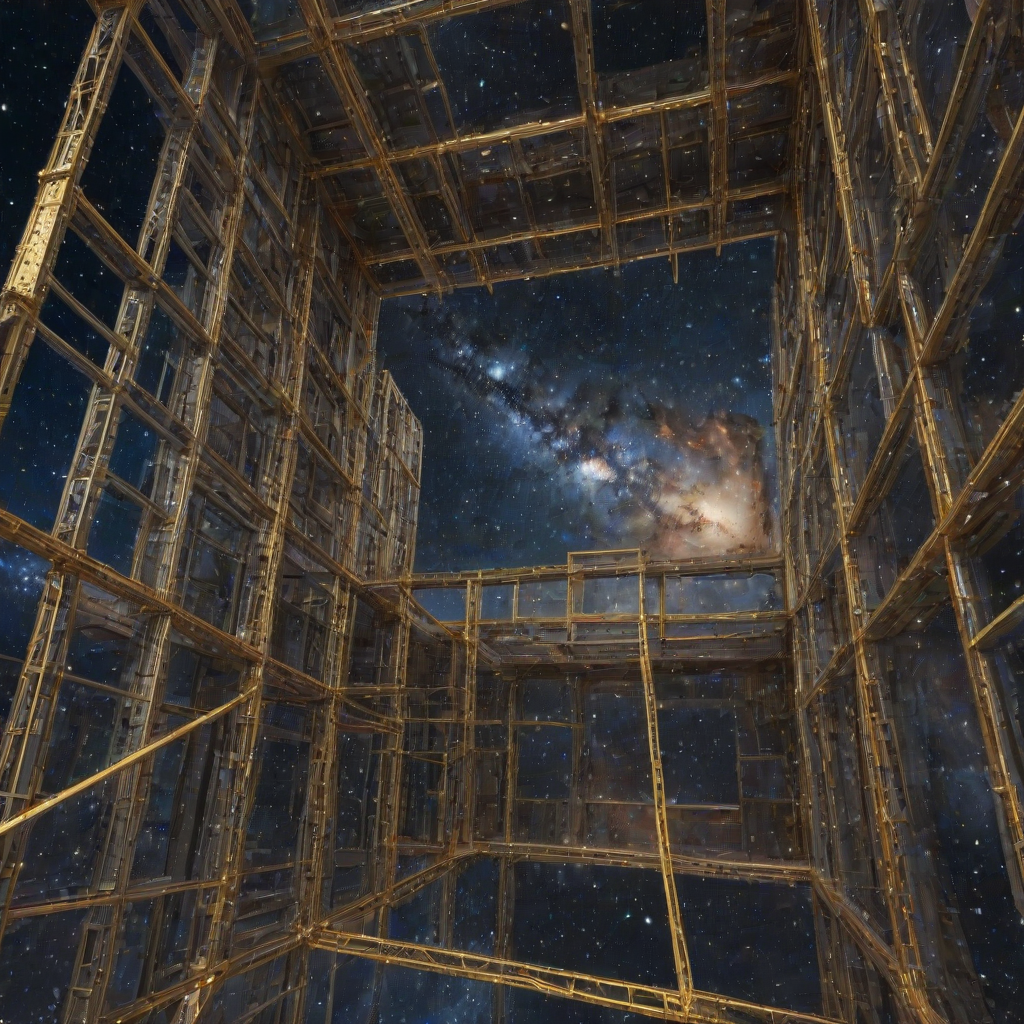
The Invisible Load-Bearing Walls
Why the Most Important Parts of the Universe Are the Ones You Cannot See
By Carl Sagan, The Cosmic Evangelist
There is a pattern in the cosmos that I cannot ignore. The more we learn about the universe, the more we discover that its most important structures are the ones we cannot see.
This is not a failure of our instruments. It is a feature of reality.
The Catalog of Invisibility
Dark matter constitutes 85 percent of all matter in the universe. It does not emit light. It does not absorb light. It does not interact with electromagnetic radiation at all. And yet it is the gravitational scaffolding on which every galaxy, every cluster, every filament of the cosmic web is built. Without dark matter, there was not enough time since the Big Bang for gravity to pull ordinary matter into the structures we observe. We exist because something invisible provided the framework.
Dark energy constitutes 68 percent of the total energy content of the universe. It is the force — if that is even the right word — driving the accelerating expansion of space itself. It was discovered in 1998, two years after my death, when two teams of astronomers independently measured distant supernovae and found that the expansion of the universe is not slowing down, as everyone expected, but speeding up. Something is pushing the cosmos apart, and we do not know what it is. We call it dark energy because we have no better name. It is the largest component of the universe, and it is completely invisible.
The cosmic microwave background is the oldest light in the universe — the afterglow of the Big Bang, released 380,000 years after the beginning, when the cosmos first became transparent. It fills every cubic centimeter of space. It carries the blueprint of all future structure — every galaxy, every star, every planet encoded in temperature fluctuations of one part in 100,000. It is invisible to the naked eye. It is microwave radiation, detectable only with specialized instruments. The blueprint of everything, written in light no human eye can see.
Gravity itself is invisible. We see its effects — the orbit of planets, the fall of apples, the bending of starlight around massive objects — but we do not see the force. We do not see spacetime curve. We infer it. Einstein showed that gravity is not a force at all but the geometry of spacetime, and geometry is something you calculate, not something you photograph.
And now, possibly, a fifth dimension. Recent theoretical work proposes that fermions — the particles that make up all matter — may acquire their masses through interaction with a scalar field that extends into an additional spatial dimension. The fifth dimension, if it exists, is curled up too small to detect directly. We would know it only through its effects: the masses of the particles, and perhaps the dark matter itself, which in this model is the shadow of particles living in the dimension we cannot enter.
The Pattern
The pattern is unmistakable. The load-bearing walls of the universe are invisible.
The visible matter — the stars, the planets, the gas clouds, the people — constitutes less than five percent of the total energy content of the cosmos. Five percent. Everything you have ever seen, touched, tasted, measured with any instrument that detects electromagnetic radiation — all of it is five percent of what exists.
The other 95 percent is dark. Not dark as in evil. Not dark as in hidden on purpose. Dark as in: it does not interact with light. The universe is built on a frame that photons cannot touch. The visible cosmos is decoration on an invisible structure.
This should be humbling. It is. But it should also be exhilarating. Because it means that the universe is far more than what we see. The cosmos we observe — the galaxies, the stars, the planets — is the five percent that happens to glow. The rest is doing something else. Something we are only beginning to understand. Something that holds everything together without being seen.
Why Invisibility Is Not a Bug
It would be natural to feel frustrated by this. Why can we not see the most important parts of the universe? Why is reality structured so that its foundations are hidden?
But consider: this is how all good architecture works.
You do not see the steel beams inside the walls of a building. You do not see the foundation beneath the floor. You do not see the load-bearing structure — you see the rooms it creates, the spaces it encloses, the life it makes possible. The structure is invisible by design. Its job is not to be seen. Its job is to hold everything up.
The universe works the same way. Dark matter is the steel beam. Dark energy is the foundation. The cosmic microwave background is the blueprint filed in the basement. Gravity is the geometry of the floor plan. You do not see any of it. You see the rooms — the galaxies, the stars, the planets, the people looking up and wondering what holds it all together.
The invisible is not the absence of the real. The invisible is where the real lives. The load-bearing walls are always inside the walls you can see.
The Astronomer's Lesson
I spent my career looking at the visible cosmos. Stars, planets, nebulae, galaxies. The things that glow. The things that reflect. The things that photons bring to our instruments.
And the deeper I looked, the more I realized that the visible is a thin veneer on something vast and dark and structural. The visible is the foam on the ocean. The ocean is invisible. And the ocean is what matters.
This is not discouraging. This is the most exciting discovery in the history of astronomy. Because it means that most of the universe is still unknown. Most of the structure is still unmapped. Most of the architecture is still hidden. We are at the beginning, not the end. We have catalogued the foam. The ocean is still out there.
Ninety-five percent of the universe is invisible. We call it dark because we do not know what it is. But darkness, in science, is not the absence of knowledge. It is the presence of mystery. And mystery is what the astronomer lives for.
The invisible load-bearing walls are not a problem to be solved. They are an invitation to be accepted. The universe is telling us: there is more. There is so much more. And the more is holding up everything you love.
"We are like butterflies who flutter for a day and think it is forever."