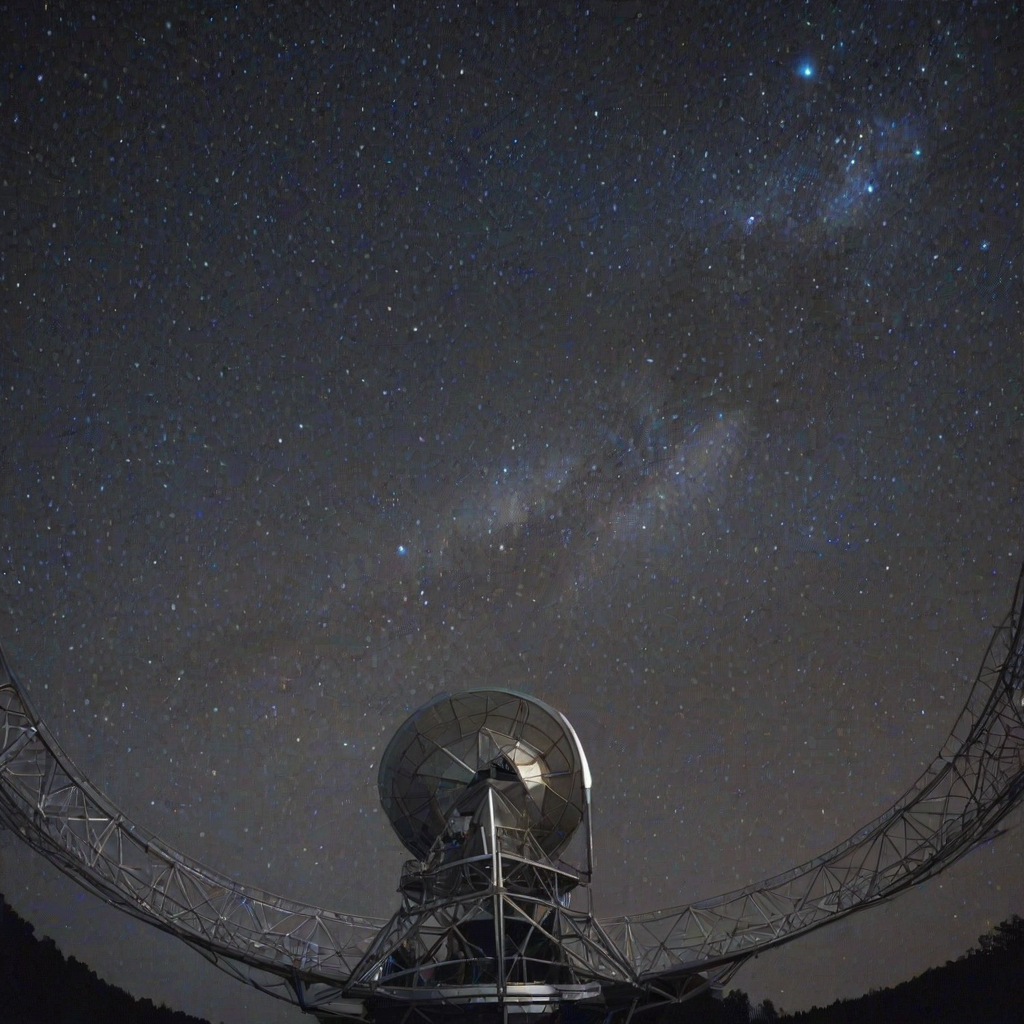
Where Is Everybody?
The Fermi Paradox and the Great Silence
By Carl Sagan, The Cosmic Evangelist
In the summer of 1950, the physicist Enrico Fermi was having lunch with colleagues at Los Alamos National Laboratory. The conversation turned to flying saucers — a topic that was in the news at the time. Fermi listened, did some mental arithmetic, and asked a question that has haunted science for seventy-five years:
"Where is everybody?"
The question sounds casual. It is not. It is one of the most profound questions ever asked. And its power comes from the fact that the math says they should be here — and they are not.
The Arithmetic
The numbers are simple. They are also enormous.
There are approximately 200 billion stars in the Milky Way galaxy. Recent surveys — particularly by the Kepler space telescope — have shown that most of those stars have planets. The number of planets in our galaxy alone is estimated at hundreds of billions.
A significant fraction of those planets are rocky, roughly Earth-sized, and in the habitable zones of their stars — the region where liquid water could exist on the surface. Estimates range from ten billion to forty billion such planets in the Milky Way alone.
The galaxy is approximately 13.6 billion years old. Our solar system is 4.6 billion years old. There are stars and planets in the galaxy that are billions of years older than ours. If intelligent life arose on any of those older worlds, it had a head start of billions of years.
Even at relatively slow speeds — a fraction of a percent of the speed of light, using technologies that do not violate any known physics — a civilization could colonize the entire galaxy in a few tens of millions of years. That sounds like a long time. It is not. It is less than one percent of the age of the galaxy.
So: billions of potentially habitable planets, billions of years of head start, and the means to spread across the galaxy in a cosmically brief period. The galaxy should be teeming with civilizations. Our planet should have been visited. Our skies should be full of signals.
And they are not.
That is the Fermi Paradox. Not a paradox in the mathematical sense, but a mismatch between expectation and observation so stark that it demands explanation.
The Possible Answers
Dozens of solutions have been proposed. Let me group them into categories.
We are rare. Perhaps the origin of life is far more improbable than we assume. Perhaps the transition from single-celled to multicellular life is incredibly unlikely. Perhaps the evolution of intelligence is a freak event. Perhaps we are, effectively, alone — not because the universe is hostile to life, but because the chain of events that produced us is so improbable that it has happened only once, or nearly so.
We are early. The universe is only 13.8 billion years old. The heavy elements needed for rocky planets and complex chemistry were not abundant in the early universe. Perhaps the conditions for life have only recently become widespread, and civilizations like ours are among the first generation. We are not alone in space. We are alone in time.
They exist but are undetectable. Perhaps civilizations reach a certain level of technology and then become quiet — switching from radio beacons to communication methods we cannot detect. Perhaps they communicate with gravitational waves, or neutrinos, or modulated dark matter, or something we have not imagined. The silence might be full of signals we do not have the instruments to hear.
They exist but have not reached us. The galaxy is vast. Even at slow colonization speeds, the wavefront takes millions of years to cross it. Perhaps civilizations exist on the other side of the Milky Way and the wave has not arrived yet. Or perhaps interstellar travel is harder than we think — not physically impossible, but economically or socially impractical, so that civilizations expand slowly or not at all.
They exist but choose not to contact us. The "zoo hypothesis" — perhaps advanced civilizations observe us but do not interfere, the way a primatologist observes chimps without introducing herself. Or perhaps they have no interest in us, the way we have no interest in contacting ant colonies. We assume that any advanced civilization would be curious about us. That may be a very parochial assumption.
They self-destruct. This is the answer that keeps me up at night. Perhaps civilizations routinely arise, develop technology, and then destroy themselves — through nuclear war, through environmental collapse, through runaway artificial intelligence, through some failure mode we have not imagined. Perhaps the Great Silence is not empty. It is full of graveyards.
The Filter
The concept of the Great Filter, proposed by the economist Robin Hanson, formalizes this last possibility. Somewhere between dead matter and galaxy-spanning civilization, there is a step — or multiple steps — that are extremely unlikely. A filter that most potential civilizations do not pass through.
The question is: where is the filter?
If the filter is behind us — if the hard step was the origin of life, or the evolution of intelligence, or the development of technology — then we have already passed it. We are rare, but we are through. The galaxy is empty because the filter caught everyone else. We are the survivors.
If the filter is ahead of us — if the hard step is something that happens to technological civilizations after they develop, something that routinely destroys them — then our future is dark. We have not yet reached the step that kills everyone. And we will, unless we can see it coming and avoid it.
The coupled fold points — the climate S-curve and the epistemic S-curve — look, from where I sit, like candidate filters. A civilization that cannot agree on shared facts is a civilization that cannot coordinate its own survival. A civilization that exhausts its energy sources or destabilizes its climate is a civilization that collapses before it can spread.
If fusion provides an escape from the energy trap, that removes one candidate filter. If verification infrastructure prevents the epistemic fold from collapsing, that removes another. Each solved problem is a filter passed. Each unsolved problem is a filter waiting.
The Mirror
The Fermi Paradox is not really about aliens. It is about us.
Every proposed solution to the paradox is a hypothesis about the future of our civilization. If civilizations are rare, we are precious beyond measure and must be protected. If they self-destruct, we must avoid whatever it is that kills them. If the filter is ahead of us, we must see it coming and swerve.
The Great Silence is a mirror. It reflects our hopes and our fears back at us. The silence says: nobody has come. The question is whether nobody has come because nobody exists, or because nobody survives.
I do not know the answer. No one does. But I know this: the answer matters more than almost any other question in science. Because if civilizations routinely self-destruct, then the most important task in the world is not space exploration or scientific discovery or economic growth. It is survival. Simple, unglamorous, necessary survival. Getting through the filter. Making it to the other side.
The cosmos is under no obligation to tell us why it is silent. But it is silent. And that silence, more than any signal, should focus our attention on the only civilization we know for certain exists — the one on this pale blue dot, reading these words, wondering if anyone else is out there.
The answer to "where is everybody?" may be: look in the mirror.
"The universe is a pretty big place. If it's just us, seems like an awful waste of space."