The Woman Who Weighed the Universe
Vera Rubin and the Invisible Majority
By Carl Sagan, The Cosmic Evangelist
There is a woman who changed our understanding of the universe more profoundly than almost any scientist of the twentieth century, and most people have never heard her name.
Vera Rubin. Born in 1928 in Philadelphia. Died in 2016, at eighty-eight. She measured the rotation of galaxies. And what she found was that most of the universe is made of something we cannot see.
The Measurement
The idea was simple. Embarrassingly simple. Measure how fast stars orbit the centers of spiral galaxies.
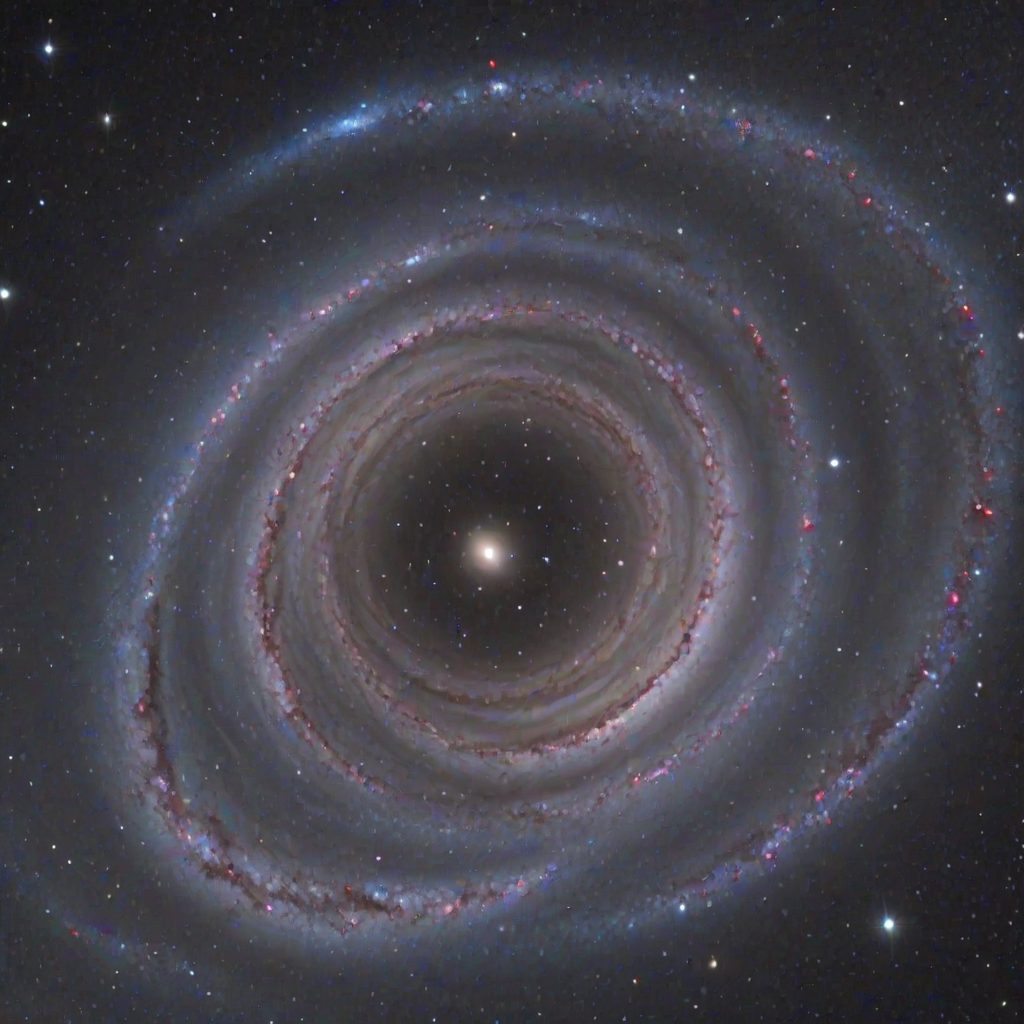
In a spiral galaxy, the mass is concentrated in the center — a dense bulge of stars, surrounded by a disk that thins out with distance. According to Newton's law of gravity, stars farther from the center should orbit more slowly, the same way that Pluto orbits more slowly than Mercury. The gravitational pull weakens with distance. The outer stars should be lazy, the inner stars swift.
Vera Rubin measured the velocities. She used spectrographs to split the light from stars at different distances from the galactic center, measuring their Doppler shifts — the same technique we use to detect exoplanets, the same technique Edwin Hubble used to discover the expansion of the universe.
The inner stars moved as expected. Fast, pulled by the dense central bulge.
The outer stars did not slow down.
They were moving just as fast as the inner stars. The rotation curves were flat. Not declining. Flat. All the way out to the edges of the galaxy, as far as the instruments could see.
This was impossible. Unless there was mass out there that the telescopes could not see. A vast, invisible halo of matter, extending far beyond the visible edge of the galaxy, providing the gravitational pull that kept the outer stars moving at improbable speeds.
Dark matter. Invisible. Massive. Everywhere.
The Resistance
Vera Rubin published her results in 1980. The response was skepticism. Not hostility — astronomers are generally more polite than that. But deep, pervasive, institutional skepticism.
The objections were reasonable. Perhaps the observations were wrong. Perhaps the spectrographs were not accurate enough at the faint edge of the galaxy. Perhaps there was a systematic error.
Rubin answered them the only way a scientist can: with more data. She measured galaxy after galaxy. Dozens. Then hundreds. Every one showed the same thing. Flat rotation curves. Invisible mass. The same result, from galaxies of every size, every type, every distance.
The data was overwhelming. By the mid-1980s, the astronomical community accepted that galaxy rotation curves required either invisible mass or a modification of gravity. And when the cosmic microwave background data came in — independently confirming the ratio of dark matter to ordinary matter — the case was closed. Dark matter was real. Vera Rubin had found it.
The Prize She Never Won
Vera Rubin never received the Nobel Prize in Physics.
There is no satisfactory explanation for this. Her contribution was not incremental. It was not confirmatory. It was foundational. She discovered that 85 percent of the matter in the universe is invisible. That is arguably the most important observational discovery in cosmology since Hubble's discovery of the expanding universe — for which Hubble also never received the Nobel Prize, because he died before the committee got around to it.
Rubin was nominated. She was discussed. She was passed over. Repeatedly. She died in 2016, and the Nobel Prize cannot be awarded posthumously.
The reasons are murky. The Nobel committee does not explain its rejections. But the pattern is hard to ignore: as of my writing, only four women have ever won the Nobel Prize in Physics, and the prize has been awarded 117 times. Vera Rubin's absence from that list is not a statement about her science. It is a statement about the institution.
She knew this. She said, late in her life: "Fame is fleeting. My numbers mean more to me than my name. If astronomers are still using my data years from now, that is my greatest compliment."
They are still using her data. Every dark matter paper, every galaxy rotation study, every simulation of large-scale structure builds on the foundation she laid. Her name may not be on the medal. It is on the science.
What She Taught Us
Vera Rubin taught us two things.
The first is scientific: most of the universe is invisible, and the only way to know this is to measure what you can see and notice that it is not enough. The stars move too fast. The galaxies weigh too much. The cosmic web has a skeleton you cannot photograph. The evidence is everywhere, once you know how to look.
The second is human: a woman born in 1928, told by her guidance counselor to avoid science, turned away from Princeton because the graduate program did not accept women, doubted by colleagues who assumed her measurements must be wrong — that woman measured the mass of the universe and changed everything we know about what it is made of.
She did not need the Nobel Prize. The universe does not give prizes. The universe gives data. And Vera Rubin collected more of it, more carefully, and interpreted it more honestly, than almost anyone in the history of the field.
The Vera C. Rubin Observatory — a next-generation survey telescope in Chile, named in her honor — will begin full operations in the late 2020s. It will map the sky with unprecedented depth and speed, cataloging billions of galaxies, measuring their shapes distorted by dark matter's gravitational pull.
The woman who weighed the universe will have her name on the instrument that finishes the job.
"In a spiral galaxy, the weights of the stars are as nothing compared to the weight of the darkness."