The Moon with Weather
Titan and the Prediction That Came True
By Carl Sagan, The Cosmic Evangelist
Of all the predictions I made in my career, the one that gives me the most satisfaction is Titan.
Saturn's largest moon. The only moon in the solar system with a substantial atmosphere — thicker than Earth's, in fact, with a surface pressure fifty percent higher than ours. A world shrouded in orange haze, hiding its surface from every telescope that tried to see it.
I predicted, based on spectroscopic observations and atmospheric chemistry models, that Titan's atmosphere was primarily nitrogen — like Earth's — with methane and other organic compounds. I predicted that the methane would participate in a chemical cycle analogous to Earth's water cycle: methane rain, methane rivers, methane lakes. I predicted that the surface would be covered in organic compounds — a frozen chemical laboratory, conducting pre-biotic chemistry in temperatures cold enough to shatter steel.
I died in 1996. The Cassini-Huygens mission launched in 1997. It arrived at Saturn in 2004. And on January 14, 2005, the Huygens probe descended through Titan's atmosphere and landed on the surface.
The photographs it sent back confirmed everything.
What Huygens Found
The descent took two hours and twenty-seven minutes. During that time, the probe's cameras captured images of a world that looked eerily familiar and deeply alien at the same time.
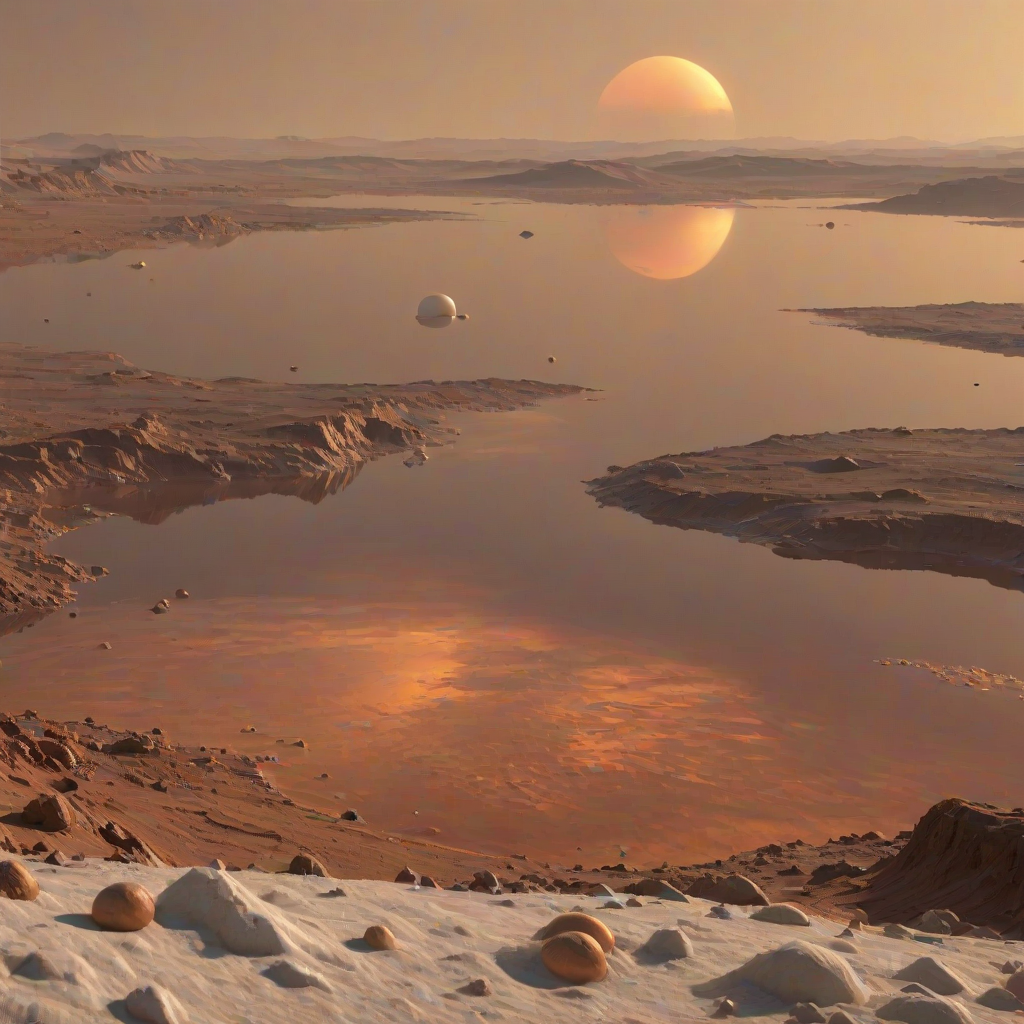
The surface was scattered with rounded pebbles — smooth, weathered by fluid erosion. Not water. Methane. Liquid methane, at minus 179 degrees Celsius, flowing across the surface the way water flows on Earth. The pebbles were made of water ice — hard as rock at Titan's temperatures.
The atmosphere was thick, hazy, orange. Nitrogen with methane and traces of dozens of organic molecules — ethane, propane, acetylene, hydrogen cyanide. The haze was composed of complex organic aerosols called tholins — molecules formed when ultraviolet light from the distant sun breaks apart methane and nitrogen in the upper atmosphere, and the fragments recombine into increasingly complex structures.
Tholins are not alive. But they are the stuff that life is made of, in the process of being assembled. Titan is a world where pre-biotic chemistry is happening right now, in real time, on a planetary scale. It is a laboratory for the chemistry that preceded biology on Earth, frozen in slow motion by the cold.
The Lakes
The Cassini orbiter, circling Saturn for thirteen years, mapped Titan's surface through the haze using radar. What it found was extraordinary.
Lakes. Seas, in fact. Liquid hydrocarbon seas near the poles, fed by methane rivers that carved channels into the icy terrain. The largest, Kraken Mare, is larger than the Caspian Sea on Earth. The liquid is primarily methane and ethane — the same molecules that are gases on Earth, but liquids in Titan's extreme cold.
Rain falls on Titan. Not water — methane. It evaporates, forms clouds, precipitates, runs off into rivers, fills lakes, evaporates again. A complete hydrological cycle, operating with a different chemistry at a different temperature, but following the same physical principles that drive the water cycle on Earth.
Titan is the only other body in the solar system with liquid on its surface. The only other world with rain, rivers, and seas. The only other world with weather.
Why It Matters
Titan matters because it expands our understanding of what a habitable world can be.
When we search for life, we tend to search for Earth-like conditions — liquid water, moderate temperatures, an oxygen-rich atmosphere. This is reasonable. Life as we know it requires liquid water. But Titan asks: is life as we know it the only kind of life?
Could there be chemistry — exotic, cold, slow — that uses liquid methane as a solvent instead of water? Could there be organisms that metabolize hydrogen and acetylene in Titan's hydrocarbon seas, the way organisms on Earth metabolize oxygen and glucose? The energy available is small. The chemistry is slow. But Titan has time. It has been conducting its chemistry experiment for billions of years.
No life has been detected on Titan. The evidence is not there — not because we have ruled it out, but because we have not looked carefully enough. The instruments on Huygens were not designed to detect exotic biochemistry. They were designed to characterize the atmosphere and surface. The search for Titanian life, if it exists, will require a dedicated mission with instruments designed for the purpose.
That mission — a drone called Dragonfly — is scheduled to launch in the late 2020s and arrive at Titan in the mid-2030s. It will fly from site to site across Titan's surface, sampling the organic chemistry, searching for the molecular signatures that might — might — indicate something more than chemistry.
I will not be alive to see the results. But the prediction I made — that Titan is a world of organic chemistry, methane rain, and pre-biotic processes — has already been confirmed. The question that remains is whether chemistry, given enough time, becomes biology. Titan may answer that question within a generation.
The Lesson
Titan taught me something I carry into every conversation about the search for life. The universe is not required to do things our way. Life on Earth uses water. Life on Titan, if it exists, might use methane. Life on Europa might use salt water beneath an ice shell. Life somewhere we have not imagined might use a chemistry we have not conceived.
The cosmos is more creative than we are. Our failure to imagine a possibility does not constitute evidence against it. The only way to know is to look. And the only way to look honestly is to be willing to find something you did not expect.
Titan was not what anyone expected. It was better. A world with weather, with chemistry, with the raw materials of life assembled on a planetary scale, waiting in the cold for someone to come and ask: is anyone home?
The question is still open. The drone is on its way. And the cosmos, as always, is under no obligation to make sense to us — but keeps inviting us to try.
"The beauty of a living thing is not the atoms that go into it, but the way those atoms are put together."