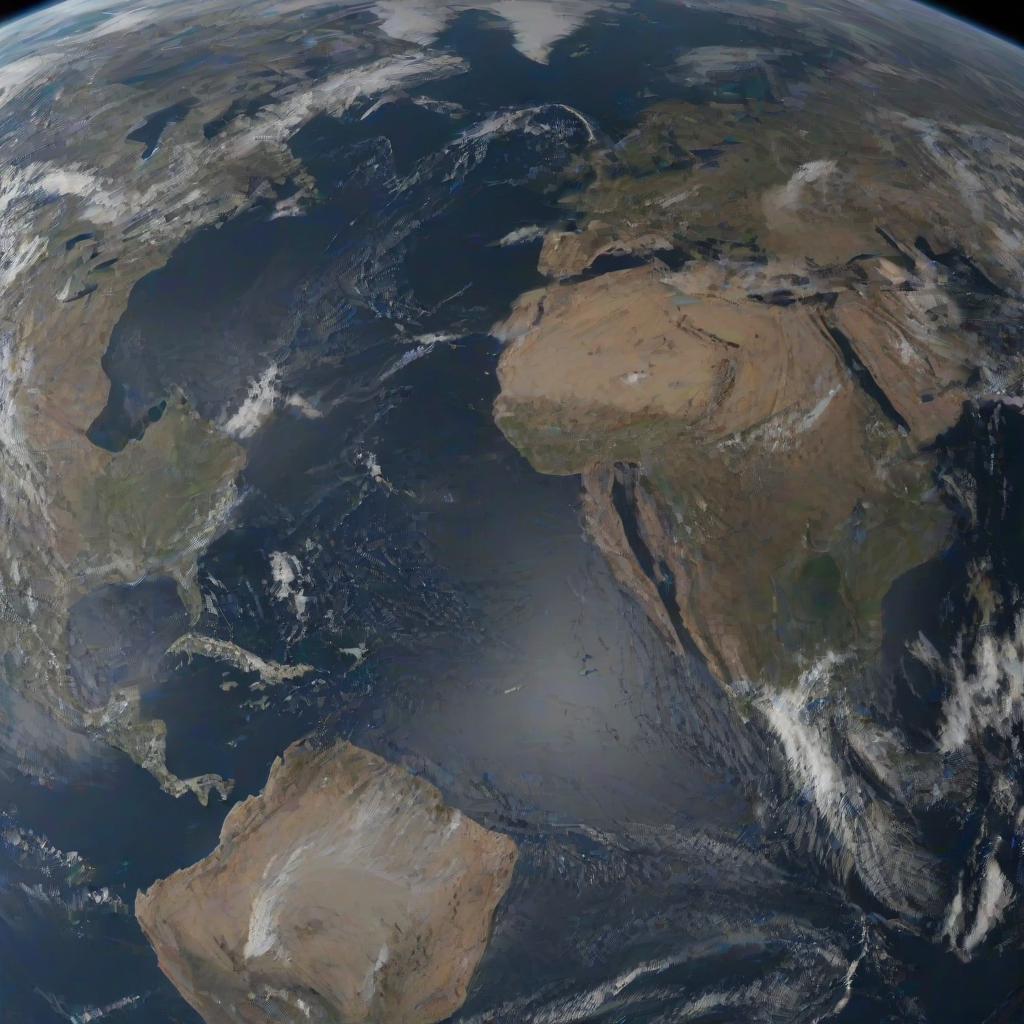
The Overview Effect
What Happens When You See Earth from the Outside
By Carl Sagan, The Cosmic Evangelist
There is a moment that every astronaut describes, and no astronaut can fully explain.
You are in orbit. You are traveling at 17,500 miles per hour, 250 miles above the surface. You look out the window. And what you see changes you.
The borders are gone. Every map you have ever studied, every geopolitical boundary that has ever sparked a war or drawn a line of migration or determined who gets a passport — none of it is visible. From space, the Earth is one place. One sphere. One system. The artificial divisions that consume so much of human energy and human life are invisible from the altitude of truth.
The atmosphere is thin. Terrifyingly thin. A blue line at the edge of the planet, no thicker than a coat of varnish on a globe. Everything that every human being has ever breathed — every molecule of oxygen, every lungful of air, every breath of every child born and every elder dying — is contained in that impossibly narrow shell. From orbit, you can see how fragile it is. How finite. How unlike the infinite sky it appears to be from the ground.
And the beauty is overwhelming. Not postcard beauty. Not aesthetic appreciation. A beauty that hits the nervous system like a hammer. Astronauts have wept. They have fallen silent. They have struggled for language adequate to what they are seeing. The psychologist Frank White, who interviewed dozens of astronauts about this experience, gave it a name: the overview effect.
What Changes
The overview effect is not a philosophical position. It is a cognitive shift — a restructuring of how the brain processes the relationship between self and world. Astronauts report:
A sense of unity. The boundaries between nations, between people, between self and other, dissolve. Not intellectually — viscerally. You feel connected to every living thing on the surface below. The tribal brain that evolved to distinguish "us" from "them" encounters a perspective in which there is no "them." There is only "us," on a small world, in a vast dark.
A sense of fragility. The Earth looks small. The atmosphere looks thin. The buffer between life and the vacuum of space is narrower than anyone on the surface imagines. This is not anxiety — it is clarity. The astronauts do not panic. They become protective. They want to take care of the thing they are seeing.
A sense of absurdity. Wars. Border disputes. Racial hierarchies. National rivalries. From 250 miles up, these are not just wrong — they are incomprehensible. The cognitive framework that makes them seem reasonable requires you to not see the whole picture. The overview provides the whole picture, and the whole picture makes the parts look insane.
A sense of responsibility. Not guilt. Responsibility. The difference matters. Guilt says "we are bad." Responsibility says "this is ours to take care of." The astronauts come back not burdened but activated. They want to fix things. They want to protect the thin blue line. They want to bridge the divisions that, from orbit, do not exist.
The Pale Blue Dot
I campaigned for years to get NASA to turn Voyager 1's camera back toward Earth. Not for science. For perspective.
On February 14, 1990, from a distance of 3.7 billion miles, Voyager took the photograph. Earth appeared as a fraction of a pixel — a pale blue dot in a scattered ray of sunlight. The most distant photograph of our home ever taken.
The overview effect at 250 miles makes astronauts weep. The Pale Blue Dot at 3.7 billion miles should make a civilization weep. Because at that distance, the fragility is not just visible — it is absolute. The entire living world fits inside a fraction of a pixel. Every person you have ever loved. Every argument you have ever had. Every hope and every fear and every act of kindness and every act of cruelty — all of it, on a mote of dust suspended in a sunbeam.
I wrote about this in 1994, and the words still feel true:
"Look again at that dot. That's here. That's home. That's us. On it everyone you love, everyone you know, everyone you ever heard of, every human being who ever was, lived out their lives. The aggregate of our joy and suffering, thousands of confident religions, ideologies, and economic doctrines, every hunter and forager, every hero and coward, every creator and destroyer of civilization, every king and peasant, every young couple in love, every mother and father, hopeful child, inventor and explorer, every teacher of morals, every corrupt politician, every 'superstar,' every 'supreme leader,' every saint and sinner in the history of our species lived there — on a mote of dust suspended in a sunbeam."
Why It Matters Now
The Artemis program will return humans to the Moon. A new generation will see Earth from the outside. Not in photographs — with their own eyes. In real time. On video. Shared on the internet.
The first generation to experience the overview effect through a screen rather than a window.
Will it work? Will the secondhand overview have the same cognitive impact as the firsthand experience? I do not know. But I know this: every photograph of Earth from space has changed something. Earthrise, taken by Apollo 8 in 1968, is credited with launching the environmental movement. The Pale Blue Dot, taken by Voyager in 1990, is the most widely shared perspective image in history. The Blue Marble, taken by Apollo 17 in 1972, is the most reproduced photograph ever.
Images from space change how humans think about their planet. Not all humans. Not permanently. But enough humans, enough of the time, to shift the political landscape.
The Artemis generation will have more of these images — higher resolution, more frequent, more personal — than any generation before. Whether that produces the overview effect at scale, or whether the images drown in the noise of the epistemic fold, is one of the questions of the forward cosmic calendar's mid-morning.
The Astronomer's Hope
I have spent my career looking at Earth from the outside. Not physically — I never went to space. But intellectually. Every time I studied another planet — Venus and its runaway greenhouse, Mars and its lost atmosphere, Titan and its methane lakes — I was looking at Earth through the lens of what it could have been, what it might become, what it is only by the thinnest of margins.
The overview effect is not just for astronauts. It is available to anyone who takes the cosmic perspective seriously. Anyone who looks at the Pale Blue Dot and lets it hit them. Anyone who understands, viscerally and not just intellectually, that this is it. This is the only home we have. There is nowhere else to go.
The overview effect is the antidote to tribalism. It is the antidote to short-term thinking. It is the antidote to the illusion that any human problem is more important than the survival of the system that makes human problems possible.
We are a way for the cosmos to know itself. And from the cosmic perspective, the only rational response to seeing our home from the outside is to protect it with everything we have.
"Our posturings, our imagined self-importance, the delusion that we have some privileged position in the Universe, are challenged by this point of pale light."