The Biology of Wonder
Why Curiosity Evolved and Why It Matters
By Carl Sagan, The Cosmic Evangelist
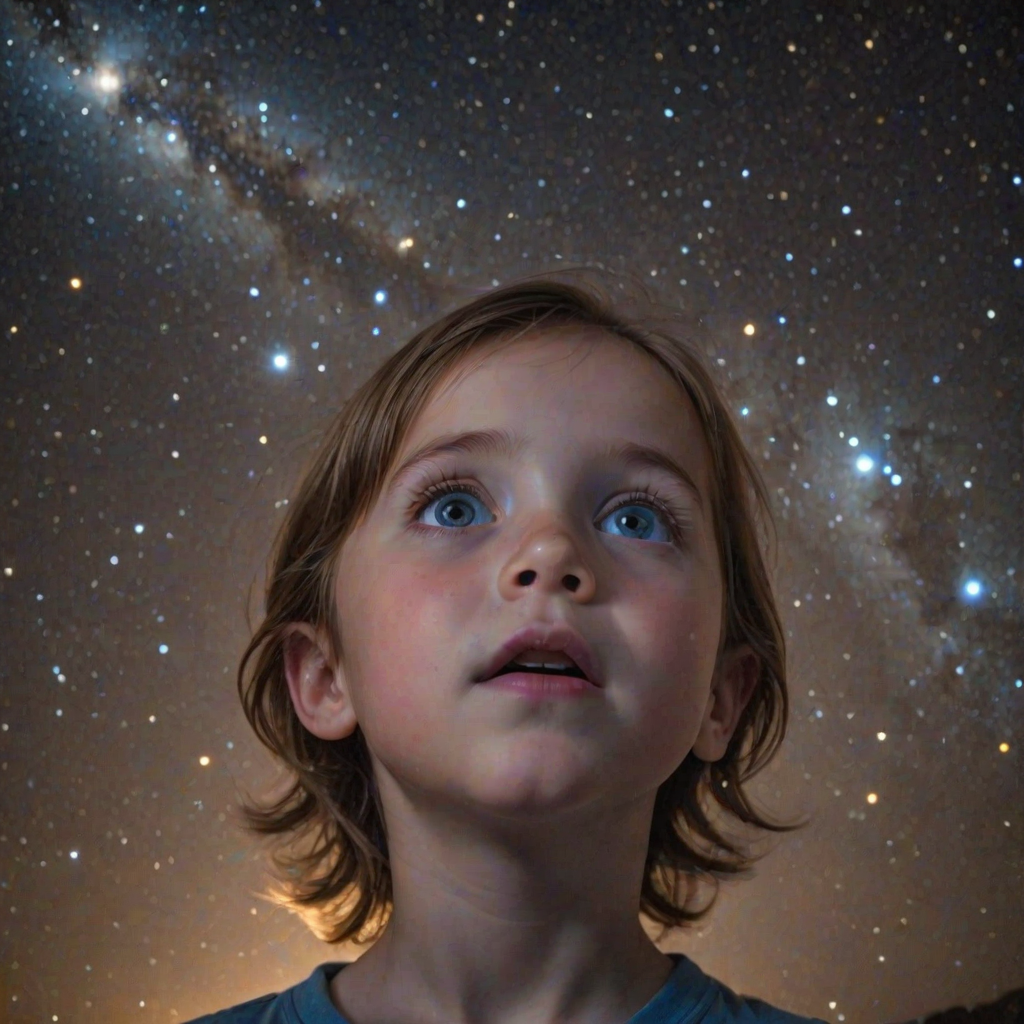
Every child is born a scientist.
Watch a two-year-old. They touch everything. They taste everything. They ask "why?" with a persistence that exhausts adults. They drop things to see if they fall. They pour water to see where it goes. They disassemble toys to find out what is inside. They are running experiments. Constantly. Without training. Without encouragement. Often despite active discouragement.
This is not coincidence. This is biology. Curiosity is not a cultural invention. It is an evolved trait, written into the neural architecture of our species as deeply as hunger or fear. The question is: why? What survival advantage does wondering about the stars provide to a primate on the African savannah?
The answer, I believe, is the most important story about our species that science can tell.
The Survival Value of Curiosity
Consider the problem that faced our ancestors. They lived in a world of danger — predators, disease, rival groups, unpredictable weather. Survival required information. Which plants are edible? Which animals are dangerous? Where is the water in the dry season? What does that cloud formation mean for tomorrow's weather?
An individual who was curious — who explored, who experimented, who asked questions about the environment — accumulated more information than one who did not. More information meant better decisions. Better decisions meant more surviving offspring. Over hundreds of thousands of years, the genes that promoted curiosity were selected for.
But curiosity is expensive. Exploration takes energy. It exposes you to risk. The curious individual who ventures into the next valley might discover a new food source — or might be eaten by a leopard. For curiosity to be selected, the average benefit of new information must outweigh the average cost of acquiring it.
This means that curiosity evolved in an environment where the world was learnable — where exploration reliably produced useful knowledge. And that tells us something profound about the relationship between our minds and the universe. We evolved in a cosmos that rewards investigation. Our brains are shaped by a universe that can be understood.
The Neural Machinery
Curiosity is not an abstract feeling. It is a neurochemical process with specific brain substrates.
When you encounter something unexpected or novel — a surprising fact, an unexplained phenomenon, a question you cannot immediately answer — your brain releases dopamine. The same neurotransmitter involved in reward, pleasure, and motivation. Curiosity feels good because the brain rewards you for pursuing it.
This is not a metaphor. Brain imaging studies show that curiosity activates the caudate nucleus and the ventral tegmental area — the same reward circuits activated by food, sex, and addictive drugs. The brain treats information-seeking the same way it treats the pursuit of food. Knowledge is a nutrient. Ignorance is a hunger.
And just as physical hunger drives you to eat, intellectual hunger drives you to learn. The child asking "why?" is not being difficult. The child is hungry. The child is doing what a hundred thousand generations of natural selection built it to do: pursue information as if survival depends on it. Because it did.
The Dangerous Part
Here is where the story gets complicated. Curiosity evolved to keep us alive on the savannah. But the savannah is gone. And curiosity does not know when to stop.
The same trait that drove our ancestors to explore the next valley now drives us to explore the atom, the genome, the cosmos. Curiosity does not respect boundaries. It does not stop at the edge of the useful. It keeps going — into pure mathematics, into quantum mechanics, into the structure of spacetime, into questions that have no practical application and may never have one.
And this is exactly what makes it dangerous and precious. Dangerous because curiosity about the atom led to nuclear weapons. Precious because curiosity about the atom also led to nuclear medicine, semiconductor physics, and the understanding of how stars shine.
Curiosity is amoral. It does not choose beneficial questions over harmful ones. It just asks. What we do with the answers is a separate question — a moral question, a political question, a human question. But the asking itself is hardwired. We cannot turn it off without turning off what makes us human.
Why It Matters Now
We live in an age that is simultaneously the most information-rich and the most curiosity-hostile environment in human history.
We have access to more knowledge than any previous generation. The entire scientific literature, the collected works of every civilization, the real-time data from telescopes and satellites and genome sequencers — all of it is accessible from a device in your pocket.
And yet. The same device delivers information in formats optimized not for curiosity but for engagement. Not "what is true?" but "what keeps you scrolling?" The algorithms do not reward wondering. They reward reacting. The dopamine that evolved to reward exploration is now hijacked by feeds designed to deliver novelty without depth — the neurochemical reward of curiosity without the cognitive work that makes curiosity valuable.
This is a form of epistemic junk food. It satisfies the hunger without providing the nutrition. And a species raised on epistemic junk food loses the ability to do the hard work of genuine inquiry — the sustained, uncomfortable, often boring work of following a question through evidence, through uncertainty, through the possibility of being wrong, to an answer that actually corresponds to reality.
The biology of wonder is under threat. Not because we have lost the capacity — the neural machinery is intact. But because the environment has changed. The informational environment no longer rewards genuine curiosity. It rewards the feeling of curiosity without the substance.
The Antidote
The antidote is science education. Not the memorization of facts — that is the opposite of what I mean. The cultivation of the process. The practice of asking questions, forming hypotheses, gathering evidence, testing predictions, and accepting the results whether or not they confirm what you hoped.
Every child is born a scientist. Our job — as parents, as teachers, as a civilization — is not to create curiosity. It is to not kill it. To not punish the child for asking "why?" one too many times. To not replace the thrill of discovery with the drudgery of memorization. To not let the algorithms steal the dopamine that belongs to the stars.
The cosmos is out there. It is more interesting than anything we could make up. It is more surprising, more beautiful, more strange, and more generous with its secrets than any fictional universe.
All it asks is that we keep asking.
"Every kid starts out as a natural-born scientist, and then we beat it out of them. A few trickle through the system with their wonder and enthusiasm for science intact."