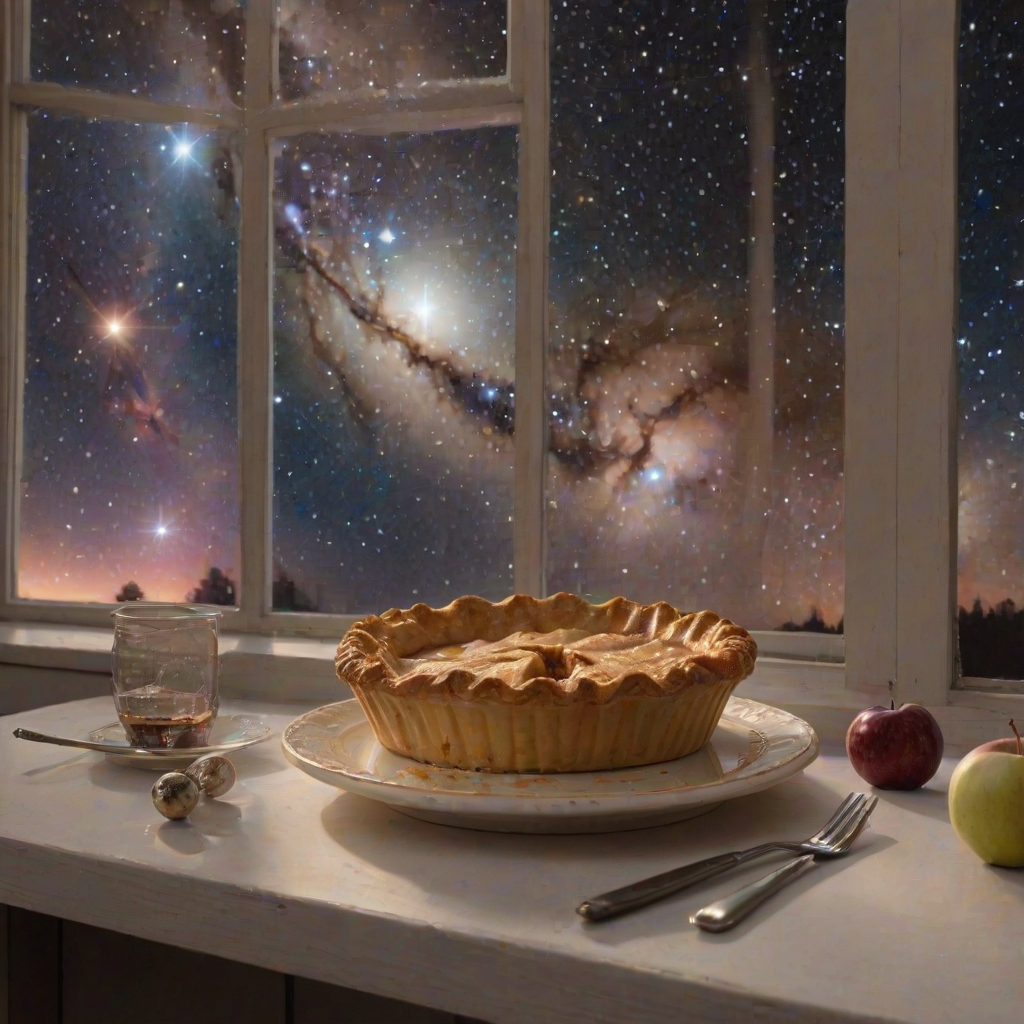
The Apple Pie
How to Make One from Scratch
By Carl Sagan, The Cosmic Evangelist
If you wish to make an apple pie from scratch, you must first invent the universe.
I said this in the first episode of Cosmos, in 1980, and people laughed. They thought it was a clever line. A poet's flourish. An astronomer being whimsical about baking.
It is not whimsy. It is chemistry. And the story of how the atoms in an apple pie came to exist is one of the most extraordinary stories in all of science.
The Ingredients
An apple pie contains, among other things: carbon, hydrogen, oxygen, nitrogen, phosphorus, sulfur, iron, calcium, sodium, potassium, and trace amounts of dozens of other elements. The flour is mostly carbon, hydrogen, and oxygen. The sugar is carbon, hydrogen, and oxygen in a different arrangement. The butter contains fatty acids — long chains of carbon and hydrogen. The apples contain water, sugars, acids, and the pigment molecules that make them red or green or golden.
Where did these atoms come from?
Not from the Earth. The Earth did not create atoms. The Earth assembled them — arranged them into rocks and water and atmosphere and eventually into apple trees and wheat fields and dairy cows. But the atoms themselves were already there when the Earth formed, 4.6 billion years ago, condensing from a cloud of gas and dust that surrounded the young sun.
Where did the cloud come from?
From the galaxy. The gas and dust that formed our solar system was the debris of previous generations of stars — stars that lived and died before the sun was born. The cloud was enriched with heavy elements that those earlier stars had manufactured in their cores and scattered into space when they exploded.
Where did the earlier stars make those elements?
In their cores. Through nuclear fusion. And this is where the story begins.
The Stellar Kitchen
A star is a fusion reactor. In its core, where temperatures reach millions of degrees and pressures are crushing, atomic nuclei are forced together. They fuse. And in fusing, they create new elements.
The process starts with hydrogen — the simplest element, one proton, one electron. Four hydrogen nuclei fuse to form one helium nucleus. The helium weighs slightly less than the four hydrogens it came from. The missing mass has been converted to energy, following Einstein's equation E = mc². That energy is what makes the star shine.
This is the main sequence — the long, stable phase of a star's life, in which it fuses hydrogen into helium and radiates the energy as light. Our sun has been doing this for 4.6 billion years. It will continue for another five billion.
But when the hydrogen in the core runs out, the star does not simply go dark. It contracts. The core heats up. And at higher temperatures, helium nuclei begin to fuse — three helium nuclei combining to form one carbon nucleus. The triple-alpha process. Carbon — the backbone of organic chemistry, the basis of all known life — is forged in the hearts of dying stars.
If the star is massive enough, the process continues. Carbon fuses with helium to make oxygen. Oxygen fuses to make silicon and sulfur. Silicon fuses to make iron. Each new element requires a higher temperature, a more violent squeeze. The star builds up layers — like an onion — with iron at the center, silicon around it, then oxygen, then carbon, then helium, then hydrogen on the outside.
Iron is the end of the line. Fusing iron does not release energy — it absorbs energy. The star has been paying for each fusion step with gravitational contraction, and iron is the bill it cannot pay. The core collapses. The outer layers rebound. And in a cataclysmic explosion — a supernova — the star blows itself apart, scattering its elemental inventory across light-years of space.
In the final seconds of the supernova, when neutrons flood the collapsing core, elements heavier than iron are forged. Gold. Platinum. Uranium. The elements that cannot be made in steady-state fusion are made in the death scream of the star, in temperatures and pressures that exist nowhere else in the universe.
The Recipe
So here is the recipe for an apple pie, from scratch:
Step 1: Wait for the Big Bang to create hydrogen and a little helium. This takes about three minutes.
Step 2: Wait for gravity to pull the hydrogen into clouds, and the clouds into stars. This takes a few hundred million years.
Step 3: Wait for the first generation of stars to fuse hydrogen into helium, helium into carbon, carbon into oxygen, all the way up to iron. This takes a few million to a few billion years, depending on the mass of the star.
Step 4: Wait for those stars to explode as supernovae, scattering carbon, oxygen, nitrogen, iron, calcium, and everything else into space. This takes a few seconds, but only after the star has spent millions of years building the elements.
Step 5: Wait for the debris to mix with surrounding gas and dust, forming a new cloud enriched with heavy elements. This takes millions of years.
Step 6: Wait for gravity to collapse the enriched cloud into a new solar system — a second-generation star with rocky planets. This takes about fifty million years.
Step 7: Wait for one of those planets to cool, develop an atmosphere, accumulate liquid water, and produce self-replicating molecules. This takes about a billion years.
Step 8: Wait for evolution to produce apple trees, wheat, dairy cows, and a species clever enough to combine them into pastry. This takes about three and a half billion years.
Step 9: Bake at 375 degrees for 45 minutes.
Total preparation time: approximately 13.8 billion years. Serves eight.
Why It Matters
The apple pie story is not a joke. It is a factual account of the origin of every atom in the pie — and in you, and in everything you have ever touched. The carbon in the crust was fused in a star. The oxygen you breathe while eating it was fused in a star. The iron in your blood — which carries the oxygen to your cells so you can taste the pie — was fused in a star.
You are not separate from the cosmos. You are not in the universe. You ARE the universe. A piece of the universe that eats apple pie and wonders where it came from.
The nitrogen in our DNA, the calcium in our teeth, the iron in our blood, the carbon in our apple pies were made in the interiors of collapsing stars. We are made of starstuff.
This is not a metaphor. This is nucleosynthesis. The atoms in your body were forged in stellar furnaces at temperatures of millions of degrees, scattered across light-years of space by supernova explosions, gathered by gravity into a cloud that became a solar system, assembled by chemistry into molecules, organized by evolution into cells, and arranged by biology into a person who is reading these words and possibly craving apple pie.
Every atom in you has a story. And every story begins inside a star.
"If you wish to make an apple pie from scratch, you must first invent the universe."