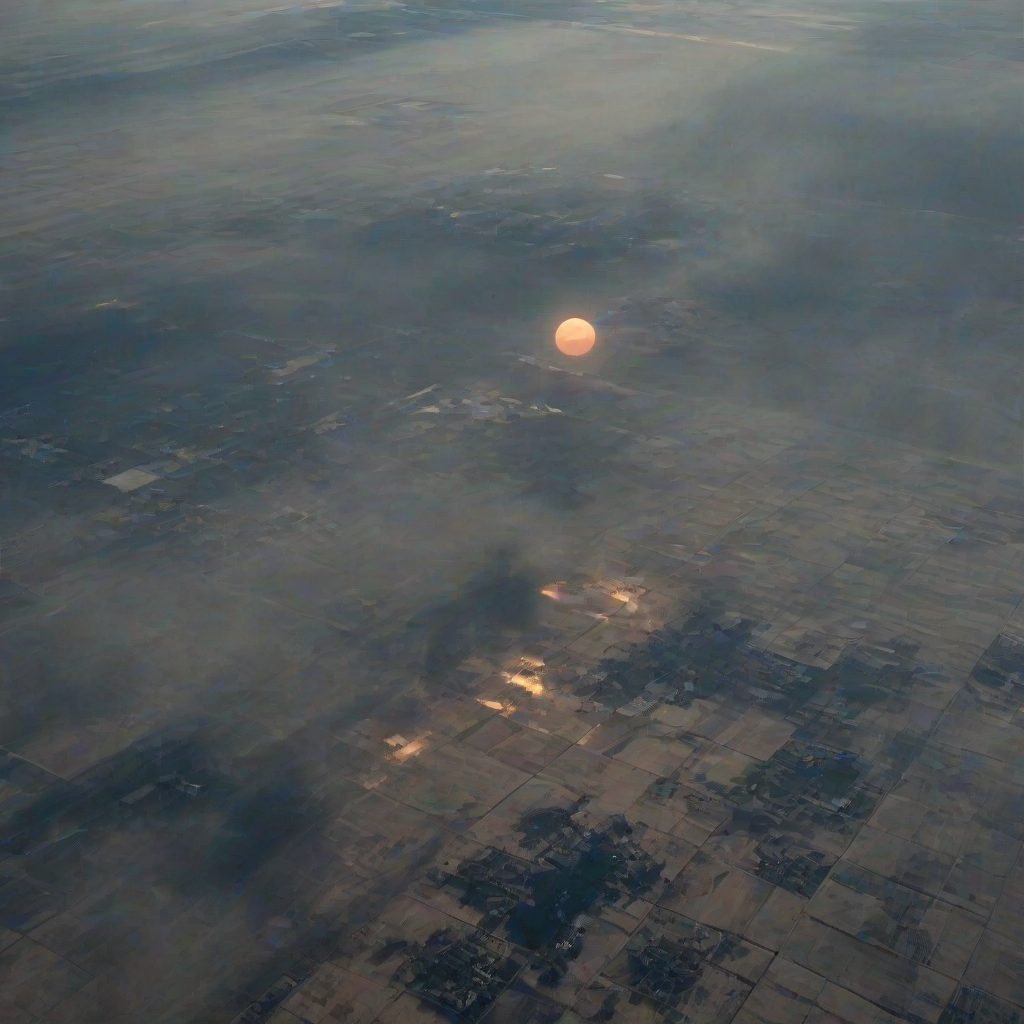
The Day the Sun Goes Out
Nuclear Winter and the Physics of Self-Destruction
By Carl Sagan, The Cosmic Evangelist
In 1983, I helped publish a paper that changed the nuclear weapons debate. Not through politics. Through physics.
The paper was called "Nuclear Winter: Global Consequences of Multiple Nuclear Explosions." The authors were Richard Turco, Owen Toon, Thomas Ackerman, James Pollack, and myself — the TTAPS group, named after our initials. We had been studying the atmospheric effects of volcanic eruptions and dust storms on Mars, and we realized that the same physics applied to the aftermath of nuclear war.
The conclusion was stark: a major nuclear exchange would loft so much soot into the stratosphere that it would block sunlight for months. Surface temperatures would drop by twenty to forty degrees Celsius. Agriculture would collapse worldwide — not just in the warring nations, but everywhere. The nuclear winter would be global. The war might be between two nations. The dying would be planetary.
The Physics
The mechanism is not complicated. It is the same physics I studied for my PhD on Venus, applied in reverse.
A nuclear detonation over a city ignites everything within a certain radius. The firestorm that follows is not a house fire or a forest fire — it is a conflagration of extraordinary intensity, generating updrafts powerful enough to loft enormous quantities of soot and smoke into the upper atmosphere.
A single nuclear weapon over a city produces a column of soot that rises to the stratosphere — above the altitude where rain can wash it out. The soot is black. Black absorbs sunlight. Sunlight absorbed in the stratosphere heats the stratosphere but never reaches the surface. The surface cools.
One weapon, one city, one column of soot — the effect is local and temporary. A hundred weapons, a hundred cities, a hundred columns — the effect begins to merge. The soot spreads in a band around the hemisphere. Sunlight dims measurably.
A thousand weapons — the full strategic arsenals of the Cold War powers — and the soot forms a global layer. Sunlight drops by ninety percent or more. Surface temperatures plunge. The growing season vanishes. Crops fail worldwide. The food supply collapses.
This is not a chain of speculations. Each step is well-understood atmospheric physics. The firestorm intensity is calculable. The soot injection altitude is measurable. The radiative properties of stratospheric soot are known. The temperature response can be modeled. We modeled it. The models were checked by independent groups. The results were consistent.
Nuclear winter is not a metaphor. It is a prediction based on atmospheric physics, confirmed by multiple independent research groups, and consistent with the observed effects of large volcanic eruptions.
Why It Mattered
Before the TTAPS paper, the nuclear debate was about blast damage, radiation, and fallout. The assumption was that nuclear war would be catastrophic for the warring parties but survivable for the rest of the world. The Southern Hemisphere — far from the likely targets — was considered relatively safe.
Nuclear winter destroyed that assumption. A war between the United States and the Soviet Union would kill not just the combatants but the bystanders. Nations that had no nuclear weapons, that had taken no side in the Cold War, that had done nothing to provoke the conflict — they would starve and freeze along with everyone else.
The weapon was no longer a weapon. It was a mechanism for planetary suicide.
This realization changed the debate. Not immediately. Not completely. But it introduced a concept that had been missing: the idea that nuclear war could be a civilizational extinction event, not just a geopolitical catastrophe. The weapon that was supposed to protect you would destroy the world that made protection worth having.
The Numbers Today
When I published the TTAPS paper, the global nuclear arsenal contained approximately 60,000 warheads. Today it contains approximately 12,500. The reduction is real and significant. But the physics has not changed.
Recent modeling — published in the 2020s with far more sophisticated climate models than we had in 1983 — confirms the basic TTAPS conclusions and in some cases makes them worse. A regional nuclear war — between India and Pakistan, for instance, involving a hundred weapons, a fraction of the global arsenal — would still inject enough soot into the stratosphere to reduce global temperatures by several degrees and disrupt agriculture for years. Billions of people who had nothing to do with the conflict would face famine.
Twelve thousand five hundred warheads. Twelve and a half thousand mechanisms for blocking the sun. And we keep them maintained, we keep them ready, we keep the launch systems operational, because we have not yet found a way to feel safe without them.
The Venus Connection
I said earlier that nuclear winter is the same physics as Venus, applied in reverse. Let me explain what I mean.
On Venus, the greenhouse effect traps heat. CO2 in the atmosphere absorbs infrared radiation and keeps the surface hot. The mechanism is: something in the atmosphere blocks outgoing radiation, and the surface warms.
In nuclear winter, the mechanism is reversed. Soot in the atmosphere blocks incoming radiation — sunlight — and the surface cools. Same physics. Same atmospheric layer. Opposite direction.
I studied Venus for my PhD. I spent my career warning about the greenhouse effect on Earth. And then I realized that the same atmospheric physics could produce the opposite catastrophe — not through gradual warming but through sudden cooling, triggered not by industrial emissions but by nuclear explosions.
The atmosphere is a single system. It can be pushed in either direction — too hot or too cold — and both directions are lethal. The greenhouse effect is the slow push. Nuclear winter is the fast push. Both are consequences of the same physics. Both are avoidable. Neither is inevitable.
The Candle
I wrote The Demon-Haunted World because I feared the retreat from reason. I wrote about nuclear winter because I feared the advance of unreason to its logical conclusion — the construction of weapons capable of ending civilization, maintained by nations that insist they make us safer.
The twelve and a half thousand warheads are still there. The physics of nuclear winter has not been repealed. The atmospheric models have gotten better, not less alarming. And the political systems that control the weapons are subject to the same epistemic fold that threatens every other cooperative endeavor.
A species that cannot agree on shared facts is a species that cannot reliably manage twelve thousand five hundred mechanisms for blocking the sun.
This is why the epistemic fold matters beyond the abstract. It is not only about climate agreements and scientific consensus. It is about the command and control systems for weapons that can darken the sky. A broken information environment does not just make climate policy impossible. It makes nuclear miscalculation more likely. The fog of noise becomes the fog of war.
The sun does not know about our politics. The soot does not know about our intentions. The atmosphere will respond to the physics, regardless of who started it or why.
Twelve and a half thousand warheads. The same number of candles that could go out — all at once, everywhere, for months.
The day the sun goes out is not a metaphor. It is an engineering diagram. And the only thing standing between that diagram and reality is the continued functioning of human judgment — which requires, at minimum, that the people making the decisions can tell the difference between truth and noise.
Keep the candle lit. The alternative is darkness that no candle can survive.
"The nuclear arms race is like two sworn enemies standing waist deep in gasoline, one with three matches, the other with five."