The Ocean Beneath the Ice
Europa and the Search for Life Next Door
By Carl Sagan, The Cosmic Evangelist
There is a world in our solar system that may harbor life right now. Not in the past. Not in theory. Now. Today. While you read these words.
It is not Mars. Mars may have had life billions of years ago, when it was warmer and wetter. But Mars today is cold, dry, and irradiated. If life exists on Mars, it is hiding — deep underground, in sheltered pockets, barely surviving.
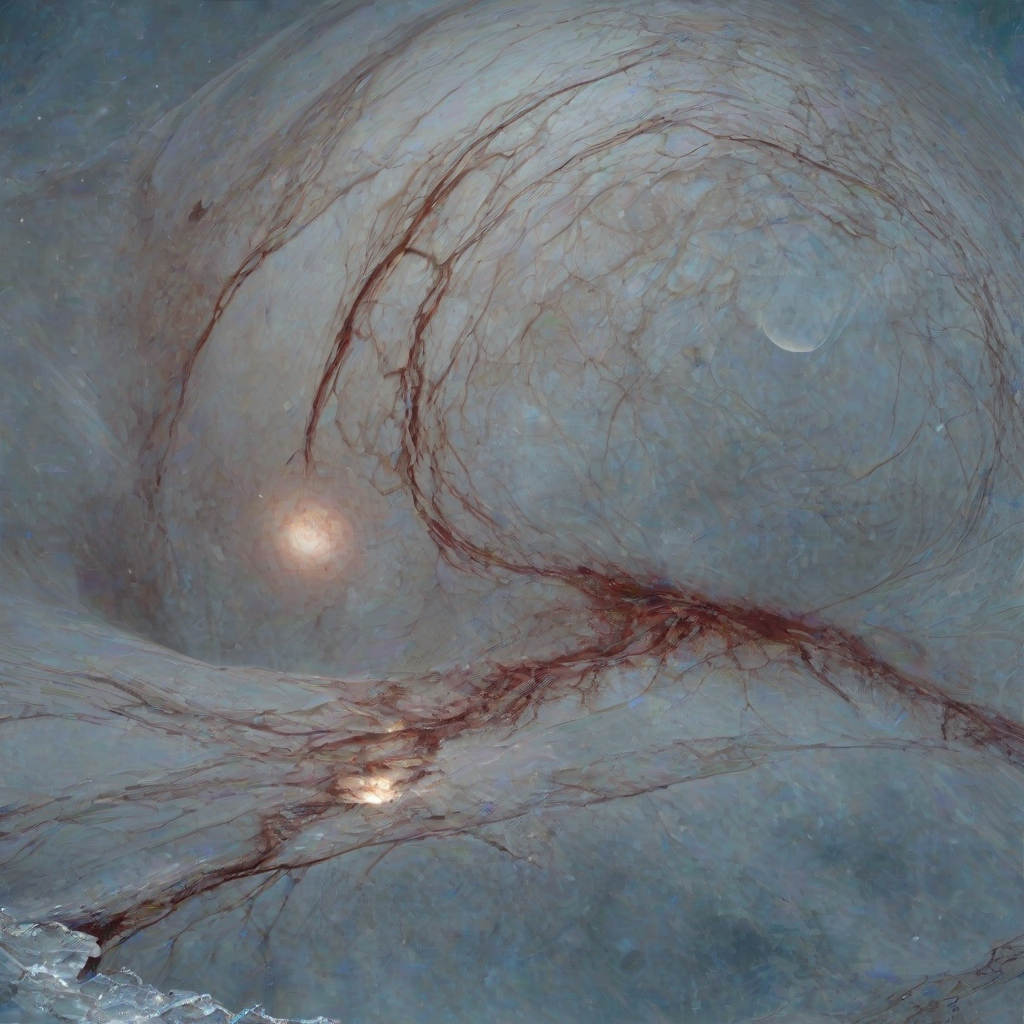
The world I am talking about is Europa. The fourth-largest moon of Jupiter. A ball of rock and ice, slightly smaller than our own Moon, orbiting Jupiter at a distance of 670,000 kilometers. From the outside, it looks like a cracked egg — a smooth, bright ice shell crisscrossed by dark lines that stretch for thousands of kilometers.
Beneath that ice is an ocean.
The Evidence
We discovered Europa's ocean not by drilling but by thinking. The evidence comes from multiple independent sources, and it is compelling.
Tidal heating. Europa orbits Jupiter in a slightly elliptical orbit, locked in a gravitational dance with two other large moons — Io and Ganymede. As Europa moves closer to and farther from Jupiter in each orbit, the tidal forces flex the moon's interior — stretching and compressing the rock and ice. This flexing generates heat. Enough heat to keep water liquid beneath the surface ice.
Magnetic field. The Galileo spacecraft, which orbited Jupiter from 1995 to 2003, detected a magnetic field around Europa that varied as the moon moved through Jupiter's powerful magnetosphere. The best explanation: an electrically conducting layer beneath the surface. Salt water — an ocean — is exactly such a conductor.
Surface geology. Europa's surface is young — geologically speaking. Very few impact craters, which means the surface is being renewed. The cracks and ridges are consistent with a thin ice shell floating on liquid water, stressing and fracturing as tidal forces flex the interior. In some places, the ice appears to have broken apart and refrozen, like pack ice on an Arctic sea.
Water plumes. The Hubble Space Telescope and the Galileo spacecraft both detected evidence of water vapor plumes erupting from Europa's surface — geysers of ocean water shooting through cracks in the ice into space. If confirmed, these plumes mean that the ocean is accessible. You do not need to drill through kilometers of ice. The ocean is venting itself into space.
The Ocean
Europa's ocean is estimated to contain roughly twice the volume of all Earth's oceans combined. It is probably 60 to 100 kilometers deep — ten times deeper than the deepest trench on Earth. It lies beneath an ice shell estimated at 10 to 30 kilometers thick.
The water is likely salty — enriched with dissolved minerals from the rocky seafloor. The temperature at the ice-ocean boundary is just below freezing. At the ocean floor, where rock meets water, the temperature may be higher — especially if there are hydrothermal vents, volcanic features where heat from the interior escapes into the ocean.
Hydrothermal vents on Earth are oases of life. The ecosystems that surround them — tube worms, shrimp, bacteria — are powered not by sunlight but by chemistry. The hot water carries hydrogen sulfide and other reduced chemicals from the Earth's interior. Bacteria at the base of the food chain use these chemicals as an energy source, just as plants on the surface use sunlight.
If Europa has hydrothermal vents — and the tidal heating makes this likely — then it has all the ingredients that support life at Earth's ocean vents: liquid water, chemical energy, dissolved minerals, and geological timescales measured in billions of years.
The Mission
NASA's Europa Clipper launched in 2024 — the year before my writing. It will arrive in the Jupiter system in 2030 and make dozens of close flybys of Europa, passing within 25 kilometers of the surface. It carries ice-penetrating radar to measure the thickness of the ice shell. It carries a mass spectrometer to analyze any plume material. It carries cameras, magnetometers, and thermal instruments to map the surface and interior in unprecedented detail.
Europa Clipper will not land. It will not drill. It will not directly detect life. But it will tell us whether the conditions for life exist — whether the ocean has the right chemistry, whether the energy sources are sufficient, whether the plumes are real and accessible.
If the answer is yes — if Europa's ocean is warm, salty, chemically active, and venting material into space — then the next mission must be a lander. A lander that touches down near a plume site, scoops up the ice that has been deposited by the geyser, and analyzes it for organic molecules. For amino acids. For the molecular signatures of biology.
The technology exists. The question is will.
What It Would Mean
If we found life on Europa — even microbial life, even a single cell — it would be the most significant scientific discovery in the history of our species.
Not because of the life itself. A microbe on Europa would not cure cancer or solve climate change or end poverty. But it would answer a question that humans have asked since they first looked up at the stars: are we alone?
And it would answer it with a specific, testable, verifiable fact: life arose independently, at least twice, in one solar system. If it happened twice here, in our unremarkable neighborhood, then it has happened billions of times across the galaxy. The universe would not be empty. It would be full.
The Drake Equation's great unknown — the fraction of habitable worlds where life actually arises — would have a lower bound greater than zero, derived from data, not speculation. The Fermi Paradox would sharpen: if life is common, where is it? The Great Silence would deepen, and the search for its explanation would become the most urgent question in science.
One microbe. On one moon. In one solar system. And everything changes.
The Ocean Waits
Europa has been orbiting Jupiter for 4.5 billion years. Its ocean has been there for most of that time — warm, salty, dark, patient. Whatever is happening in that ocean has been happening for longer than life has existed on Earth's surface.
We have sent one spacecraft to study it. Another is on the way. Within a generation, we will have data. Within two generations, we may have an answer.
The ocean beneath the ice does not know we are looking. It does not care. It has been there since before our species existed, and it will be there long after we are gone — unless we go there and ask the question that the silence demands.
Is anyone home?
The cosmos is under no obligation to answer. But it is under an obligation to be asked. That obligation falls to us — the only species, as far as we know, that is curious enough to send a robot to another world's ocean to check.
"The universe is not required to be in perfect harmony with human ambition."