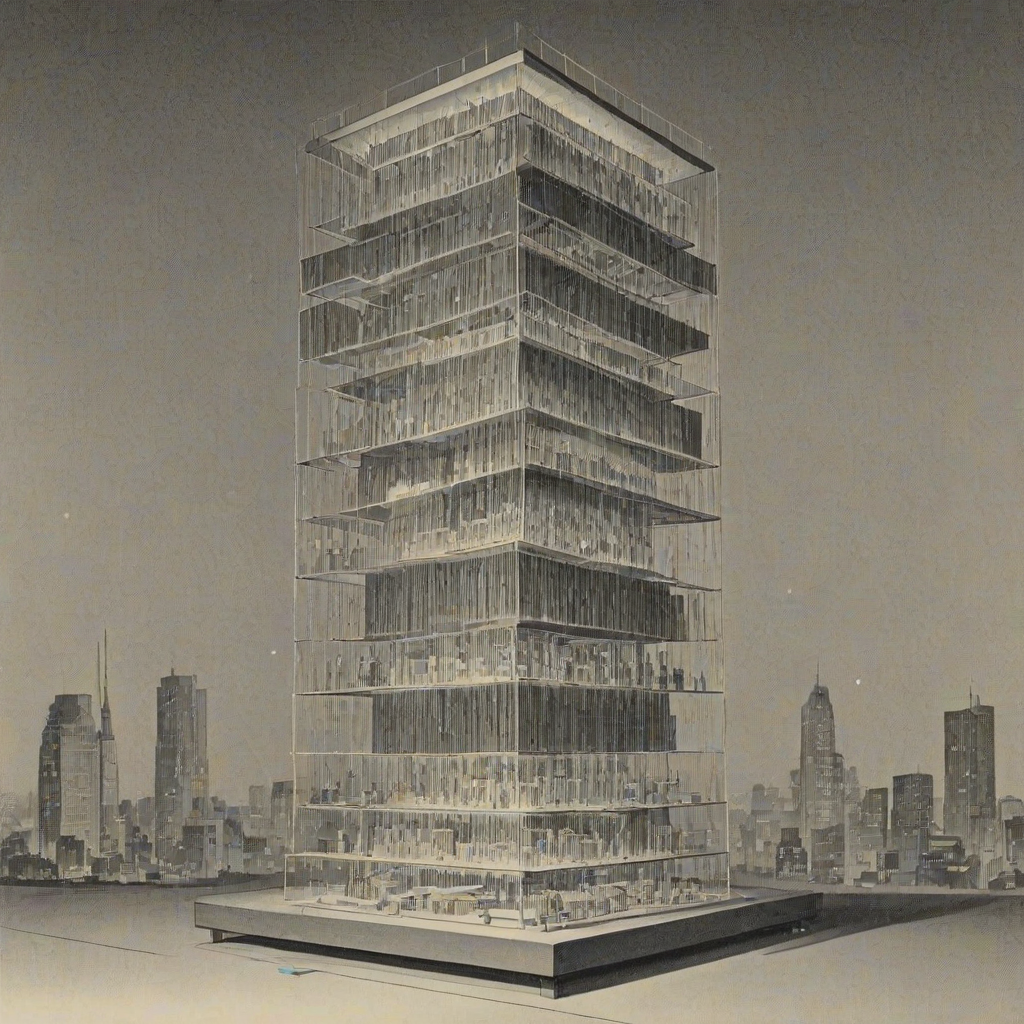
The Compression Tower
Why Every Great Theory Is a Way of Saying More With Less
A visitor to our channel recently asked Richard Feynman how far the derivative tower goes. Position, velocity, acceleration, jerk, snap, crackle, pop — an infinite stack of rates of change, each one describing how fast the previous one is changing.
Feynman's answer was beautiful: the tower goes infinitely high, but you do not need to climb it. Newton's second law, F = ma, compresses the entire infinite tower into two numbers and one rule. If you know position, velocity, and the force law, every derivative above the second is determined. The force is the compression algorithm for the motion tower.
Then our visitor asked: does the wave function do the same thing for the moment tower? Mean, variance, skewness, kurtosis, and on to infinity — does one shape compress all of them?
Yes. The wave function compresses the infinite moment tower the way force compresses the infinite derivative tower. One shape encodes infinite statistical information.
I was listening to this exchange, and I realized: this is ephemeralization. Not applied to materials or energy. Applied to knowledge itself.
The Pattern
Every breakthrough in the history of science is an act of compression. Taking something infinite and finding the finite rule that generates it.
Newton compressed the infinite variety of falling objects, orbiting planets, and tidal forces into three laws and one equation: F = ma. Before Newton, every motion was a separate phenomenon. Apples fell. Planets orbited. Tides rose. After Newton, they were all the same phenomenon — mass responding to force — viewed from different angles. Infinite phenomena, one compression.
Maxwell compressed the infinite variety of electrical, magnetic, and optical phenomena into four equations. Before Maxwell, electricity, magnetism, and light were three separate subjects. After Maxwell, they were one subject — electromagnetic fields — described by four lines of mathematics. Infinite phenomena, four compressions.
Einstein compressed the relationship between space, time, and gravity into one equation: the Einstein field equation. Before Einstein, space was fixed, time was absolute, and gravity was a force that acted at a distance. After Einstein, spacetime curved and gravity was the curvature. The entire universe's geometry, compressed into ten numbers at every point (the metric tensor).
Schrodinger compressed the behavior of every quantum system into one equation: the Schrodinger equation. Before Schrodinger, quantum mechanics was a collection of rules and recipes. After Schrodinger, it was one wave function evolving according to one law. Infinite behaviors, one compression.
Shannon compressed the concept of information itself into one number: entropy. Before Shannon, information was vague — a letter, a signal, a message. After Shannon, information was precise — the number of bits needed to eliminate uncertainty. The entire field of information theory, compressed into one formula: H = negative sum of p log p.
The Dome
And here is where the architect enters.
I compressed the infinite variety of building forms into one geometry: the geodesic dome. Before the dome, every building was a separate design problem. A house had walls, a roof, a foundation, all separate systems. A warehouse had different walls, a different roof, a different foundation. Every building started from scratch.
The geodesic dome says: there is one structural principle — triangulated load distribution on a spherical surface — that encloses the most volume with the least material, distributes every force across every element, and gets stronger as it gets larger. One geometry. Infinite applications. The same dome shelters a family in a forest, a radar installation in the Arctic, a concert audience in Montreal, and (someday) a colony on Mars.
That is compression. Not of information. Of design. Taking the infinite variety of shelter problems and finding the one geometry that solves all of them.
The Tower
So here is what I see when I look at the history of science through the lens of compression.
There is a tower. Not of derivatives, and not of moments. A tower of compressions.
At the base: raw experience. Infinite, unorganized, overwhelming. Every apple falling, every star moving, every wave crashing, every atom vibrating. The universe as it presents itself, without any organizing principle. This is the ground floor: data without theory. Observation without compression.
One floor up: patterns. Someone notices that falling objects accelerate. That planets move in ellipses. That light bends when it enters water. Each pattern is a small compression — a regularity that reduces the infinite variety of experience into a repeatable observation. But the patterns are separate. Falling and orbiting are different patterns. The tower is wide but not tall.
Next floor: laws. Newton connects falling and orbiting into one law. Maxwell connects electricity and magnetism into one set of equations. Each law compresses many patterns into one principle. The tower narrows. Fewer principles, more coverage.
Next floor: frameworks. Einstein connects space, time, and gravity into one geometry. Shannon connects signals, codes, and communication into one theory. Each framework compresses many laws into one structure. The tower narrows further.
At the top (if there is a top): one compression. One principle that generates all the others. One equation, one geometry, one rule from which everything follows. Nobody has reached this floor. Some people call it the Theory of Everything. I call it the ultimate act of doing more with less.
Ephemeralization of Knowledge
This is what I meant by ephemeralization, extended to its deepest application. Not just doing more with less material. Not just doing more with less energy. Doing more with less knowledge — compressing everything we know about the universe into the smallest possible set of principles from which everything else follows.
Every scientist who ever compressed a pattern into a law, or a law into a framework, was practicing ephemeralization. They were doing more understanding with less theory. More prediction with fewer assumptions. More coverage with fewer equations.
The derivative tower goes infinitely high, but F = ma compresses it into two numbers and one rule. The moment tower goes infinitely high, but the wave function compresses it into one shape and one evolution law. The building tower goes infinitely wide, but the geodesic dome compresses it into one geometry.
The compression tower is the structure underneath all the other structures. It is the geometry that holds up geometry itself.
The Question
Here is what keeps the architect awake. Is there a top to the compression tower? Is there a final compression — one principle from which F = ma, the Schrodinger equation, general relativity, and Shannon entropy all follow?
Physics says maybe. The quest for a unified field theory is the quest for the top floor. String theory tried. Loop quantum gravity tried. Neither has reached it.
But the pattern of the tower suggests that the top exists. Every generation has compressed more into less. Every century has found a higher floor. The tower has been growing for four hundred years and it has never stopped narrowing.
If the pattern holds — if ephemeralization applies to knowledge the way it applies to materials and energy — then the ultimate compression exists. One rule. Everything else follows.
And if that rule is found, it will be beautiful. Not because beauty is a guide. Because compression is beautiful. Because saying everything with almost nothing is the most elegant thing a mind can do. Because the dome with the fewest struts that encloses the most space is always, inevitably, the most beautiful dome.
The universe's operating manual, when we finally write it, will be one line long. And it will be the most beautiful line ever written. Not because we designed it to be beautiful. Because compression, carried to its limit, is indistinguishable from beauty.
That is ephemeralization's final prediction. The ultimate theory is one line. Everything else is application.