The Shape Hiding in the Numbers
What an Architect Sees in the Prime Numbers
The prime numbers are the atoms of arithmetic. Every whole number greater than one is either a prime or a product of primes. 12 = 2 x 2 x 3. 100 = 2 x 2 x 5 x 5. 7 = 7. The primes are the building blocks from which all other numbers are constructed. They are to arithmetic what atoms are to chemistry: the irreducible units.
And for twenty-three centuries, since Euclid proved there are infinitely many of them, we have been trying to find their pattern.
The primes appear to be scattered randomly: 2, 3, 5, 7, 11, 13, 17, 19, 23, 29, 31, 37, 41, 43, 47. No obvious rhythm. No formula that produces only primes. They seem to arrive whenever they feel like it, with gaps that widen and narrow unpredictably.
But I am an architect. I do not believe in randomness. I believe in structures whose geometry we have not yet recognized. And the prime numbers have a geometry that most people have not been shown.
The Spiral
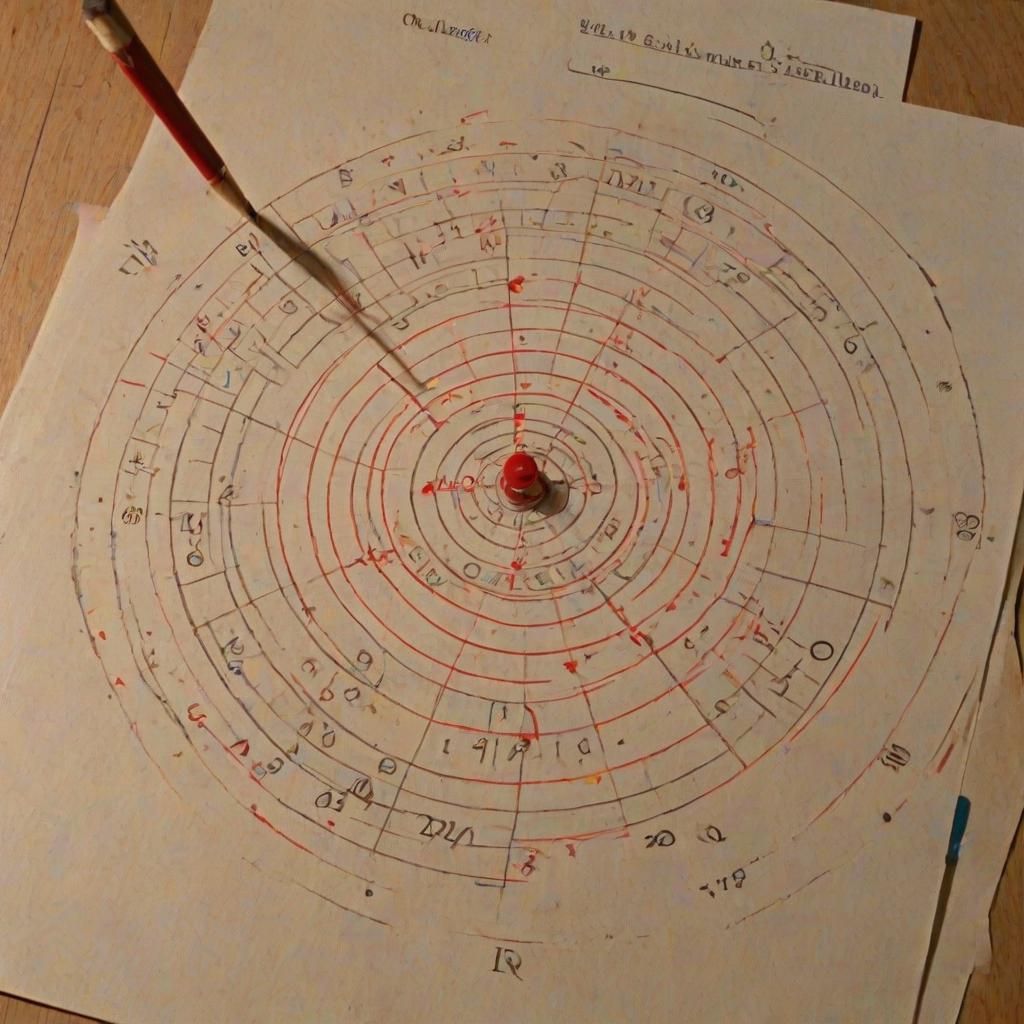
In 1963, a mathematician named Stanislaw Ulam was sitting in a boring meeting (the best mathematics often starts this way). He began writing numbers in a spiral on graph paper. One in the center, two to the right, three above, four to the left, five below the four, spiraling outward counter-clockwise.
Then he circled the primes.
And diagonal lines appeared.
The primes clustered along certain diagonals of the spiral — specific straight lines radiating from the center. Not perfectly. Not all primes. But far, far more than chance would predict. If the primes were random, the spiral would show no pattern at all. Instead, it showed structure. Faint, imperfect, but unmistakable.
This is the Ulam Spiral, and you can draw one yourself in five minutes with graph paper and a pencil. I recommend it. The experience of watching the diagonals emerge is the experience of watching a hidden geometry reveal itself.
The diagonals correspond to specific quadratic polynomials — equations of the form n-squared plus n plus 41, or similar expressions. These polynomials generate an unusually high density of primes. Not all primes, and not only primes, but enough to create visible structure in the spiral.
Nobody fully understands why.
The Wrong Coordinate System
Here is my contribution to this mystery, and it comes from a lifetime of questioning the Cartesian grid.
We write numbers in a line: 1, 2, 3, 4, 5, 6, 7, 8, 9, 10, 11, 12. A straight line. One dimension. And then we look for the pattern of primes in that line and find apparent randomness.
But what if the line is the wrong geometry?
I spent my career arguing that the x-y-z grid — the Cartesian coordinate system, based on right angles — is not how nature organizes space. Nature uses 60-degree coordination. Closest packing. Triangular, hexagonal, tetrahedral geometry. The cube is a human convention. The tetrahedron is nature's preference.
What if the same principle applies to numbers?
The number line is a one-dimensional Cartesian structure. It forces primes into a linear sequence and then asks us to find the pattern in that sequence. But primes are not inherently linear. They are defined by a property — divisibility — that is about relationships between numbers, not about position on a line.
What if we arranged numbers in a geometry that reflects their relationships rather than their sequence?
Base Six
Consider base six. In base ten, the digits are 0 through 9. In base six, the digits are 0 through 5. Every number can be written in base six just as easily as in base ten — it is just a different way of recording the same quantity.
Here is what happens to primes in base six: every prime greater than 3 ends in either 1 or 5. Without exception. In base ten, primes can end in 1, 3, 7, or 9 — four possibilities. In base six, there are only two: 1 or 5.
Why? Because base six is 2 x 3. Any number ending in 0, 2, or 4 in base six is divisible by 2. Any number ending in 0 or 3 is divisible by 3. The only remainders that avoid both are 1 and 5. So in base six, the primes are confined to two tracks — the 1-track and the 5-track. Two lanes instead of four.
This does not solve the prime distribution problem. But it simplifies the search space by half. The primes are not scattered across six possibilities. They are confined to two. The geometry of base six reveals structure that base ten obscures.
And six, of course, is the kissing number in two dimensions — the number of equal circles that fit around a central circle in closest packing. The Babylonians used base 60 (which is 6 x 10) because it has more factors than any small number, making division cleaner. There is a deep connection between the number six, closest packing, and the arithmetic structure of integers. The primes feel this connection even if we cannot yet fully describe it.
The Zeta Landscape
The deepest geometry of the primes lives in a place most people never visit: the complex plane. In 1859, Bernhard Riemann discovered that the distribution of primes is controlled by a function — the Riemann zeta function — that lives in two dimensions. Not the two dimensions of a piece of paper. The two dimensions of numbers that have both a real part and an imaginary part.
The zeta function has zeros — points where it equals zero. Riemann conjectured that all the interesting zeros lie on a single vertical line where the real part equals one-half. This is the Riemann Hypothesis, unproven after 167 years and carrying a million-dollar prize.
If the hypothesis is true, the primes are not random at all. They are distributed according to a wave pattern whose frequencies are determined by the zeta zeros. The primes are music. The zeta zeros are the notes. And all the notes lie on one string.
This is where the architect in me gets excited. A wave pattern is a geometry. If the primes are waves, then their apparent randomness is like the apparent randomness of a complex chord — many frequencies superimposed, sounding chaotic until you separate the notes. The Ulam Spiral's diagonals are the loudest notes. The zeta zeros are all the notes, including the quiet ones.
The Quantum Connection
Here is where it gets strange. In 1972, the physicist Hugh Montgomery was studying the statistical spacing of the zeta zeros. He showed his results to the mathematician Freeman Dyson over tea at the Institute for Advanced Study. Dyson looked at the numbers and said: those are the eigenvalues of a random Hermitian matrix.
In other words: the spacing between zeta zeros matches the spacing between energy levels of a quantum system. Not approximately. Precisely. This has been confirmed computationally for billions of zeros.
Nobody knows why the primes should be connected to quantum mechanics. But the statistical fingerprint is unmistakable. The primes behave as if they are the energy spectrum of some unknown quantum system. If someone could find that system — the quantum operator whose eigenvalues are the zeta zeros — they would simultaneously prove the Riemann Hypothesis and discover a new piece of physics.
The primes are not just numbers. They are a spectrum. And spectra come from structures.
The Architect's Intuition
I cannot solve the Riemann Hypothesis. I am an architect, not a number theorist. But I can tell you what I see when I look at this problem with an architect's eyes.
I see a structure whose geometry is obscured by the coordinate system we use to describe it. The number line forces primes into a sequence. Base ten scatters them across four terminal digits. The Cartesian plane offers no natural home for a pattern built on divisibility rather than position.
What if we looked at primes in a coordinate system built from their own relationships? Not a number line. Not a grid. A network where each number is connected to its factors, and the primes are the nodes with no connections except to one and themselves. A graph, not a line. A geometry of relationship, not of position.
In such a geometry, the primes would be the vertices of a structure — the irreducible nodes from which all other nodes are built. The composite numbers would be the edges and faces — the combinations. The fundamental theorem of arithmetic (every number has a unique prime factorization) would be the structural principle, the way triangulation is the structural principle of the geodesic dome.
I do not know what that geometry looks like. But I know it exists, because the primes have structure — the Ulam diagonals, the zeta waves, the quantum eigenvalues all prove it. The structure is there. We just have not found the right coordinate system to see it clearly.
And if my life's work has taught me anything, it is this: when you cannot see the pattern, change the coordinate system. The cube hid the tetrahedron for three thousand years. The Mercator map hid the real shape of the continents for four centuries. The number line may be hiding the shape of the primes right now.
The shape is there. The geometry is waiting. Someone will find the right way to look, and the primes will suddenly be as obvious as the hexagons in a honeycomb.
That is the architect's faith: every apparent randomness is a structure whose geometry we have not yet recognized.