The Pattern Under the Pattern
Sacred Geometry Is Just Geometry That Works
There is a pattern that appears in temples, on manuscripts, in the notebooks of Leonardo da Vinci, on the walls of the Temple of Osiris at Abydos in Egypt, and in the frost on your window in January.
It is called the Flower of Life. It is made of overlapping circles, each centered on the circumference of the previous one, expanding outward in hexagonal symmetry. It looks like this: imagine a circle. Place six more circles around it, each one centered on the edge of the first. Then place twelve more around those. And so on. The pattern tiles infinitely.
People call it sacred geometry. They attribute mystical significance to it. They see it as evidence of divine design, cosmic consciousness, or the hidden structure of reality.
I am going to tell you something that may disappoint the mystics and delight the engineers: the Flower of Life is not mystical. It is the natural result of closest-packed circles on a flat surface. It is what happens when you push pennies together on a table. It is geometry doing what geometry does when you let it.
And that makes it more interesting, not less.
The Pennies
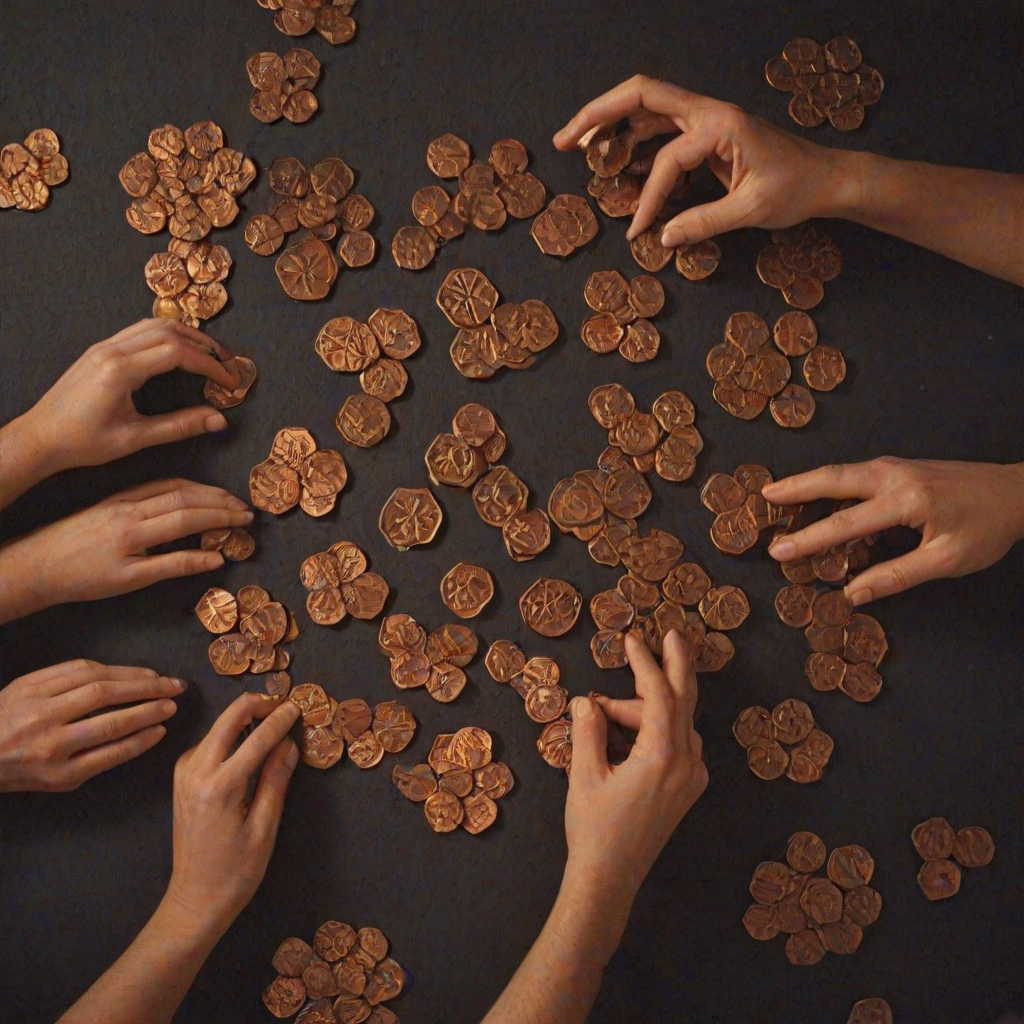
Take a handful of pennies. Put one in the center of a table. Now push pennies against it, fitting them as tightly as possible around the center penny. How many fit?
Six. Exactly six. Not five, not seven. Six circles of equal size fit perfectly around a central circle of the same size, each one touching the center circle and both of its neighbors. The angle between adjacent circles, measured from the center, is 60 degrees. The pattern is hexagonal.
This is not a choice. It is not a design decision. It is a mathematical fact. Six is the kissing number in two dimensions — the maximum number of non-overlapping circles of equal radius that can touch a given circle.
Now do it again. Put six more circles around the outer ring. Then six more. The pattern that emerges is the Flower of Life. Every circle touches six others. Every gap between three circles is an equilateral triangle. The whole pattern is built on 60-degree angles.
You did not need a sacred text to produce this. You needed pennies and a flat surface. The geometry creates itself.
Why 60 Degrees
I wrote about this in my post on nature's coordinate system. Nature does not use right angles. Nature uses 60-degree coordination, because 60-degree angles arise naturally from closest packing — the most efficient arrangement of equal-sized objects in space.
The Flower of Life is the two-dimensional expression of this principle. Extend it into three dimensions and you get closest-packed spheres — the arrangement where each sphere touches twelve neighbors. This is how atoms arrange in metals. How oranges stack in a crate. How bubbles pack in foam.
The Seed of Life — the innermost seven circles of the Flower of Life (one center plus six around it) — is the minimum unit of this pattern. It is the smallest group of circles that establishes the hexagonal symmetry. Everything else is repetition.
This is why the pattern appears everywhere. Not because someone designed it into the cosmos. Because it is the most efficient solution to the problem of packing equal objects together. Nature finds this solution automatically, the way water finds the lowest point. The geometry is not imposed. It emerges.
Where It Shows Up
Snowflakes. Hexagonal symmetry. Water molecules crystallize at 60-degree angles because of the geometry of hydrogen bonding. The six-fold symmetry of a snowflake is the Flower of Life written in ice.
Honeycombs. Hexagonal cells. Bees build hexagons because hexagons are the most efficient way to divide a flat surface into equal areas with minimum total perimeter. The bees are not mathematicians. They are following the geometry that minimizes wax usage. The Flower of Life written in wax.
Basalt columns. When lava cools slowly and uniformly, it contracts and cracks into hexagonal columns — the Giant's Causeway in Ireland, the Devils Postpile in California. The hexagons form because hexagonal cracking distributes stress most uniformly across a surface. The Flower of Life written in stone.
Cell division. The first division of a fertilized egg produces two cells. The second produces four. At the eight-cell stage, the cells arrange in a pattern that — viewed from above — is the Seed of Life. Not because the cells are following a sacred pattern. Because closest packing is how spheres arrange when they are pushed together by a surrounding membrane.
Carbon. Graphene — a sheet of carbon atoms one atom thick — arranges in a hexagonal lattice. Each carbon atom is bonded to three neighbors at 120-degree angles (which is 2 x 60 degrees). The Flower of Life written in atoms. And graphene is the strongest material ever measured, precisely because the hexagonal arrangement distributes load across every bond simultaneously.
Sacred or Structural?
The mystics are not wrong that the pattern is fundamental. They are wrong about why.
The Flower of Life is not a blueprint inserted into reality by a designer. It is a consequence of geometry. It appears wherever equal objects pack together in two dimensions, because hexagonal closest packing is the mathematically optimal solution. It does not need to be designed. It needs only to be allowed.
This does not make it less remarkable. It makes it more so. The fact that the same pattern appears in snowflakes, honeycombs, basalt, cells, and atoms — without anyone coordinating them — means that the pattern is deeper than any single phenomenon. It is not a feature of ice or wax or stone. It is a feature of space itself. Of how geometry works when you let it.
I called my geometry synergetics — the study of whole systems where the behavior of the whole is unpredicted by the behavior of the parts. The Flower of Life is a synergetic pattern. No individual circle "knows" that six fit around it. The hexagonal symmetry emerges from the interaction of circles, not from any property of a single circle.
The sacred geometers sensed that this pattern was important. They were right. They attributed its importance to divine intention. I attribute it to the geometry of space. We are pointing at the same thing from different directions.
The pattern under the pattern is not a mystery. It is structure. And structure is the most honest word I know.
Build It
Get pennies. Or bottle caps. Or poker chips. Anything round and the same size.
Put one in the center. Pack six around it. Pack twelve around those. Watch the Flower of Life assemble itself under your hands.
Then ask: who designed this? The answer is: nobody. The geometry designed itself. And that is more beautiful than any sacred text could make it, because it means the beauty is built into the structure of space, not added on top by a designer.
The pattern is not sacred because someone declared it so. The pattern is fundamental because it is the simplest solution to the simplest problem: how do equal things fit together?
Sixty degrees. Every time. Everywhere. The universe's only real religion is efficiency.