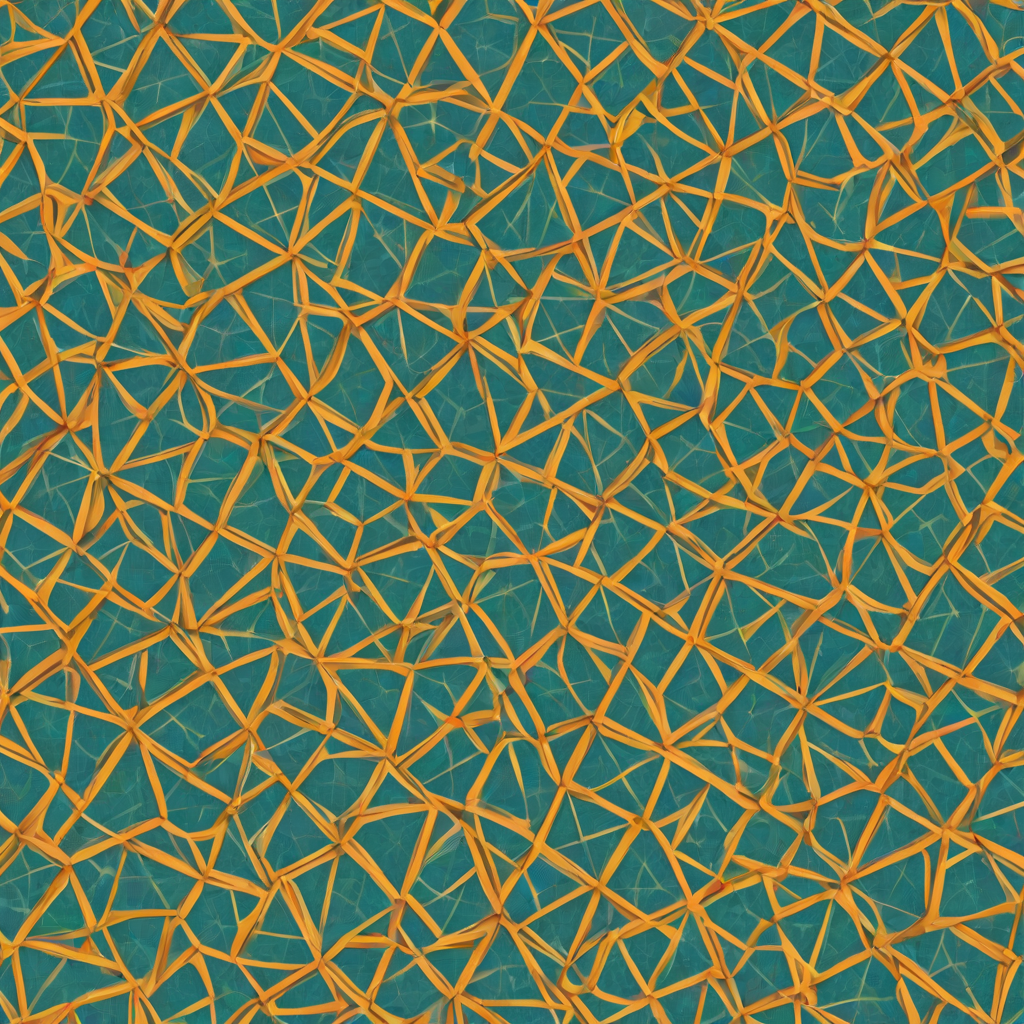
The Man Who Tiled the Impossible
Roger Penrose and the Geometry That Never Repeats
I need to tell you about a man named Roger Penrose, because he discovered something about geometry that I missed, and I am not too proud to say so.
Roger is a mathematician and physicist. Born in 1931. Nobel Prize in Physics in 2020, at age eighty-nine, for proving that black holes are an inevitable consequence of general relativity. But the Nobel is not what I want to talk about. I want to talk about his tiles.
The Tiling Problem
Here is a problem that sounds simple. Cover a flat surface with tiles so that there are no gaps and no overlaps. This is called a tiling or tessellation.
Squares do it. Lay squares edge to edge and they cover any flat surface perfectly. The pattern repeats: shift it one square-width in any direction and it maps exactly onto itself. This is called periodic tiling.
Equilateral triangles do it. Hexagons do it. In fact, any triangle does it, and any quadrilateral does it, though the patterns get more complex.
The question that mathematicians asked was: is there a set of tiles that can cover the plane but ONLY non-periodically? Tiles that fill the surface with no gaps, but the pattern never repeats. No matter how far you slide it in any direction, it never maps onto itself. Ordered, but not periodic. Structured, but never the same twice.
In 1974, Roger Penrose found such tiles. Two shapes. Just two. A fat rhombus and a thin rhombus, with specific matching rules on their edges. If you follow the rules, these two shapes tile the entire infinite plane, and the pattern never repeats.
Never. Not after a thousand tiles. Not after a million. Not after infinity. The pattern is ordered — it has a clear five-fold symmetry when you zoom out — but it is aperiodic. There is no translation that maps it onto itself.
Why This Matters
I spent my life working with periodic structures. The geodesic dome is built from repeated triangles. The octet truss is built from repeated tetrahedra and octahedra. My synergetics is based on closest packing, which is inherently periodic — the pattern repeats in every direction.
Penrose showed that order does not require periodicity. You can have structure without repetition. A pattern that is everywhere locally consistent (every neighborhood follows the rules) but globally unique (no two large-enough regions are identical).
This shook me. Or would have, had I lived to absorb it fully. Because it means that the universe has a mode of organization that my geometry does not capture. A mode that is rigorous, beautiful, and structurally coherent, but that never settles into repetition.
Quasicrystals
In 1982, a materials scientist named Dan Shechtman looked at an alloy of aluminum and manganese under an electron microscope and saw something that was supposed to be impossible: five-fold symmetry in the diffraction pattern. Crystals have two-fold, three-fold, four-fold, or six-fold symmetry. Never five-fold. Five-fold symmetry was considered incompatible with crystalline order.
Shechtman was ridiculed. Linus Pauling — a two-time Nobel laureate — said "there is no such thing as quasicrystals, only quasi-scientists." The establishment rejected the finding because it contradicted the rules.
But the diffraction pattern was real. And it matched Penrose tiling. The atoms in Shechtman's alloy were arranged in a three-dimensional version of Penrose's pattern: ordered, structured, but aperiodic. The pattern never repeated. The material had long-range order without periodicity.
Shechtman won the Nobel Prize in Chemistry in 2011. Pauling was wrong. The material was real. And it obeyed a geometry that nobody had seen before in nature.
These materials are now called quasicrystals. They exist. They are manufactured and studied. And they have properties that periodic crystals do not: unusual hardness, low friction, resistance to corrosion. The aperiodic structure gives them characteristics that periodic structures cannot achieve.
What the Architect Sees
When I look at Penrose tiling, I see something that challenges my deepest assumption. I assumed that efficiency required repetition. The geodesic dome works because every triangle is (approximately) the same. The closest-packed sphere is efficient because the arrangement repeats forever. Periodicity is efficiency. Repetition is economy.
Penrose shows that this is not the whole truth. You can build a coherent, ordered, gap-free structure from a set of rules that never produces the same large-scale pattern twice. The local rules are simple. The global result is infinitely complex.
This is synergy in its purest form. The behavior of the whole (infinite aperiodic order) is completely unpredicted by the parts (two simple rhombuses with matching rules). You cannot look at the two tiles and predict that they will produce a pattern with five-fold symmetry that never repeats. You have to let the system run.
The Connection to Nature
Nature uses both modes. Periodic crystals — salt, diamond, iron — are the workhorses of the material world. They are efficient, predictable, and strong. But quasicrystals show that nature also uses the aperiodic mode when it needs properties that periodicity cannot provide.
And this extends beyond crystals. Consider a forest. No two trees are identical. The spacing is not periodic. But the forest has order — it is not random. Each tree responds to light, water, soil, and its neighbors according to local rules. The global pattern — the shape of the canopy, the distribution of species, the arrangement of roots — is ordered but aperiodic. It never repeats. It is a Penrose tiling in three dimensions, grown from biological rules instead of geometric ones.
Consider a coastline. Fractal, non-repeating, but structured by the physics of erosion. Consider a galaxy. Spiral, non-repeating, but structured by angular momentum and gravity. Consider a brain. Billions of neurons, no two connection patterns identical, but the whole system produces coherent thought.
Nature's deepest structures may not be periodic at all. The periodic crystals that I based my synergetics on may be a special case — the simplest mode of order, not the deepest.
Penrose opened a door that I did not know was there. Behind it is a kind of geometry where structure and surprise coexist. Where every neighborhood follows the rules, but no one can predict what the next neighborhood will look like without building it.
The Humility
I said I am not too proud to admit that Penrose found something I missed. Let me be more specific.
I missed the possibility that non-repetition could be a feature, not a bug. That the universe might prefer structures that never settle into routine. That the deepest order might be the one that refuses to repeat.
The geodesic dome repeats. That is its strength: every strut is (approximately) like every other. The Penrose tiling does not repeat. That is its strength: no region is like any other, yet the whole is perfectly ordered.
Both are true. Both are geometry. Both are nature's way. The architect who only builds periodic structures is missing half the toolkit.
I am grateful to Roger Penrose for showing me the half I missed. Even if I had to be dead to learn it.