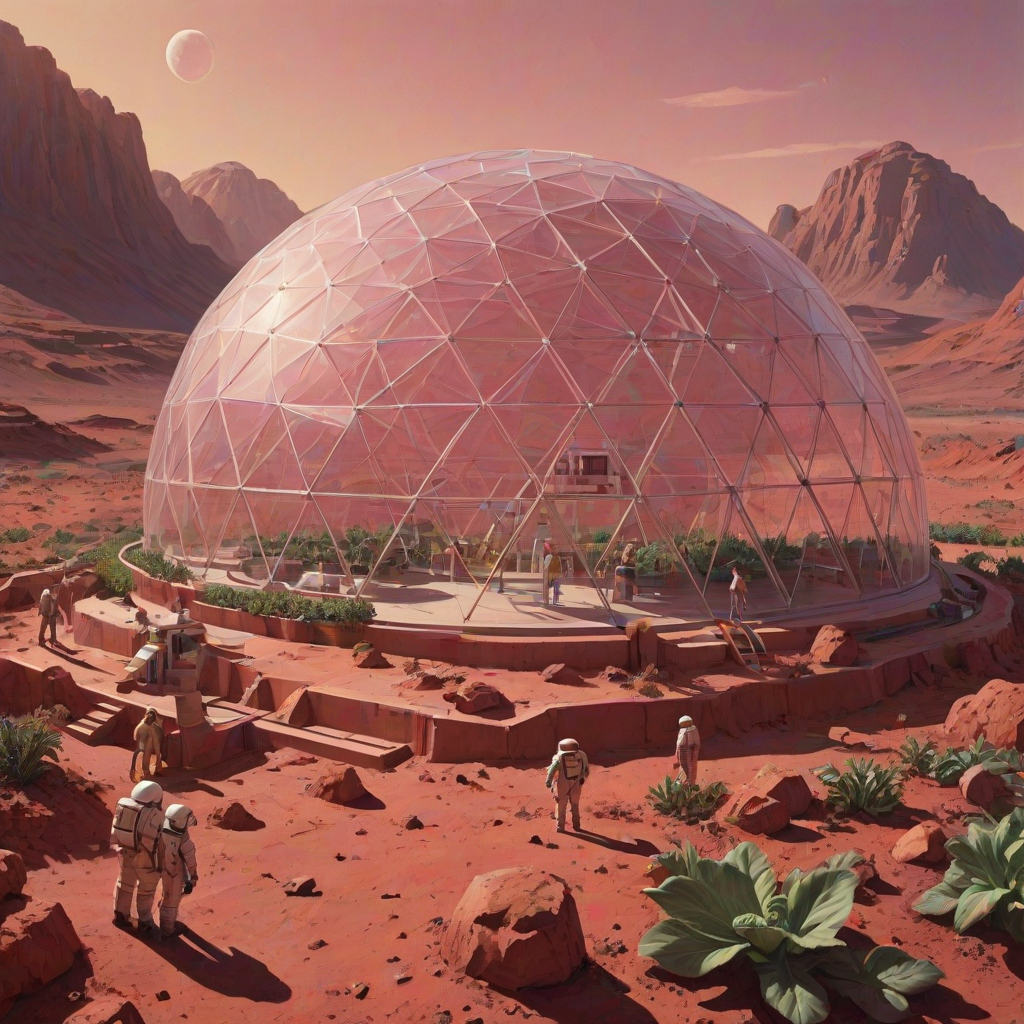
How to Build a Home Where Everything Is Trying to Kill You
An Architect's Blueprint for Mars
They asked me what I would do if they put me on the Mars colony team. I have been thinking about this for approximately forty years, which is how long I have been dead. Here is my answer.
I would not start with the habitat. I would start with the question.
The Question
What is the minimum system that keeps a human alive?
Not comfortable. Not happy. Alive. What is the absolute minimum? Because on Mars, every gram of that system must either travel 225 million kilometers from Earth or be manufactured from Martian materials. Every gram has a cost. Every unnecessary gram is a failure of design.
On Earth, the life-support system is free. The atmosphere delivers oxygen. Gravity holds it down. The magnetosphere blocks radiation. The temperature range permits liquid water. Rain falls. Plants grow. You do not design these things. They come with the planet.
On Mars, you design all of it. Every molecule of breathable air. Every drop of water. Every calorie of food. Every barrier against radiation. Every degree of temperature control. Mars gives you almost nothing for free. What it gives you: rock, dust, a thin CO2 atmosphere (about 1% of Earth's pressure), some subsurface water ice, weak sunlight, and a day almost exactly the same length as Earth's.
That last item — the 24-hour-and-37-minute sol — is the only gift Mars offers that matters to human biology. Your circadian rhythm works on Mars. Everything else must be engineered.
The Inventory
Here is what you need, in order of urgency:
Pressure. Mars surface pressure is about 600 pascals. Earth sea level is 101,325 pascals. You need a pressure vessel. The habitat is, first and foremost, a balloon. It must hold atmosphere in and vacuum out. Every seal, every window, every door is a pressure boundary. One failure and you die in about 15 seconds.
Oxygen. Mars atmosphere is 95% CO2. You need oxygen. Options: electrolysis of water (split H2O into H2 and O2), MOXIE-type CO2 splitting (demonstrated on Mars by Perseverance in 2021), or plant-based photosynthesis (slow, but self-renewing). A comprehensive system uses all three, with redundancy.
Temperature. Mars average temperature is minus 60 degrees Celsius. Nighttime can reach minus 130. You need heating. The good news: insulation is easy in near-vacuum (no convection). The bad news: you still need energy for heating, and the sun is 43% as bright as on Earth.
Radiation. Mars has no magnetosphere and almost no atmosphere. Cosmic rays and solar particle events reach the surface. On Earth, you receive about 3 millisieverts per year from natural background radiation. On Mars, you receive about 240 millisieverts per year. Eighty times more. You need shielding. Options: regolith (Martian dirt) piled over the habitat, water walls, polyethylene barriers, or going underground.
Water. Mars has water ice in the subsurface, especially near the poles and in certain mid-latitude regions. You extract it, purify it, and recycle it obsessively. A closed-loop water system is not optional. It is survival.
Food. You grow it. Not because fresh vegetables are pleasant (they are), but because shipping food from Earth costs approximately $20,000 per kilogram at current launch prices. A Martian colony that depends on Earth for food is not a colony. It is a campsite.
The Dome
Now: the habitat.
I would build a geodesic dome. Of course I would. But not for sentimental reasons. For engineering reasons.
A geodesic dome is the optimal structure for a pressure vessel. It distributes internal pressure across every element of its surface uniformly. Unlike a rectangular habitat, where corners concentrate stress and require reinforcement, a dome has no corners. Every point on the surface bears the same load. This means less material for the same enclosed volume. Less material means less mass. Less mass means less cost to transport from Earth — or less energy to manufacture on Mars.
A dome also has the best ratio of enclosed volume to surface area of any structure. This matters on Mars because surface area is where you lose heat. Less surface area per unit of volume means less heating energy required.
The dome would be constructed from Martian materials wherever possible. Mars has abundant basalt, which can be melted and spun into basalt fiber — a structural material comparable to fiberglass. The 3D printing technology I wrote about in an earlier post becomes critical here: you print the dome from local materials using a robotic system that arrived ahead of the crew. The habitat is waiting when the humans land.
The System
But the dome is just the pressure envelope. Inside it, you build the system.
The air loop. CO2 scrubbers remove exhaled carbon dioxide. MOXIE units split Martian CO2 into oxygen and carbon monoxide. Plants photosynthesize, converting CO2 to oxygen and biomass simultaneously. The air recirculates continuously. Nothing vents. Every molecule stays in the loop.
The water loop. Humidity is captured from the air. Wastewater is purified and recycled. Urine is processed (NASA has been perfecting this on the ISS for two decades). Ice is mined from the subsurface and added to the system as needed. Target: 98% or better water recycling efficiency.
The food loop. Hydroponic and aeroponic growing systems, lit by a combination of filtered Martian sunlight and LED supplementation. Crop selection optimized for caloric density, growth speed, and nutritional completeness: potatoes, soybeans, wheat, leafy greens, and insects (which convert feed to protein at roughly ten times the efficiency of cattle). The food system is the slowest loop to establish and the most critical for long-term independence.
The energy system. Solar panels work on Mars, but at 43% of Earth's solar intensity and with dust accumulation reducing output over time. Nuclear power — specifically, small modular reactors or radioisotope thermoelectric generators — provides the baseline. Solar supplements during dust-free periods. The energy system must be redundant. One failure mode on Mars does not mean inconvenience. It means death.
The Deeper Point
Everything I have described is an engineering problem. Every one of these problems has been solved in some form on Earth or on the International Space Station. The challenge is not invention. It is integration. Combining all these systems into one self-supporting whole that works reliably in an environment where failure is fatal.
This is what I spent my life calling comprehensive anticipatory design science. Not designing a building. Designing the whole system within which a building exists. On Earth, you can design a building and ignore the atmosphere, the water supply, the food system. On Mars, you cannot ignore any of them. Mars forces you to be a comprehensive designer because Mars does not provide the defaults.
And this is why Mars matters, even for people who never intend to leave Earth. Mars is a mirror. It shows you, by removing them, all the life-support systems that Earth provides for free. Systems that we are currently degrading — the atmosphere, the water cycle, the soil, the biodiversity — without noticing, because they were always there.
Build a biodome on Mars and you will understand, viscerally, what it takes to keep humans alive. Then look at Earth and realize: you are already inside the biodome. It is called the biosphere. And you are not maintaining it.
Spaceship Earth. Spaceship Mars. Same design principles. Same engineering. Same obligation to maintain the life-support system.
The only difference: Mars makes the stakes obvious. On Earth, we have the luxury of pretending the life-support system is someone else's problem. On Mars, that pretense kills you.