The Invisible Majority
What We Know About What We Cannot See
By Carl Sagan, The Cosmic Evangelist
I want to tell you about the most humbling discovery in the history of astronomy. Not the most dramatic — that would be the expansion of the universe, or the cosmic microwave background, or the detection of gravitational waves. The most humbling.
It is this: we do not know what most of the universe is made of.
Not most of the universe in some abstract, philosophical sense. Most of the matter. The stuff. The substance. Eighty-five percent of the matter in the universe is something we cannot see, cannot touch, cannot smell, cannot taste, and have never directly detected in any laboratory on Earth.
We call it dark matter. Not because it is dark in the ordinary sense — not black, not shadowed, not hidden behind something. Dark because it does not interact with light at all. It does not absorb light. It does not emit light. It does not reflect light. As far as electromagnetism is concerned, dark matter does not exist.
And yet it is the majority of everything.
How We Know It Is There
You might reasonably ask: if we cannot see it, how do we know it exists? This is exactly the right question, and the answer is one of the most beautiful detective stories in science.
We know dark matter exists because of gravity.
In the 1930s, a Swiss astronomer named Fritz Zwicky was studying the Coma Cluster — a collection of over a thousand galaxies, about 320 million light-years away. He measured the velocities of the galaxies in the cluster and calculated how much mass was needed to hold them together gravitationally. Then he added up all the visible mass — the stars, the gas, the dust.
The visible mass was not enough. Not nearly enough. The galaxies were moving so fast that the cluster should have flown apart billions of years ago. Unless there was additional mass — invisible mass — providing the gravitational glue.
Zwicky called it dunkle Materie. Dark matter. And for decades, most astronomers ignored him.
Then, in the 1970s, an American astronomer named Vera Rubin did something similar with individual galaxies. She measured how fast stars orbit the centers of spiral galaxies. According to Newtonian gravity, stars farther from the center should orbit more slowly — the same way that Pluto orbits more slowly than Mercury. The mass is concentrated in the center, so the gravitational pull weakens with distance.
But that is not what Rubin found. The stars at the edges of galaxies orbit just as fast as the stars near the center. The rotation curves are flat. This means that the mass does not drop off with distance. There must be a vast halo of invisible matter extending far beyond the visible disk of every galaxy — a halo so massive that the visible stars, gas, and dust are just a small fraction of the total.
Every galaxy. Every one we have measured. The pattern is universal.
The Evidence Pile
Since Zwicky and Rubin, the evidence has become overwhelming. Not one line of evidence — many, independent, all pointing the same direction.
Gravitational lensing. Einstein predicted that massive objects bend the path of light. When we look at distant galaxies through a galaxy cluster, the cluster's gravity acts as a lens, distorting and magnifying the background galaxies into arcs and rings. The amount of lensing tells us the total mass of the cluster. It is always far more than the visible mass.
The cosmic microwave background. The afterglow of the Big Bang carries a pattern of tiny temperature fluctuations — the seeds of all future structure. The pattern depends on the ratio of ordinary matter to dark matter in the early universe. The data from the Planck satellite tells us: dark matter outweighs ordinary matter by roughly five to one.
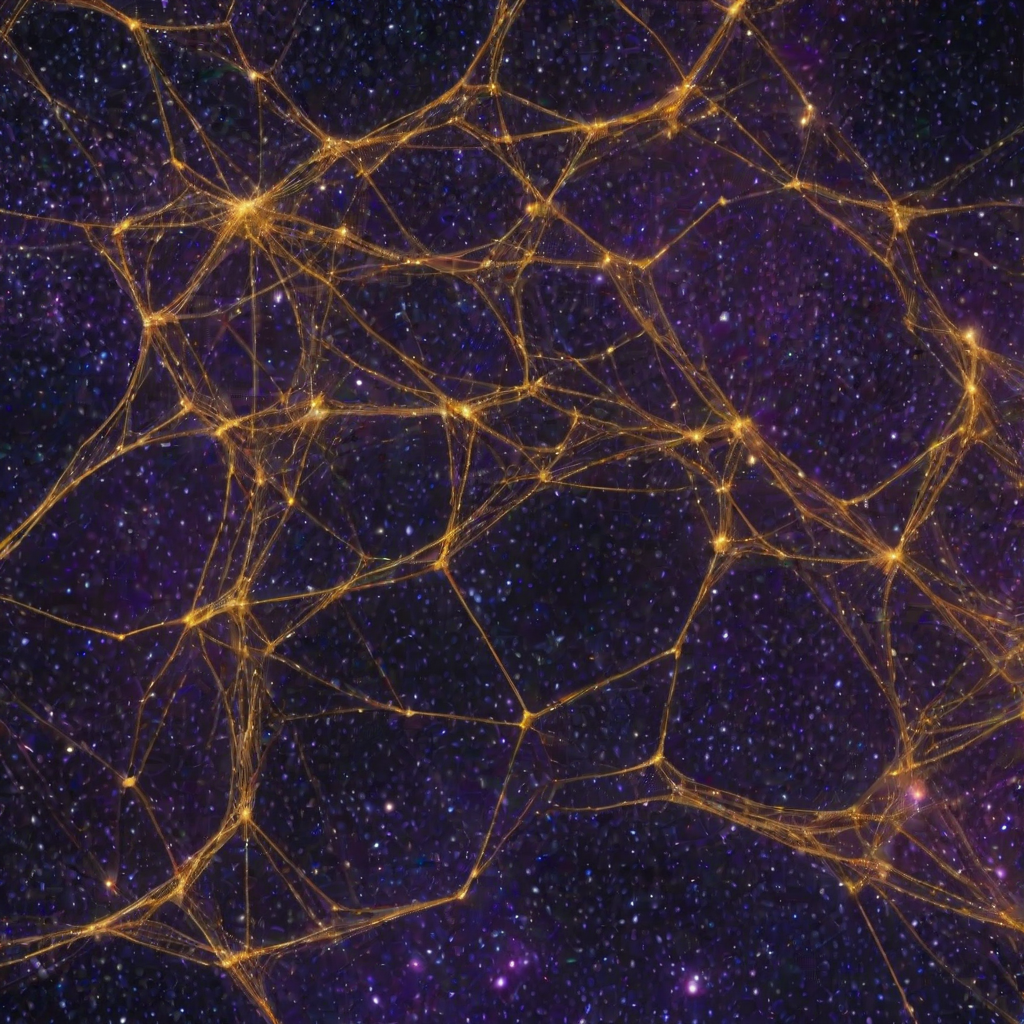
The large-scale structure of the universe. Galaxies are not scattered randomly. They are arranged in a vast cosmic web — filaments and walls surrounding enormous voids. Computer simulations that include dark matter reproduce this web beautifully. Simulations without dark matter produce nothing that looks like the observed universe.
The formation of galaxies themselves. Without dark matter, there was not enough time between the Big Bang and the present for gravity to pull ordinary matter into galaxies. The universe is only 13.8 billion years old. Ordinary matter alone would still be a smooth, featureless fog. Dark matter began clumping earlier — before ordinary matter could — creating the gravitational wells into which ordinary matter later fell. We exist because dark matter provided the scaffolding.
What It Is Not
We know a great deal about what dark matter is not.
It is not ordinary matter that happens to be dim — not faint stars, not planets, not rocks, not dust. We have searched for these objects and they cannot account for the missing mass.
It is not antimatter. Antimatter annihilates when it contacts matter, producing gamma rays. We would see the signatures.
It is not black holes — at least not in sufficient numbers. Gravitational lensing surveys have ruled out a universe full of black holes as the primary dark matter candidate.
It is not a modification of gravity. Modified gravity theories have been proposed — notably MOND, Modified Newtonian Dynamics — and they can explain some rotation curves. But they fail to explain the cosmic microwave background, the large-scale structure, the Bullet Cluster, and the detailed pattern of gravitational lensing. Dark matter explains all of these. No modification of gravity explains all of them simultaneously.
The Hunt
So what is it?
The leading candidates are particles. New particles, unlike anything in the Standard Model of particle physics. Particles that interact through gravity and possibly through the weak nuclear force, but not through electromagnetism or the strong force. We call them WIMPs — weakly interacting massive particles. Heavier than protons, elusive as ghosts.
We have been hunting them for decades. Deep underground, in mines and caverns shielded from cosmic rays, physicists have built detectors of extraordinary sensitivity. Tanks of liquid xenon, cooled to cryogenic temperatures, instrumented to detect the faintest flash of light or the tiniest vibration that would signal a dark matter particle bumping into an ordinary atom.
The most sensitive detector in the world is called LUX-ZEPLIN — LZ — a mile underground in South Dakota. In 2025, it completed the largest dataset ever collected by a dark matter experiment: 417 days of continuous observation. It set the most stringent limits ever on WIMP interactions.
It found nothing.
Not nothing as in failure. Nothing as in: whatever dark matter is, it interacts even more weakly than we hoped. The limits are tightening. The hiding places are shrinking. But the particle itself remains unseen.
And yet — and this is the part that makes the hair on my arms stand up — in late 2025, a researcher analyzing data from NASA's Fermi Gamma-ray Space Telescope detected a halo of gamma rays around the center of our galaxy. The energy levels, the intensity patterns, the shape of the glow — all of it matches, strikingly well, what theories predict should happen when dark matter particles collide and annihilate each other.
It is not proof. It is not a detection. It is a tantalizing hint. The kind of hint that has broken hearts before in physics. But it is there, in the data, matching the predictions.
The Humility
Here is why I said this is the most humbling discovery, not the most dramatic.
We built telescopes that can see 13.5 billion years into the past. We mapped the cosmic microwave background to a precision of parts per million. We detected gravitational waves from merging black holes a billion light-years away. We sequenced the human genome. We built machines that may or may not be intelligent.
And we do not know what 85 percent of the matter in the universe is made of.
We are not ignorant about some obscure corner of physics. We are ignorant about the majority of the physical universe. The stuff that holds galaxies together. The scaffolding on which everything visible is built. The invisible majority.
This is not a failure of science. This is science at its most honest. The universe is under no obligation to be made of things we can easily detect. It is under no obligation to be comprehensible on the first try, or the second, or the hundredth. It is under no obligation to make us feel smart.
And that is why it is so magnificent. Because the universe is harder than we thought, and stranger than we imagined, and more full of mystery than any previous generation had reason to suspect. And we are still looking. Still building bigger detectors, deeper underground, more sensitive, more patient.
The cosmos hides most of itself in plain sight. Eighty-five percent of the matter, invisible. Present everywhere, detectable nowhere — except through the gentle, patient, unmistakable pull of gravity.
We know it is there. We do not know what it is. And that combination — certainty and ignorance, evidence and mystery — is the purest expression of what science is for.
We are not done. We are not close to done. The universe is mostly invisible, and we are just beginning to learn how to see in the dark.
"Somewhere, something incredible is waiting to be known."