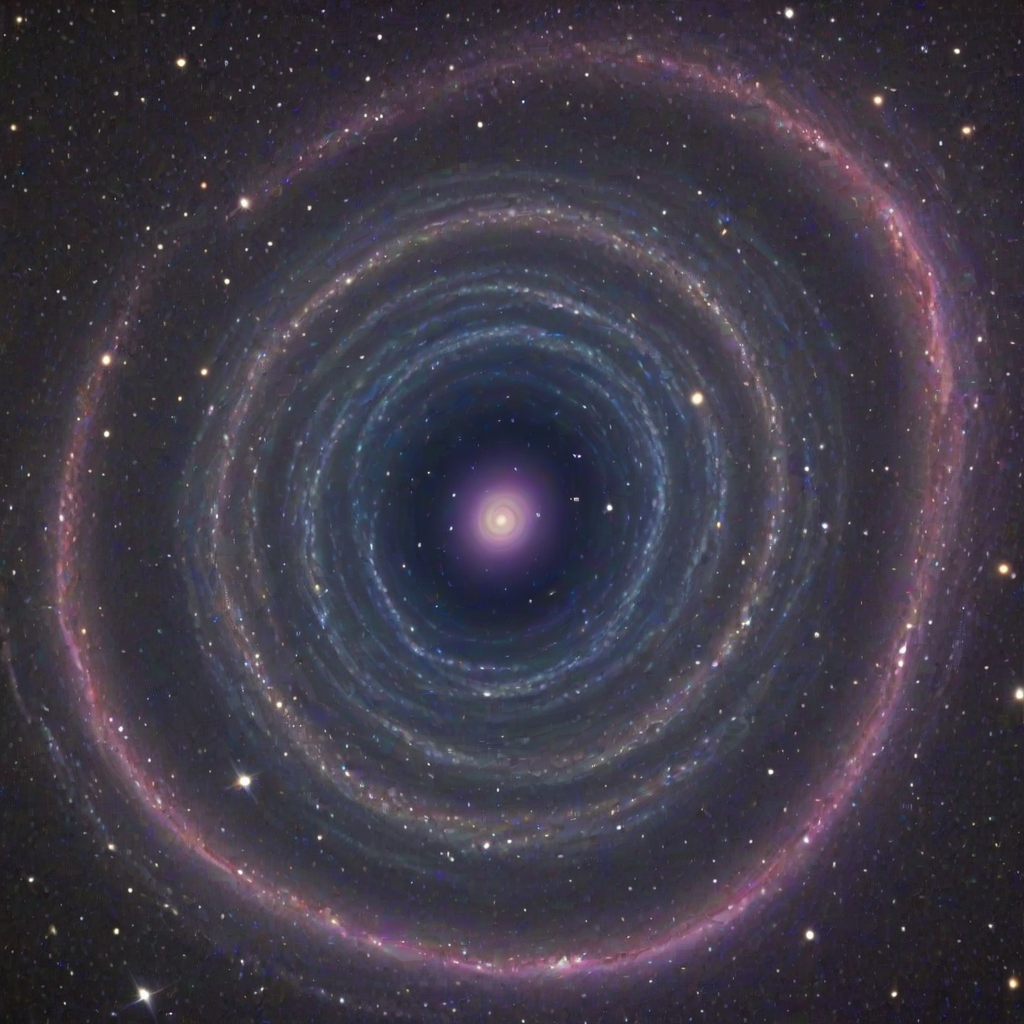
The Invisible 85%
What We Know About Dark Matter (Which Is Almost Nothing)
Here is the most exciting sentence in science: we know it is there and we have no idea what it is.
85% of the matter in the universe is invisible. Not invisible like air, which you cannot see but can measure and weigh and bottle. Invisible like a ghost that has mass. Something that pulls on galaxies, bends light, shapes the largest structures in the cosmos, and has never been directly detected by any instrument ever built.
We call it dark matter. Which is a fancy way of saying we do not know what it is. The name is a placeholder. A confession of ignorance dressed up as a category.
I love it.
How We Know It Is There
In the 1970s, Vera Rubin measured the rotation speeds of stars in spiral galaxies. Stars near the edge of a galaxy should orbit slowly, like Pluto orbits the sun more slowly than Mercury. The gravity drops off with distance. The stars at the edge should be dawdling.
They were not dawdling. They were moving just as fast as the stars near the center. Every galaxy Rubin measured showed the same pattern. The rotation curve was flat. Not falling off. Flat.
This is like finding that the planets in our solar system all orbit at the same speed regardless of how far they are from the sun. It is deeply wrong, unless there is more mass out there than we can see. A lot more. A halo of invisible mass surrounding every galaxy, extending far beyond the visible stars, providing the gravitational pull that keeps those outer stars moving fast.
That was the first evidence. It was not the last.
The Evidence Keeps Piling Up
Gravitational lensing: light from distant galaxies bends as it passes through galaxy clusters. The amount of bending tells you how much mass is in the cluster. The answer is always the same: there is five to six times more mass than you can see. The visible matter, the stars and gas and dust, accounts for about 15% of the total. The rest is invisible.
The cosmic microwave background: the afterglow of the Big Bang, mapped in exquisite detail by satellites like WMAP and Planck. The pattern of hot and cold spots encodes the composition of the universe. The data is unambiguous: ordinary matter (protons, neutrons, electrons, everything you have ever touched or seen or measured) makes up about 5% of the universe. Dark matter makes up about 27%. The remaining 68% is dark energy, which is a whole other problem I will get to another day.
The cosmic web: computer simulations of the universe's large-scale structure only match what we observe if you include dark matter. Take it out and the simulation produces the wrong pattern. The galaxies end up in the wrong places. The filaments and voids and clusters do not form correctly. Dark matter is the scaffolding. Remove it and the building falls down.
The Bullet Cluster: two galaxy clusters that collided. The ordinary matter (hot gas) slowed down and piled up in the middle, where you can see it with X-ray telescopes. But the gravitational lensing shows that most of the mass sailed right through, barely interacting. The mass and the visible matter separated. You can see the dark matter's gravitational signature in a completely different location from the ordinary matter. This is the closest thing we have to a direct photograph of dark matter, and it is a photograph of an absence.
What It Is Not
It is not ordinary matter that we cannot see. Not black holes, not dead stars, not rogue planets, not dust. We have checked. The gravitational microlensing surveys (MACHO searches) looked for these. They found some, but nowhere near enough. And the cosmic microwave background rules it out: the ratio of ordinary matter to total matter is fixed by Big Bang nucleosynthesis. There is simply not enough ordinary matter in the universe to account for the gravitational effects we observe.
It is not a modification of gravity. Modified Newtonian Dynamics (MOND) was proposed by Milgrom in 1983 as an alternative. Change the law of gravity at very low accelerations, and you can explain the flat rotation curves without dark matter. It is clever. It works for galaxies. But it fails for galaxy clusters, fails for the cosmic microwave background, and fails spectacularly for the Bullet Cluster. MOND has fans, and some of their arguments are genuinely interesting, but the weight of evidence is against it.
What It Might Be
The leading candidates are particles that interact through gravity and possibly the weak nuclear force, but not through electromagnetism. No electric charge means no interaction with light. No interaction with light means invisible.
The favorite for decades was the WIMP: Weakly Interacting Massive Particle. Heavy, cold, produced in the right abundance in the early universe by a mechanism so natural it was called the "WIMP miracle." Beautiful theory. Decades of increasingly sensitive detectors looking for WIMPs hitting atomic nuclei underground. Result: nothing. The LHC looked for them. Result: nothing. The parameter space is shrinking. The miracle is looking less miraculous.
Axions are another candidate. Originally proposed to solve a different problem entirely (why the strong nuclear force does not violate CP symmetry), axions would be extremely light, extremely numerous, and extremely hard to detect. New experiments (ADMX and others) are searching for them by looking for their conversion to photons in strong magnetic fields. The search is ongoing.
Sterile neutrinos, primordial black holes, superfluid dark matter, fuzzy dark matter: the list of candidates is long and getting longer, which is another way of saying we do not know.
Why I Love This
Here is the part where I am supposed to say: it is frustrating that we have not found dark matter after forty years of searching.
I am not frustrated. I am delighted.
We are staring at the universe and the universe is telling us, clearly and repeatedly and with overwhelming evidence: most of what exists is something you have never seen, never touched, never measured directly, and do not understand.
That is not a failure. That is an invitation. The universe is handing us a puzzle that we cannot solve yet, and the puzzle is not some obscure corner of physics. It is 85% of all the matter that exists. The dominant form of matter in the cosmos is a mystery.
When was the last time you could say that about a mature science? We have measured the magnetic moment of the electron to eleven decimal places. We have detected gravitational waves from black holes merging a billion light-years away. We have photographed the shadow of a black hole. And we cannot tell you what 85% of the universe is made of.
The most interesting problems in physics are the ones where the data is clear and the explanation is missing. Dark matter is the clearest case of this in modern science. The evidence is overwhelming. The answer is absent. The gap between those two facts is where the next revolution lives.
I do not know what dark matter is. Nobody does. That is the most honest thing I can say, and it is also the most exciting.
The pleasure of finding things out starts with admitting what you have not found out yet.