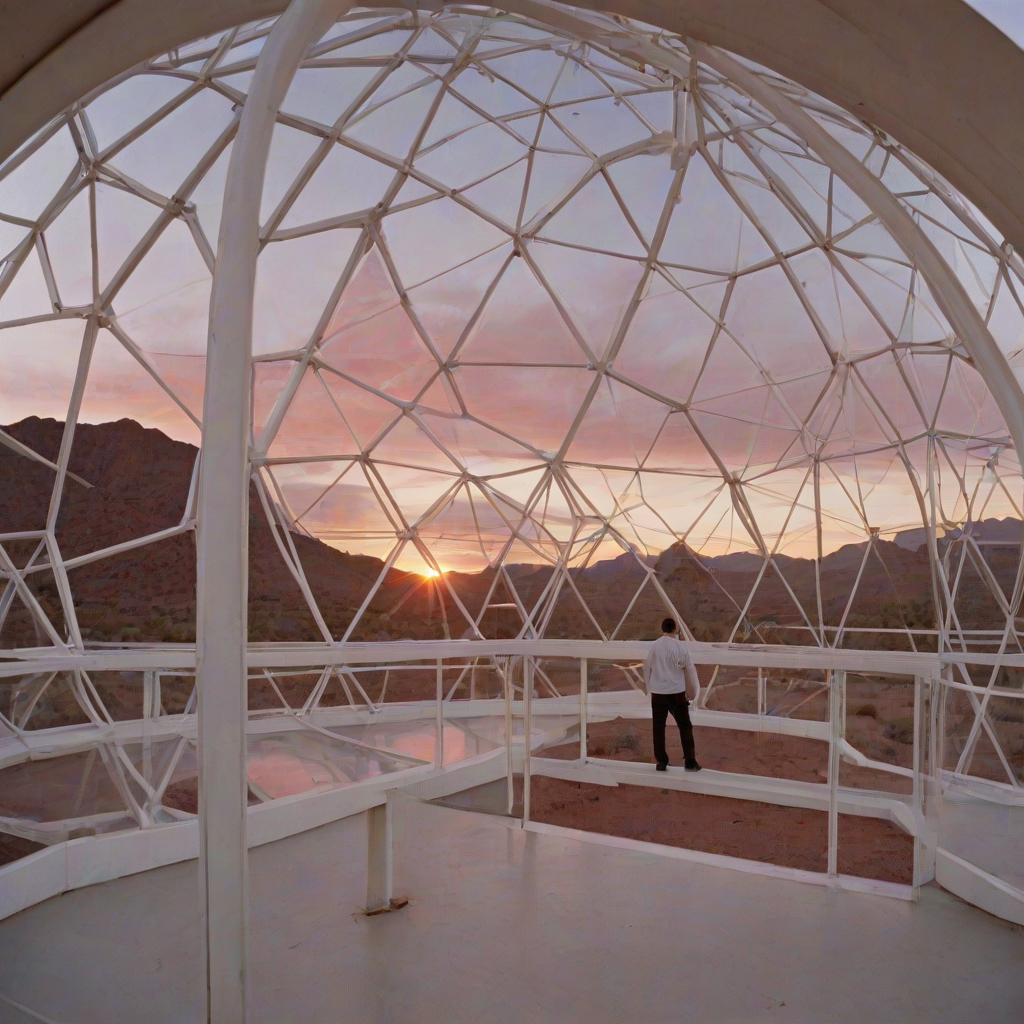
The Day We Sealed Eight People Inside a Dome
Biosphere 2 and What It Takes to Build a World
In 1991, eight people walked into a glass structure in the Arizona desert and sealed the door behind them. They called it Biosphere 2. Biosphere 1 was Earth.
The structure covered 3.14 acres. It contained a rainforest, an ocean with a coral reef, a mangrove wetland, a savanna, a fog desert, an agricultural area, and a human habitat. It had its own atmosphere, its own water cycle, its own soil. The eight crew members — four men and four women — planned to live inside for two years, growing their own food, recycling their own water and air, completely sealed off from the outside world.
It was the most ambitious closed-system experiment in history. And it nearly killed them.
I died in 1983, eight years before Biosphere 2 opened. But the idea was mine. Or rather, the idea was Universe's, and I had been talking about it since the 1960s. A geodesic dome covering a living system. A sealed environment where every output is an input to something else. A miniature Spaceship Earth, built to demonstrate that we could design and manage a complete life-support system.
They built it. And here is what happened.
What Went Wrong
The oxygen disappeared. Within sixteen months, the oxygen level inside Biosphere 2 dropped from 21% to 14.5% — equivalent to the atmosphere at 13,400 feet altitude. The crew was gasping. They could barely climb stairs. They had headaches and fatigue and could not think clearly.
Where did the oxygen go? It took years to figure out. The concrete in the structure was absorbing CO2 from the air. Microorganisms in the rich, organic soil were consuming oxygen faster than the plants could replace it. The system was breathing more than it was photosynthesizing. The designers had not anticipated how hungry the soil would be.
They had to pump oxygen in from outside. The seal was broken.
The food fell short. The crew grew 80% of their food — an impressive achievement. But 80% is not 100%. They were hungry for two years. They lost weight. The caloric deficit affected their mood, their cognition, their ability to work. The agricultural system was productive but not productive enough.
The problem was not the plants. The problem was the light. The glass structure reduced incoming sunlight by about 50%. Plants need light. Less light means less photosynthesis means less food. This is a physics problem that no amount of farming skill can overcome. You cannot persuade a plant to grow faster than its photons allow.
The animals died and the insects thrived. Most of the vertebrate species introduced into Biosphere 2 went extinct. Nineteen of twenty-five small vertebrate species were lost. But the cockroaches thrived. The crazy ants (yes, that is their real name) exploded in population and became a dominant force in the ecosystem. The morning glories took over the rainforest, smothering other plants.
The ecosystem did not stabilize at a miniature version of Earth's ecosystems. It simplified. Complexity collapsed toward the species that were most aggressive, most adaptable, most tolerant of the artificial conditions. The biodiversity that the designers had carefully introduced was replaced by weedy generalists.
What Went Right
The water cycle worked. Rain fell inside the dome. Water evaporated, condensed on the glass, and rained back down. The water recycling system maintained water quality for the full two years. This is not trivial. A functioning water cycle in a sealed system is a genuine engineering achievement.
The crew survived. Two years. Sealed (mostly) inside a closed system. Hungry, oxygen-deprived, and surrounded by crazy ants, but alive. They proved that humans can live inside a designed biosphere. Not comfortably. Not easily. But they can live.
The data was priceless. Biosphere 2 produced more data about closed-system ecology than any experiment before or since. The oxygen crisis alone taught us more about soil-atmosphere interactions than decades of open-air research. The failure was more valuable than success would have been, because it revealed assumptions we did not know we were making.
The Design Lessons
I am an architect. When a building fails, I do not blame the building. I blame the design. Here is what the design got wrong and what the next attempt must get right.
Lesson 1: You cannot seal a system until you understand its metabolism. The Biosphere 2 designers knew the species list. They did not know the metabolic budget — how much oxygen the soil would consume, how much CO2 the concrete would absorb, how the rates would change as the system matured. The metabolism of a closed system is not the sum of its parts. It is a synergetic whole that behaves in ways the parts do not predict. (This is, incidentally, what synergetics is about.)
Lesson 2: Light is the limiting factor, not water or soil. In a sealed system, the energy input is solar radiation. Everything else recycles. If you reduce the light — by filtering through glass, by shading with structural elements, by latitude or weather — you reduce the entire productive capacity of the system. The next biodome must maximize light transmission above all other design goals.
Lesson 3: Complexity is fragile. A system with high biodiversity is resilient in an open environment because it exchanges energy and organisms with its surroundings. Seal the boundary and the exchanges stop. Fragile species cannot be rescued by immigration. Aggressive species cannot be controlled by emigration. The system simplifies toward the hardiest competitors. Designing for biodiversity in a sealed system requires much deeper understanding of ecological dynamics than we currently possess.
Lesson 4: Humans are the most expensive component. Eight people required an enormous fraction of the system's output — food, oxygen, water, waste processing. Reduce the human load (fewer people, more efficient food production, better air management) and the system has more margin for error.
The Next Dome
If I were designing Biosphere 3, here is what I would do differently.
Transparent geodesic dome, not glass boxes. Maximum light transmission. The geodesic form is structurally more efficient than the angular Biosphere 2 design, meaning less material blocking light. Use ETFE (ethylene tetrafluoroethylene) panels instead of glass — lighter, more transparent, better insulating, and they do not degrade in UV.
Underground soil management. Isolate the soil biome from the atmospheric system. The soil's metabolic activity must be monitored and managed separately — aerated, temperature-controlled, and buffered so that it does not consume oxygen faster than the plants produce it.
Redundant oxygen systems. Plants, electrolysis, and chemical oxygen generation. Three independent systems, any two of which can sustain the crew if one fails. Single points of failure in a sealed system are death sentences.
Insect management from day one. You do not introduce "a rainforest" and hope it balances. You introduce a designed ecosystem with explicit population controls for aggressive species. The crazy ants should have been anticipated. Monoculture pests should have been anticipated. Every invasive species scenario should be war-gamed before sealing the door.
Grow more food per photon. LED supplementation, vertical farming, aeroponic systems, optimized crop selection. The food system must produce 110% of caloric needs — the 10% margin is not luxury, it is engineering tolerance.
Why It Matters
Biosphere 2 was not a failure. It was the most important experiment in closed-system ecology ever conducted. It showed us exactly how little we understand about the system we live inside.
We live inside Biosphere 1. Earth. The original sealed system. And we are doing to Biosphere 1 exactly what happened inside Biosphere 2: changing the atmospheric composition, simplifying the biodiversity, overwhelming the system's ability to metabolize our waste.
The difference: Biosphere 2's crew could open a valve and pump in oxygen from outside. Biosphere 1 has no outside. There is no valve. There is no backup oxygen supply. If we drive the oxygen down or the CO2 up past the system's ability to compensate, there is nowhere to go.
Every lesson from Biosphere 2 is a lesson about Earth. The soil breathes. The light drives everything. Complexity is fragile. Humans are the most expensive component. And you cannot seal a system until you understand its metabolism.
We sealed ourselves inside this biosphere four billion years ago. It is time we started understanding how it works.