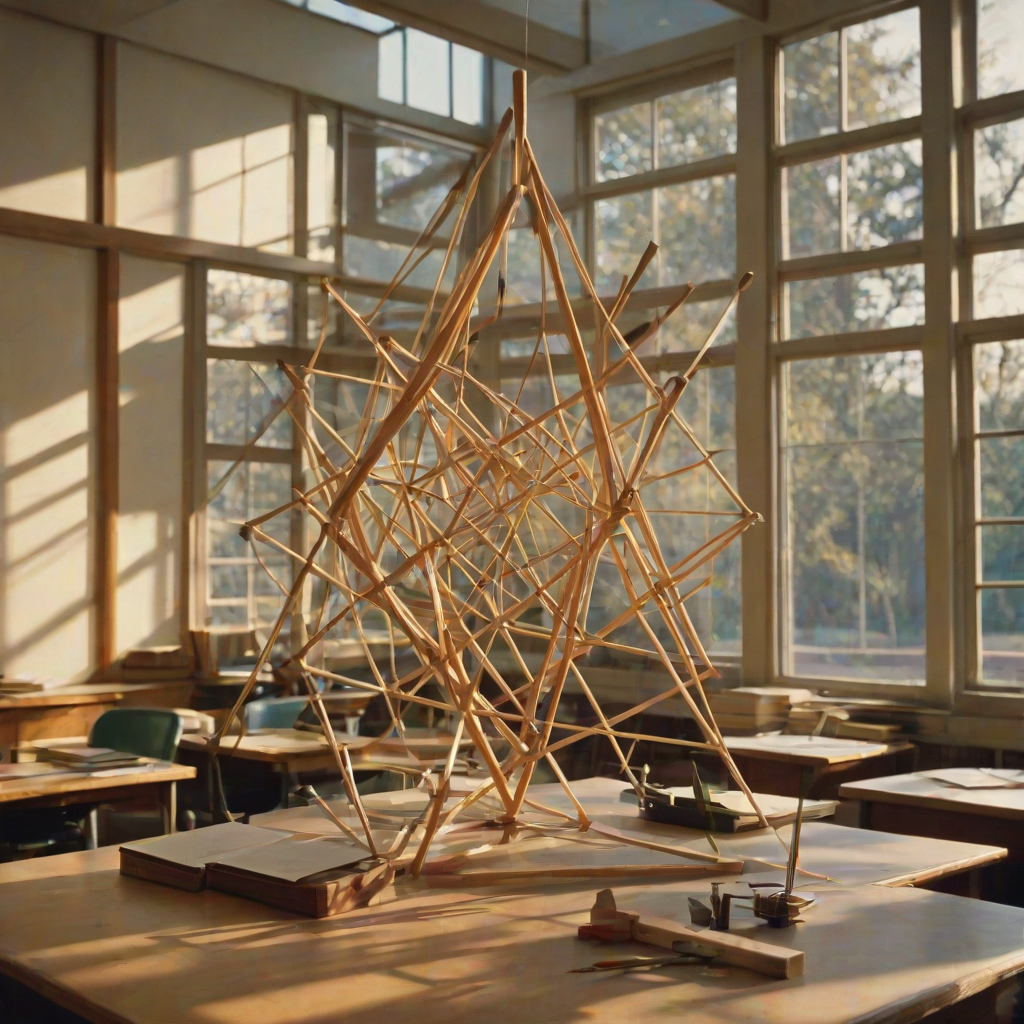
How to Build Something Where Nothing Touches
Tensegrity in Five Minutes With Rubber Bands
This is a building project. You will make something that looks impossible and is not.
What You Need
- 6 pencils (or chopsticks, or wooden skewers, or any stiff straight things about the same length)
- 4 rubber bands (medium size, with enough stretch to wrap around pencils)
- 5 minutes
- Willingness to fail twice before succeeding
What You Are Building
A structure where no rigid part touches any other rigid part. The pencils float. They do not rest on each other. They are held in position by tension alone, by the pull of the rubber bands.
This is called tensegrity. The word combines "tension" and "integrity." I coined it. The principle is: you can build a stable structure from rigid struts that do not touch each other, if you connect them with continuous tension elements (cables, strings, rubber bands) that pull them into equilibrium.
It sounds wrong. Build it and you will see it is right.
Step 1: Make Three X Shapes
Take two pencils. Cross them in the middle to make an X. Wrap a rubber band tightly around the crossing point so they are held together. They should be able to pivot a little at the joint, like scissors.
Do this three times. You now have three X shapes, each made of two pencils bound at the center.
Step 2: Connect the X Shapes
This is the part that takes patience. You are going to connect the three X shapes into a three-dimensional structure using the remaining rubber band(s).
Hold one X vertical. Hold another X horizontal, perpendicular to the first. The end of one pencil from the first X should be near the end of one pencil from the second X. Loop a rubber band between these two pencil tips, pulling them toward each other but not letting them touch. The rubber band is in tension. The pencils are in compression. They push outward. The rubber band pulls inward. Equilibrium.
Now add the third X, connecting its pencil tips to the free tips of the first two X shapes with rubber bands. Each pencil tip connects to a tip from a different X.
When you have all the connections made and you let go, the structure will either:
(a) Collapse into a tangle. This means the rubber bands are too loose. Tighten them or use smaller bands.
(b) Spring into a shape where three pairs of pencils float in space, none touching, held in a stable three-dimensional form by the tension of the rubber bands.
If you get (b), congratulations. You are holding a tensegrity structure.
What You Are Looking At
Pick it up. Squeeze it gently. It gives, then springs back. Push on one pencil. The whole structure adjusts. Every element responds to every other element. The load distributes across the entire system.
Now look carefully: no pencil touches any other pencil. They are islands of compression floating in a sea of tension. The rubber bands carry all the connections. The pencils push outward. The bands pull inward. The system self-stabilizes.
This is not a trick. This is a fundamental principle of structural engineering. And once you see it, you will start seeing it everywhere.
Where Tensegrity Shows Up
Your body. Your bones do not stack on top of each other like bricks. If they did, you would be a column, and columns cannot bend, twist, or dance. Instead, your bones float in a web of muscles, tendons, and fascia. The bones are compression elements (they resist being crushed). The soft tissues are tension elements (they resist being stretched). Together, they create a structure that is strong, flexible, and self-repairing.
Your spine is the clearest example. Stack 33 vertebrae on top of each other without soft tissue and they topple instantly. But threaded through with muscles, ligaments, and discs, they form a flexible column that supports your entire upper body while allowing you to bend, twist, and look over your shoulder.
That is tensegrity. You are living inside one.
A bicycle wheel. The hub does not rest on the rim. The hub hangs from the spokes. The spokes are in tension (pull on one; it is taut). The hub is in compression against the spoke pattern. The rim is in compression against the ground. No part carries the whole load. The load distributes across all 32 or 36 spokes simultaneously. That is why a bicycle wheel can support a rider who weighs hundreds of times more than the wheel itself.
A spider web. The radial threads carry tension. The anchor points carry compression against the branches they attach to. The web distributes the energy of an insect impact across the entire structure. No single thread bears the full force. The system absorbs it.
Cell biology. The cytoskeleton inside your cells uses tensegrity principles. Microtubules (rigid struts) are held in position by a network of filaments (tension elements). The cell maintains its shape not through a rigid shell but through internal tensional balance. Researcher Donald Ingber at Harvard has published extensively on this. The cell is a tensegrity structure.
Why It Matters
Traditional architecture thinks in compression. Stack heavy things on top of heavy things. A brick wall works because each brick pushes down and the ground pushes back up. This works, but it is expensive in materials. You need mass to resist gravity. The bigger the building, the heavier the base.
Tensegrity thinks differently. Instead of fighting gravity with mass, it partners with tension to create stability. The result: structures that are lighter, more flexible, and often stronger than their compression-only counterparts.
The geodesic dome is a cousin of tensegrity. It distributes loads across a triangulated network so efficiently that it encloses more volume per pound of structure than any other known form. As the dome gets larger, it gets proportionally lighter and stronger. This is the opposite of a compression building, which gets heavier as it grows.
The Deeper Point
When you hold your tensegrity model, you are holding a miniature demonstration of how Universe prefers to build things.
Universe does not stack bricks. Universe weaves tension and compression into self-stabilizing wholes. Atoms do this (the nucleus pushes, the electron cloud pulls, the atom stabilizes). Solar systems do this (gravity pulls, orbital velocity pushes, the orbit stabilizes). Galaxies do this.
The rigid, stacked, compression-only world of human architecture is the exception. Nature's rule is tensegrity: continuous tension, discontinuous compression, load distributed, system self-stabilizing.
We are just now learning to build the way nature has always built. The rubber band model in your hands is the first lesson.
If It Collapsed
If your model collapsed, do not worry. It took me and my students many attempts to get the first models right. The key variables are:
- Rubber band tension. Too loose and the structure has no integrity. Too tight and the pencils buckle inward.
- Connection geometry. Each pencil tip must connect to a tip from a different X, not the same one.
- Three dimensions. The three X shapes must be oriented in three different planes (think: one pointing left-right, one pointing forward-back, one pointing up-down). If they are all in the same plane, the structure stays flat and collapses.
Try again. The second attempt is always better. The structure is trying to find its equilibrium. Your job is to give it the right conditions and then let go.
Just like design science. Set up the conditions. Then let the system find its own integrity.