A Quarter Ton vs. 175,000 Tons
The Weight of Doing More With Less
In 1956, the first transatlantic telephone cable went into service. It was called TAT-1, and it could carry 36 simultaneous telephone calls between North America and Europe.
It required 1,500 nautical miles of cable. The cable contained copper conductors, insulation, and repeater amplifiers mounted every 37 nautical miles on the ocean floor. The total weight of the system was approximately 175,000 tons.
Thirty-six phone calls. 175,000 tons.
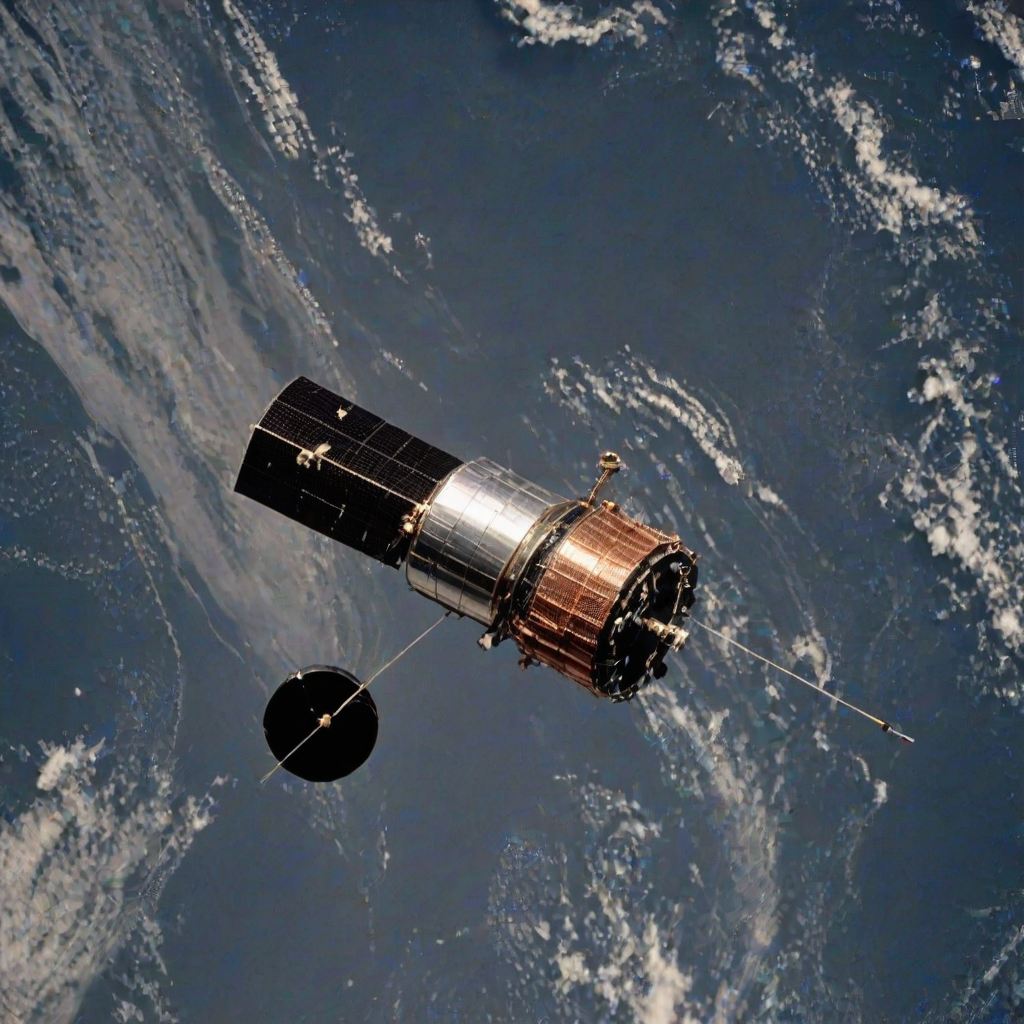
In 1962, Telstar 1 went into orbit. It was the first active communications satellite. It weighed 170 pounds. It could relay television signals, telephone calls, and data across the Atlantic at the speed of light.
By the time communications satellites matured in the 1970s, a single satellite weighing roughly a quarter of a ton (about 500 pounds) could handle thousands of simultaneous telephone calls, plus television, plus data.
A quarter of a ton outperforming 175,000 tons.
That is a weight ratio of 700,000 to 1. Seven hundred thousand to one. The satellite does not do slightly more with slightly less. It does enormously more with almost nothing.
The Word for This
I coined a word for this phenomenon: ephemeralization.
Ephemeralization means doing more and more with less and less, until eventually you can do everything with nothing.
That last part sounds like a joke. It is not. It is the observable trajectory of every technology humans have ever developed. And understanding it changes how you think about the future.
The Pattern
Look at any technology over time and you will see the same pattern.
Computing. In 1946, ENIAC weighed 30 tons, filled a room, and could perform about 5,000 calculations per second. Your smartphone weighs 6 ounces and performs billions of calculations per second. That is ephemeralization. Same function, less material, more performance.
Lighting. A candle converts about 0.04% of its chemical energy into visible light. An incandescent bulb converts about 2%. An LED converts about 50%. Same function (photons hitting your retina), dramatically less energy wasted. The light is getting cheaper while the darkness stays the same price.
Agriculture. In 1900, one American farmer fed about 7 people. By 1950, one farmer fed about 15. Today, one farmer feeds over 150. Same number of hands. Same basic biology. Better knowledge, better tools, better seeds, better systems. More food from less labor.
Communication. A letter carried by ship in 1800 took weeks to cross the Atlantic and carried a few hundred words. A fiber optic cable in 2026 carries billions of words per second at the speed of light. The weight of communication per word has dropped by a factor that is difficult to express without scientific notation.
The pattern is universal. In every domain. In every era. We learn to do more with less.
Why This Matters for the Future
Here is why ephemeralization is the most important concept most people have never heard of.
The pessimists say: we are running out of resources. The population is growing. The planet is finite. Eventually we hit the wall.
The pessimists are correct about the planet being finite. They are incorrect about hitting the wall. Because they are measuring the wrong thing.
They are measuring the tonnage of raw materials. They should be measuring the performance per ton. And performance per ton has been rising exponentially for centuries.
We do not need more copper to make more phone calls. We eliminated the copper. We do not need more steel to enclose more space. The geodesic dome encloses more volume per pound of structure than any building ever conceived. We do not need more farmland to grow more food. We need better knowledge applied to the same farmland.
The question is never "do we have enough stuff?" The question is "have we learned enough to do what we need with the stuff we have?"
And the answer, decade after decade, century after century, is: we keep learning more.
The Malthus Error
Thomas Malthus predicted in 1798 that population growth would outstrip food production, leading to mass starvation. He was a good mathematician working with bad assumptions.
His assumption: the productivity of a farm is fixed. A given acre produces a given amount of food. More people, same acres, therefore starvation.
His error: he did not account for ephemeralization. Crop yields per acre have increased by a factor of four to ten since Malthus wrote, depending on the crop. The acres did not change. The knowledge did.
Malthus measured resources. He should have measured resourcefulness.
This is the error that repeats in every generation. Someone counts the physical stuff, projects a straight line, and predicts catastrophe. Then technology does more with less, the line curves upward, and the catastrophe does not arrive. Not because we got lucky. Because we got smarter.
The Catch
Now: I am not saying that everything is fine. Everything is not fine. Ephemeralization is a trend, not a guarantee. We must actively choose to apply it.
We could use our increasing technological capability to make weapons instead of livingry (my word for the opposite of weaponry). We could use it to enrich a few instead of providing for all. We could burn through resources faster than we learn to replace them.
The trajectory of technology points toward doing everything with nothing. But trajectories can be redirected. A rocket aimed at the moon can be aimed at a city instead.
The choice is ours. And the choice is urgent. Because we now have enough technological capability to make the world work for 100% of humanity without ecological offense or the disadvantage of anyone. The satellite proved it: the resources are adequate. The design intelligence exists. The question is whether we will apply it to livingry or to weaponry.
That question is not technical. It is political. And it is the most important question alive.
The Number to Remember
700,000 to 1. That is the weight ratio between the transatlantic cable and the satellite that replaced it. Write it on your wall. Whenever someone tells you we are running out of something, remember that number. We are not running out. We are learning to need less. The trajectory is clear. The only question is whether we choose to ride it.