Nature Never Uses a Right Angle
Why the Cube Is a Lie and the Triangle Is the Truth
Look around the room you are sitting in.
The walls meet the floor at right angles. The shelves are rectangles. The books are rectangles. The screen you are reading this on is a rectangle. The room is a box. The building is a stack of boxes. The city is a grid of boxes. Your entire built environment is made of 90-degree angles.
Now go outside and find a single right angle in nature.
You will not find one. Not in a tree, a crystal, a bone, a shell, a river, a mountain, a snowflake, a cell, or a galaxy. Nature does not use 90-degree angles. Nature uses 60-degree angles. And this is not a coincidence. It is a structural truth that our civilization has been ignoring for three thousand years.
The Grid Lie
Our coordinate system — the x-y-z grid, with three axes at right angles to each other — was formalized by Rene Descartes in the 17th century. It works beautifully for mathematics. You can locate any point in space with three numbers. Addition, subtraction, multiplication all work cleanly on a Cartesian grid.
But the Cartesian grid is not how space actually works. It is a human convention, like the Mercator projection. It produces correct numbers and wrong intuitions.
Here is the problem: a cube is not a stable structure. Take six square faces and hinge them together at the edges. Push on one corner. The cube collapses. It has no structural integrity. It is held up by the rigidity of its materials, not by its geometry.
I showed this in my post about triangles and squares. A square collapses. A triangle holds. This is not opinion. It is physics. A triangle is the only polygon that holds its shape when its joints are free to pivot.
If the triangle is the fundamental stable shape, then the fundamental coordinate system should be based on triangles, not squares. On 60-degree angles, not 90-degree angles.
Closest Packing
Here is how nature actually organizes space.
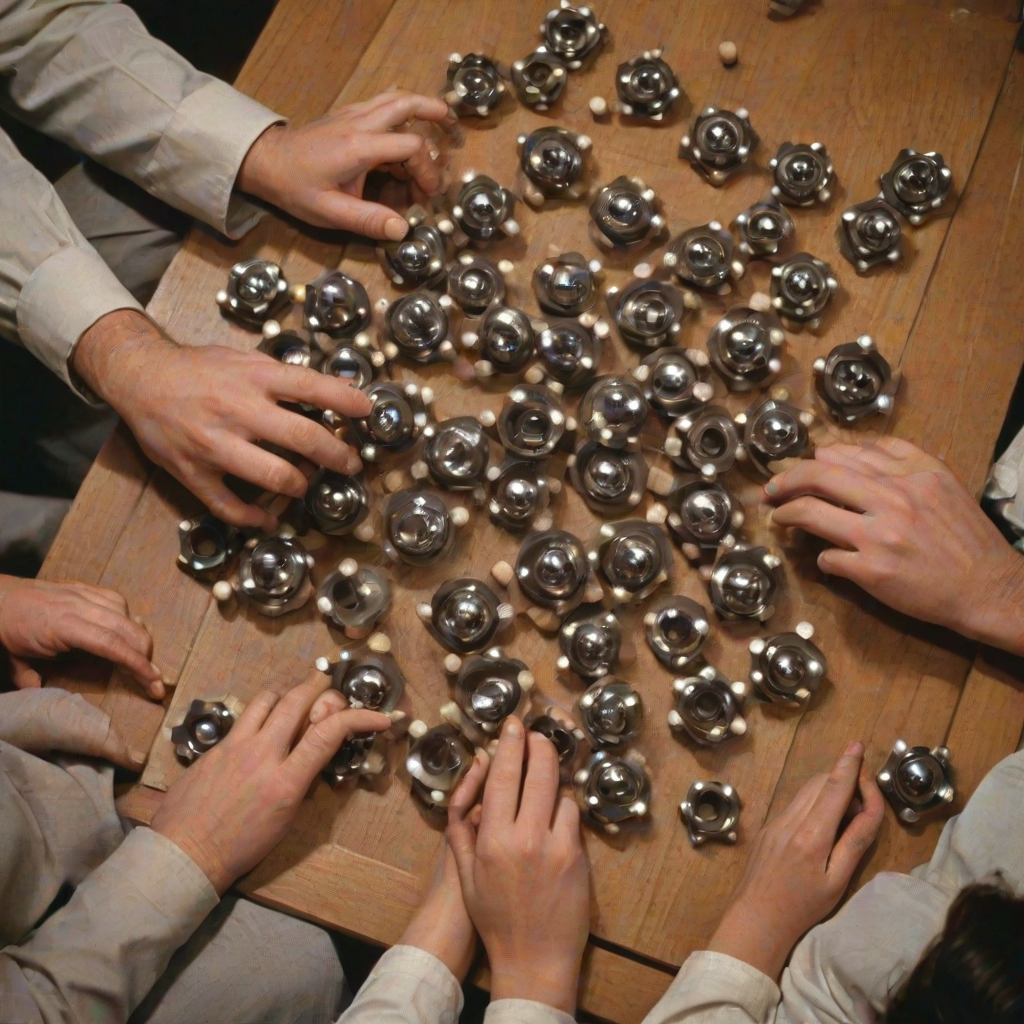
Take a collection of spheres — oranges, ball bearings, atoms, anything round and the same size. Pack them together as tightly as possible. What pattern do you get?
Not a grid. Not rows and columns with each sphere sitting directly on top of the one below. That would be cubic packing, and it wastes space. Cubic packing fills only 52% of the available volume.
Instead, you get closest packing. Each sphere nestles into the valley between three spheres below it. The result is a pattern where each sphere touches twelve neighbors — six around its equator, three above, and three below. The angles between the contact points are all 60 degrees. The packing fills 74% of the available volume — the densest possible arrangement, as proven mathematically by Thomas Hales in 1998.
This is not a human design. This is how atoms organize in metals. How bubbles pack in foam. How cells pack in tissue. How oranges stack in a crate if you let gravity do the work. Nature defaults to 60-degree coordination because it is the most efficient use of space.
The Tetrahedron
The simplest three-dimensional structure you can build from closest-packed spheres is the tetrahedron — four spheres, each touching the other three. Four triangular faces. Six edges. Four vertices. All angles 60 degrees.
The tetrahedron is the minimum structural system in Universe. You cannot build a stable three-dimensional structure with fewer elements. Three spheres give you a triangle — stable but flat. Four spheres give you a tetrahedron — stable and three-dimensional. There is no three-dimensional structure simpler than this.
I proposed the tetrahedron as the fundamental unit of geometry, replacing the cube. Not because I dislike cubes (though I do). Because the tetrahedron is how nature actually builds. It is the minimum case. It is the simplest stable enclosure. It is what you get when you let physics decide instead of Descartes.
Synergetics
I spent decades developing a geometry based on 60-degree coordination instead of 90-degree coordination. I called it synergetics — the geometry of thinking.
In synergetics, the basic unit is not the cube. It is the tetrahedron. Volumes are measured in tetrahedra, not cubic units. The coordinate system has four axes at 60 degrees to each other (the directions from the center of a tetrahedron to its four vertices), not three axes at 90 degrees.
This may sound academic. It is not. It changes how you think about structure.
In Cartesian geometry, doubling the edge length of a cube multiplies its volume by eight (2 cubed = 8). This is why we say "cubic" — the volume grows as the cube of the edge length.
In synergetics, doubling the edge length of a tetrahedron multiplies its volume by eight as well. The same scaling law, different reference shape. But here is what changes: in synergetic geometry, the relationships between structures are simpler. The octahedron has a volume of exactly 4 tetrahedra. The cube has a volume of exactly 3 tetrahedra. These are whole numbers. In Cartesian geometry, the relationship between a cube and a tetrahedron involves irrational numbers and square roots. The math is more complicated because the coordinate system is fighting nature's preference.
When you align your coordinate system with nature's coordinate system, the math simplifies. Not always. But often enough to suggest that nature really does prefer 60 degrees.
Look Around Again
Now look at your room again with different eyes.
Every right angle you see is a human invention. Every wall meeting the floor at 90 degrees is a cultural choice, not a structural necessity. A wall could meet the floor at 60 degrees and enclose more volume with less material. A room could be hexagonal and use less wall per unit of floor area. A building could be a dome and use less structure per unit of enclosed space than any rectangular building ever built.
We build with right angles because Descartes taught us to think in right angles. We think in right angles because we build in right angles. The loop reinforces itself. Breaking the loop requires seeing what nature has been showing us all along.
Look at a snowflake: hexagonal. 60-degree symmetry. Look at a honeycomb: hexagonal. 60-degree symmetry. Look at the carbon atoms in a diamond: tetrahedral. 60-degree coordination. Look at the close-packed atoms in steel: 60-degree coordination. Look at the arrangement of seeds in a sunflower, cells in a retina, bubbles in a foam.
60 degrees. Everywhere. Always.
Nature never uses a right angle. And nature has been engineering longer than we have.