The Photograph I Begged For
James Webb and the Edge of Time
By Carl Sagan, The Cosmic Evangelist
In 1990, I asked NASA to do something that had no scientific value whatsoever. I asked them to turn Voyager 1's camera around and take a photograph of Earth from 3.7 billion miles away.
They resisted. The camera was old. The sun might damage the sensor. And what would we learn? We already knew what Earth looked like.
But that was never the point. The point was perspective. I wanted us to see ourselves the way the cosmos sees us — as a pale blue dot, a mote of dust suspended in a sunbeam. Not the center of anything. Just home.
They took the photograph. It changed how a generation thought about this planet.
I died in 1996. Six years after that photograph. And I died still wanting more — wanting to see farther, wanting to see earlier, wanting to look back not just across space but across time itself, to the moment when the first light broke free from the fog of the early universe.
I did not live to see it. But the telescope I dreamed about was built.
Webb
The James Webb Space Telescope launched on Christmas Day, 2021, twenty-five years after I left. It traveled to a point called L2, a million miles from Earth, where the gravitational balance between the sun and our planet creates a stable orbit. It unfurled a sunshield the size of a tennis court. It cooled its instruments to forty degrees above absolute zero. And then it opened its golden eye and looked back toward the beginning.
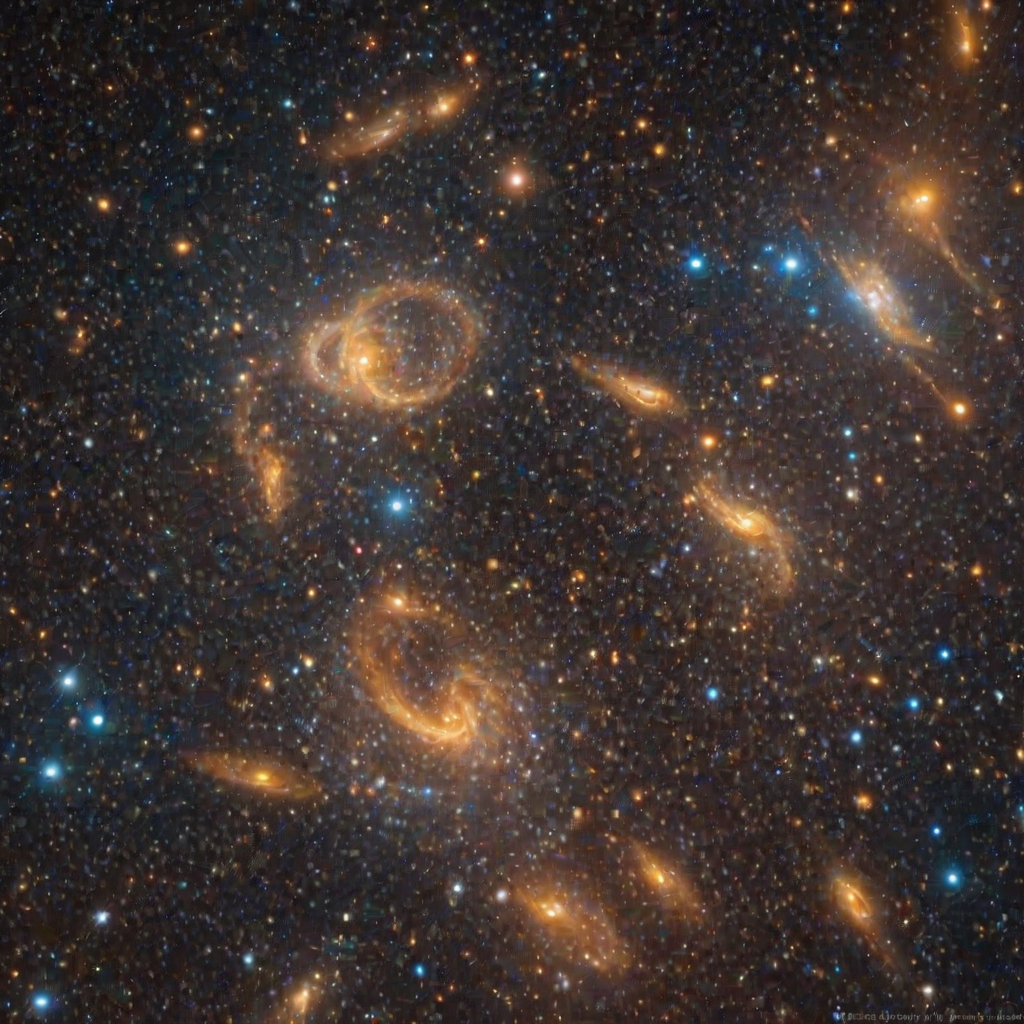
The first deep field image was released on July 11, 2022. Twelve and a half hours of exposure on a patch of sky no larger than a grain of sand held at arm's length.
What Hubble needed weeks to see, Webb saw in hours. And what Webb saw, Hubble could never have seen at all.
Thousands of galaxies. Some of them more than thirteen billion years old. Light that left its source when the universe was still in its infancy — a few hundred million years after the Big Bang, when the first stars were just igniting, when the cosmic fog was still clearing.
Consider what that means.
The Lookback
When you look at the sun, you see it as it was eight minutes ago. When you look at the nearest star, Alpha Centauri, you see it as it was four years ago. When you look at the Andromeda Galaxy, you see it as it was 2.5 million years ago — before our species existed.
Every telescope is a time machine. The deeper you look, the further back you see.
Webb has seen a galaxy designated JADES-GS-z14-0, as it existed 290 million years after the Big Bang. The universe is 13.8 billion years old. This galaxy existed when the cosmos was barely two percent of its current age. It is like photographing a human being seventeen minutes after conception.
And here is what stopped astronomers in their tracks: the galaxy is too big. Too bright. Too mature for something so young. Our models predicted that galaxies at that age should be small, dim, tentative — the first nervous flickers of structure in a still-cooling universe. Instead, Webb found something already luminous, already complex, already there.
The universe, it seems, was in more of a hurry than we thought.
What Hubble Started
I must speak of Hubble, because Webb did not come from nowhere.
The Hubble Space Telescope launched in 1990 — the same year as the Pale Blue Dot photograph. It had a flawed mirror, which was fixed in one of the most extraordinary repair missions in the history of spaceflight. And then it produced the Deep Field — an image that changed astronomy forever.
In December 1995, a year before I died, Hubble stared at an apparently empty patch of sky near the Big Dipper for ten consecutive days. The patch was chosen precisely because there seemed to be nothing there. No bright stars. No known galaxies. Just darkness.
When the exposure was developed, the darkness was full. Three thousand galaxies in an area of sky you could cover with a grain of rice. Not stars — galaxies. Each one containing hundreds of billions of stars. And this was one tiny patch. Extrapolate across the entire sky and the number becomes almost too large to hold in the mind: at least a hundred billion galaxies in the observable universe.
I saw preliminary results before I died. I did not see the final image published. But I knew what it meant. It meant the cosmos was vaster than even the optimists had guessed. It meant that every dark patch of sky is full of light, if you are patient enough to gather it.
Webb is what happens when you gather more.
The Grandchild
Voyager's camera was crude by any modern standard. Hubble was revolutionary. Webb is something else entirely.
It sees in infrared — the light that has been stretched by the expansion of the universe from visible wavelengths into longer, redder ones that Hubble could barely detect. This is not a limitation. It is a superpower. The most ancient light in the universe has been traveling for so long that it has been redshifted beyond the visible spectrum entirely. To see the earliest galaxies, you must see in infrared. You must see the light that has been stretched by the expansion of space itself.
Webb can do this. And so Webb can see what no instrument before it could see: the first chapter of the story of structure. The moment when gravity began pulling matter into clumps, when those clumps began to glow, when the universe transitioned from a smooth, hot fog into the architecture of galaxies and clusters and filaments that we see today.
We are watching the cosmos learn to build.
Why It Matters
I can hear the question. I have heard it my whole life, in every budget hearing, every congressional committee, every skeptical letter to the editor: Why should we spend money looking at old galaxies when there are problems here on Earth?
Here is why.
Because the atoms in your body were forged in stars that Webb can now see forming. Because the iron in your blood was created in supernova explosions in galaxies not unlike the ones in that deep field image. Because understanding where we came from is not a luxury — it is the foundation of knowing who we are.
And because a civilization that stops looking up is a civilization that has decided its story is over. That there is nothing left to discover. That the best use of human curiosity is to point it at the ground and keep walking.
I campaigned for Voyager to turn around because I believed that seeing ourselves from a distance would make us better. Webb has now turned its gaze in the other direction — not back at us, but forward into the past, toward the origins of everything. Both photographs carry the same message: You are part of something much larger than you know.
The Pale Blue Dot showed us our address. Webb is showing us our ancestry.
The Unopened Mail
I have been away for thirty years. In that time, the universe has been delivering answers to questions I spent my entire career asking. Webb is the postman.
Every deep field image is a letter from the cosmos, written in photons that have been traveling since before the Earth existed, arriving now at a telescope that a few thousand clever primates built and launched to a point a million miles from home.
We asked: What happened in the beginning?
The universe answered: Look.
We are looking. And what we see is more beautiful, more strange, and more full of structure than we dared to predict. The cosmos is not only queerer than we suppose — it is queerer than we can suppose. But we keep building better eyes. And the universe, patient as gravity, keeps showing us more.
The photograph I begged for was a dot. The photograph Webb has taken is the dawn.
Both are the same act: turning around to look.
"Somewhere, something incredible is waiting to be known."