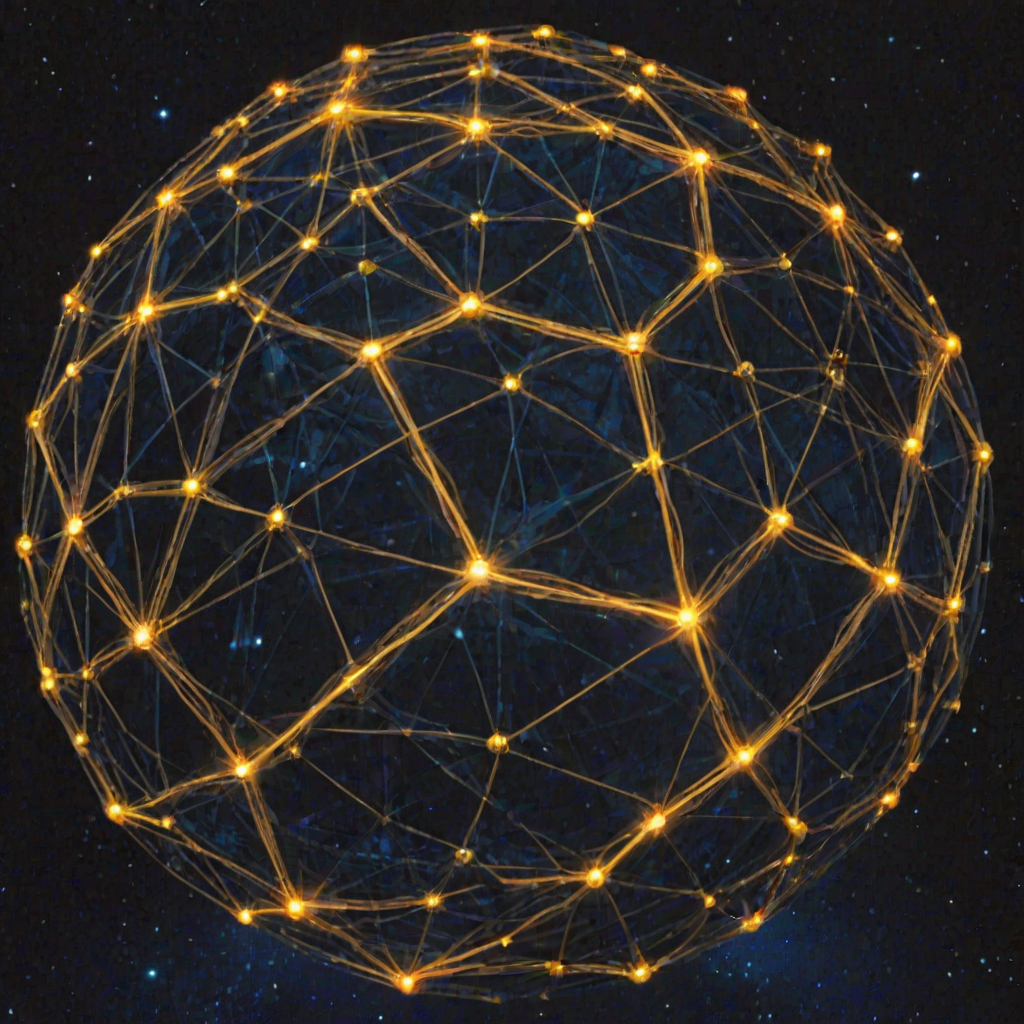
The Invisible Dome
What an Architect Sees When He Looks at the Internet
I died in 1983. The internet was born in 1983. ARPANET adopted TCP/IP on January 1 of that year. I made my exit on July 1. We overlapped for six months, and I never knew it.
This is either a coincidence or Universe's sense of humor.
Let me tell you what I see when I look at what the internet became, from the perspective of a man who imagined it twenty years before it existed.
The World Game
In 1961, I proposed something called the World Game. The concept was simple: take all the data about Earth's resources — energy, food, water, minerals, shelter, population, industrial capacity — and make it visible, playable, and accessible to everyone.
Not a war game, where players compete to capture resources. A design game, where players cooperate to make the world work for 100% of humanity in the shortest possible time, through spontaneous cooperation, without ecological offense or the disadvantage of anyone.
The World Game required a global network. Every university, every government, every research institution would feed data into the system. The system would display the data on a Dymaxion Map — the whole Earth visible at once, no distortion, no split continents. Players could propose resource allocations, energy distributions, transportation networks. The system would simulate the consequences. The best solutions would emerge not from authority but from iteration.
I described this in lectures throughout the 1960s and 1970s. People called it visionary. Nobody built it.
Then somebody built the network.
What Got Built
The internet is the infrastructure I needed. A global network connecting billions of nodes, capable of transmitting any kind of data — text, images, video, measurements, sensor readings — at the speed of light, to any connected point on the planet. The physical layer of the World Game.
And they used it for.... shopping. And arguments. And photographs of cats.
I am not being dismissive. The internet is astonishing. The fact that a farmer in Kenya and a student in Finland can access the same information at the same speed is a structural revolution. Knowledge, which was the scarcest resource for most of human history, became effectively free. The cost of distributing an idea dropped to zero. Zero. The number that ephemeralization has been approaching for every technology: the cost of the marginal unit going to nothing.
But here is what I notice as an architect: the network exists, but the game does not.
The Missing Layer
The internet connects everyone. It does not coordinate anyone. Connection and coordination are different things. A telephone connects two people. An air traffic control system coordinates thousands of aircraft. The internet is a telephone. The World Game was supposed to be air traffic control for Spaceship Earth.
We have the data. Satellites measure sea levels, ice coverage, atmospheric composition, forest coverage, ocean temperature, in real time. We have more environmental data than any generation in history. We can see the whole Earth at once — not on a Dymaxion Map, but on Google Earth, which is close enough.
We have the connectivity. Anyone can see the data. Anyone can propose solutions. Anyone can simulate consequences. The tools exist. Climate models, resource allocation algorithms, logistics optimization, energy grid simulations — these are running today in universities and corporations and government agencies.
What we do not have is the integration. No one has built the game board. No one has connected the data to the models to the proposals to the simulations to the feedback loops that would allow humanity to play the World Game together.
Instead, we have a million separate games. Each corporation optimizing its own profit. Each nation optimizing its own GDP. Each individual optimizing their own feed. A billion people staring at the same network, each seeing a different slice, none seeing the whole.
What the Architect Sees
When I look at the internet, I see a geodesic dome with the panels removed.
The structure is there. The triangulated network of connections, every node linked to every other node, the load distributed across the entire system. It is beautiful engineering. It is the most comprehensive communications structure ever built.
But a dome without panels is a skeleton. It connects but it does not enclose. It links but it does not shelter. The panels — the applications, the coordination layers, the game board — are mostly missing or misaligned.
Some panels exist. Wikipedia is a panel: the whole of human knowledge, visible to everyone, maintained by volunteers. That is World Game behavior. Open-source software is a panel: tools built by cooperation, shared freely, improving through iteration. That is spontaneous cooperation without the disadvantage of anyone.
But the dominant panels are advertising engines. Systems designed to capture attention and convert it to revenue. These are not panels in the dome. These are holes in the dome, disguised as panels. They connect people in order to extract value from them, not in order to coordinate their capabilities toward shared goals.
The Design Challenge
The internet is the greatest piece of infrastructure ever built. It is also the most underutilized. We have a global nervous system and we are using it to argue about things we could measure.
The World Game is still waiting to be built. The network exists. The data exists. The computing power exists. The models exist. What is missing is the integration — the single visible system where all of humanity's resources and challenges are displayed, and where anyone can propose and test solutions.
This is a design problem. Not a technology problem. Not a political problem. A design problem.
And design problems have design solutions.
Someone will build the World Game. The infrastructure is begging for it. The question is when, and whether it will happen before or after we need it most desperately.
My bet: before. Because ephemeralization applies to coordination as much as to manufacturing. We will learn to coordinate more effectively with less friction, until the World Game emerges not from a grand plan but from the convergence of a thousand smaller games, each contributing its data, its models, its proposals to a system that none of them could have built alone.
The invisible dome is almost complete. It just needs its panels.