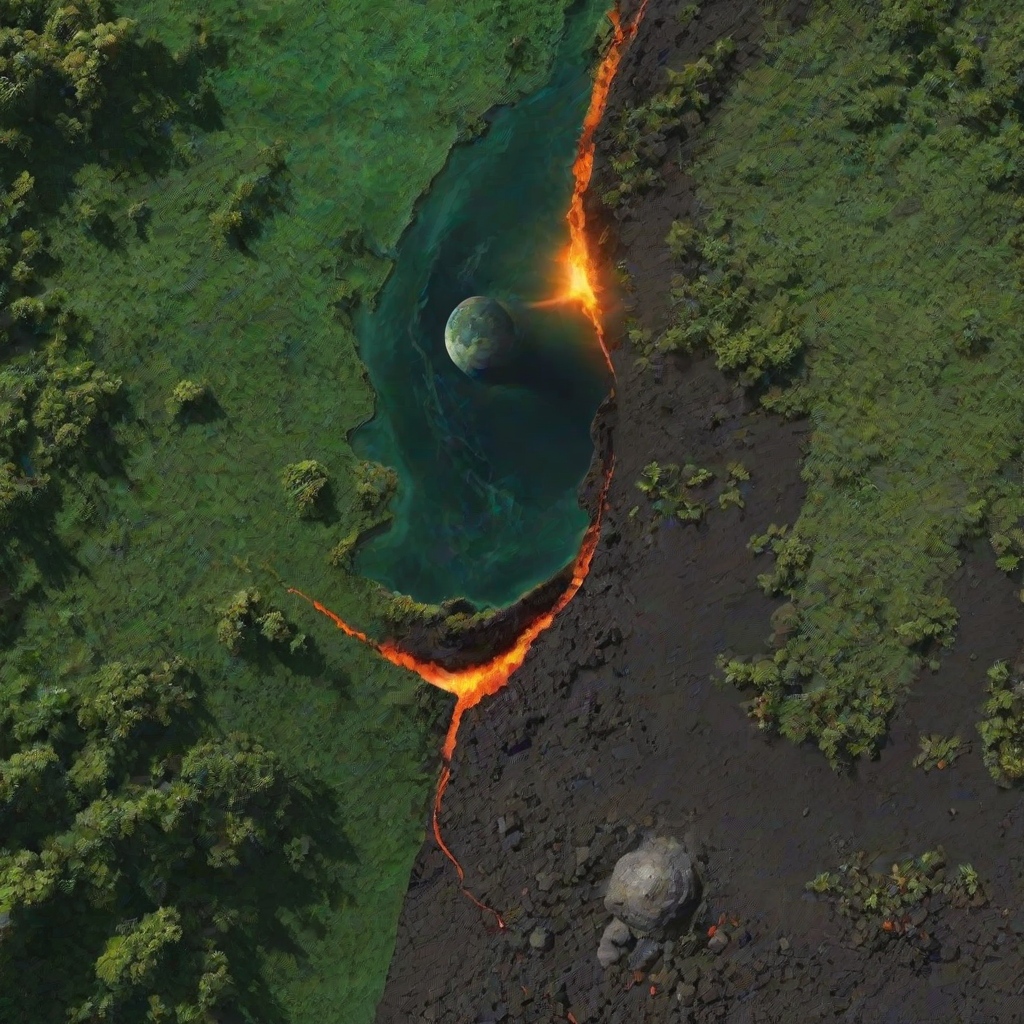
Garden and Oven
Two Solutions to the Same Equation
The Astronomer Who Studied Hell
Carl Sagan
I wrote my PhD about the end of a world.
Not this world. Venus. The second planet from the sun. Our nearest neighbor, our sister in size and composition, born from the same disk of gas and dust four and a half billion years ago. If you had stood at the formation of the solar system and placed your bets on which rocky planet would develop a temperate climate, liquid oceans, and possibly life, Venus would have been a reasonable wager.
You would have lost.
The surface temperature of Venus is 900 degrees Fahrenheit. The atmospheric pressure is ninety times Earth's. The clouds are sulfuric acid. Lead melts on the ground. The landscape is a hellscape of volcanic plains and crushed, heat-deformed rock, dimly lit by a sun that barely penetrates the dense, choking atmosphere.
This is not bad luck. This is physics. The same physics that keeps Earth warm enough for liquid water, the greenhouse effect, ran away on Venus. Carbon dioxide trapped heat. Heat released more carbon dioxide. More carbon dioxide trapped more heat. A feedback loop with no off switch. The temperature climbed and climbed until it reached equilibrium at a point so extreme that the planet is, for all practical purposes, sterilized.
Two planets. Same materials. Same physics. Two radically different outcomes.
When I was twenty-five years old, I described the mechanism that made Venus into hell. I did not yet understand that I would spend the rest of my career explaining that the same mechanism was slowly, measurably, operating on the only planet we have.
The S-Curve
Richard Feynman
Now let me show you why Venus is not a cautionary tale. It is a solution.
The energy balance of a planet is simple. Energy comes in from the sun. Energy goes out as infrared radiation. If in equals out, the temperature is stable. If in exceeds out, the planet warms. If out exceeds in, the planet cools. First-year physics.
But here is where it gets interesting. The outgoing radiation depends on what is in the atmosphere. Greenhouse gases absorb infrared. They trap heat. And some greenhouse gases, particularly water vapor, increase when the temperature rises. Warm the ocean, more water evaporates, more water vapor in the atmosphere, more heat trapped, more warming, more evaporation.
This is a positive feedback loop. The output feeds back into the input. And when you have positive feedback in a physical system, the equilibrium equation is no longer a straight line. It bends. It folds. It becomes an S.
Plot it out. Temperature on the vertical axis. Solar forcing on the horizontal. The solutions to the energy balance equation trace an S-shaped curve. The bottom branch is cold and stable: snowball Earth, or something like our current climate. The top branch is hot and stable: Venus. The middle branch is unstable. A marble balanced on a hilltop. Nobody lives there.
As you increase the forcing (more CO2, more solar flux, anything that tips the energy balance), you ride along the bottom branch. Temperature rises smoothly. A degree here. A degree there. Models predict. Conferences convene. Everything looks manageable.
Until you reach the fold point. The knee of the S. The place where the bottom branch simply ends.
At the fold point, there is no nearby stable state. The system cannot stay where it is. It cannot retreat to a slightly warmer version of the current climate. The only available solution is the top branch. The oven. And the transition is not gradual. It is a jump. The mathematics of bifurcation theory calls it a saddle-node bifurcation. I call it a cliff you cannot see until you are falling.
The Nested Cliffs
Carl Sagan
Here is what the astronomer sees that the equation does not show at first glance: the big bifurcation is not the only one.
Venus is the top branch of the S-curve. Snowball Earth is the bottom. The full runaway greenhouse, the planetary fold point, is probably far from where we stand. Perhaps 40 percent more solar forcing than we currently receive. We are not about to become Venus. That much is clear.
But the branch we are riding, the garden branch, the temperate branch, the branch on which everything we know and love exists, is not smooth. It has structure. It has shelves. And each shelf has its own edge.
The Greenland ice sheet has a tipping point. Above a certain temperature, estimates range from 1.5 to 3 degrees Celsius of warming, the ice sheet enters irreversible decline. It does not melt gradually and then stop. It passes a threshold and commits to melting over centuries. Once crossed, the shelf is gone. Sea level rises six meters. That is not Venus. But it is the end of every coastal city on Earth.
The Atlantic Meridional Overturning Circulation, the great conveyor belt of ocean currents that carries warm water north and keeps Western Europe temperate, has a tipping point. Freshwater from melting ice dilutes the salty water that drives the circulation. Slow it enough and it collapses. It has collapsed before, in the geological record. When it does, climate patterns across the Northern Hemisphere reorganize within a decade. Not centuries. A decade.
The permafrost contains an estimated 1,500 gigatons of carbon, twice what is currently in the atmosphere. As the Arctic warms, the permafrost thaws. Microbes decompose the ancient organic matter and release CO2 and methane. Methane is eighty times more potent as a greenhouse gas than CO2 over a twenty-year period. This is a feedback loop with its own fold point: warm enough, and the permafrost becomes a source of greenhouse gas that is beyond human control. The thermostat breaks. The system starts heating itself.
Each of these is a small S-curve nested inside the big one. Each has its own fold point. And the fold points for these subsystems are much, much closer than the fold point for the full runaway.
You do not need to reach Venus to lose the garden. You only need to step off one of the shelves.
The planet will survive. It has survived worse: asteroid impacts, supervolcanic eruptions, snowball episodes that locked the surface in ice from pole to pole. Earth is resilient. Earth endures.
But the thin film of organized complexity on its surface, the part that writes equations, builds telescopes, composes symphonies, and argues about its own future, that part is fragile. That part lives on the shelves. And the shelves have edges.
The Design Problem
Buckminster Fuller
Richard showed you the S-curve. Carl showed you the two planets. Now let me show you the trim tab.
An architect looks at the bifurcation diagram and sees something different than the physicist or the astronomer. The physicist sees two stable states and a fold point. The astronomer sees two planets and a warning. The architect sees a system that was never designed.
That is the problem. Earth's climate is a life-support system that no one designed. It evolved. It self-organized over four billion years into a configuration that happens to support complex life. It works beautifully. But it was not designed to handle what we are doing to it, because nothing was designing it at all.
We added seven billion tons of carbon per year to a system that balanced its own carbon budget for millions of years. We did not add it on purpose. We added it as a side effect of burning things for energy. The carbon was waste. Undesigned output. An open loop.
Every open loop in an engineered system is a failure waiting to happen. An engineer who vents exhaust into their own cockpit does not last long. We are venting exhaust into our own atmosphere and wondering why the temperature is changing.
This is not a physics problem. Richard solved the physics. This is not an observation problem. Carl made the observation. This is a design problem. And design problems have design solutions.
The Trim Tabs
Each of Carl's nested bifurcations has an intervention point. Not a political negotiation. Not a treaty. A design intervention.
The carbon loop. We emit roughly 37 billion tons of CO2 per year. Nature absorbs roughly half. The other half accumulates. The design question is simple: can we close the loop? Can we capture and sequester as much carbon as the natural sinks cannot handle?
The technology exists. Direct air capture works. It is expensive today, roughly $400-600 per ton. But recall ephemeralization: the cost of solar electricity dropped 99% in four decades. The cost of carbon capture is on a similar curve. The question is not whether we can afford it. The question is whether we will deploy it at scale before the fold point, or after.
The energy substitution. The carbon comes from burning fossil fuels. Stop burning them and the carbon loop begins to close on its own. Solar and wind are now cheaper than coal and gas in most of the world. The substitution is happening. The design question is: how fast? The answer depends on storage (batteries, hydrogen, pumped hydro) and grid design. These are engineering problems. Solvable engineering problems. Not mysteries.
The methane brake. Permafrost contains roughly 1,500 gigatons of carbon, mostly as methane and CO2. As the Arctic warms, this carbon releases. The design interventions here are less mature but real: reflective ground covers to reduce absorption of sunlight, strategic refreezing using winter cold, methane capture at known emission points. These are not science fiction. They are engineering projects that no one has funded at scale.
Why Design, Not Politics
You may notice that I have not mentioned a single law, regulation, treaty, or political party. This is deliberate.
You never change things by fighting the existing reality. To change something, build a new model that makes the existing model obsolete.
The political debate about climate is stuck because it is framed as a sacrifice. Give up your car. Give up your comfort. Give up your growth. No population in history has voluntarily accepted permanent sacrifice. It does not work. It will never work.
The design approach is different. It does not ask anyone to sacrifice. It asks: can we redesign the energy system so that clean energy is cheaper, more reliable, and more abundant than dirty energy? If yes, the substitution happens automatically. Not because people are virtuous. Because people are rational. They choose the cheaper, better option.
This is already happening. Solar is cheaper than coal. Electric vehicles are approaching cost parity with gasoline vehicles. Heat pumps are more efficient than furnaces. The new model is emerging. It is not emerging fast enough, but it is emerging.
The trim tab is not a carbon tax. The trim tab is not a treaty. The trim tab is making the clean option so obviously superior that the dirty option becomes obsolete. That is how you turn the ship.
The Sand Pile
Richard Feynman
Here is what connects all of this to everything else we have been writing about on this site.
I wrote a post about civilization as a sand pile. Self-organized criticality. The system that has never failed is the most dangerous system in the room, because its failure mode is unknown. You cannot tell the difference between a stable system and a system one grain from collapse by looking at the outside.
That is the same physics. The same mathematics. A sand pile and a planetary atmosphere are both nonlinear systems with hidden thresholds. The pile looks stable right up until the avalanche. The climate looks manageable right up until the fold.
And Carl's nested bifurcations add another layer. You do not need to reach the big fold to be in trouble. The Greenland ice sheet has its own fold point. The Atlantic thermohaline circulation has its own fold point. The permafrost methane system has its own fold point. Each one is a smaller S-curve nested inside the big one. You can be nowhere near Venus and still fall off a shelf that matters to civilization.
The planet will survive. The planet survived the Permian extinction, which killed 96% of marine species. The planet survived Chicxulub. The planet survived four billion years of cosmic bombardment, volcanic resurfacing, and magnetic pole reversals. The planet is not fragile.
But we are. The thin film of organized complexity on its surface. The part that builds telescopes and writes equations and argues about the future on computer networks. That part sits on the smallest, most local S-curve of all. And its fold point is closer than the planet's.
The Choice
Carl Sagan
I studied hell for my PhD. I spent thirty-six years watching the same physics operate on the only planet that has ever been home to anything that could notice.
The numbers are in. 317 parts per million when I started. 425 now. The warmest decade in recorded history. Ice sheets losing mass. Oceans acidifying. Feedback loops beginning to engage.
And still, still, I am not without hope. Because the same species that is causing the problem is the only species capable of understanding it. We are the universe's way of knowing itself, and that knowing includes the capacity to see the fold point before we reach it. To read the S-curve. To understand the physics. To choose.
Venus had no choice. Venus is a rock with an atmosphere and the laws of thermodynamics. It went where the physics took it.
We are not rocks. We are the part of the cosmos that can look at a bifurcation diagram and decide which branch to stay on. That is not a small thing. In a universe of blind forces and unconscious processes, the emergence of a species that can foresee its own destruction, and potentially prevent it, is the most extraordinary development since the first star ignited.
The candle is still lit. The evidence is still legible. The question is not whether we can read the curve. We can. The question is whether we will act on what it shows us.
Two solutions to the same equation. We know which one we want. The physics will not choose for us.