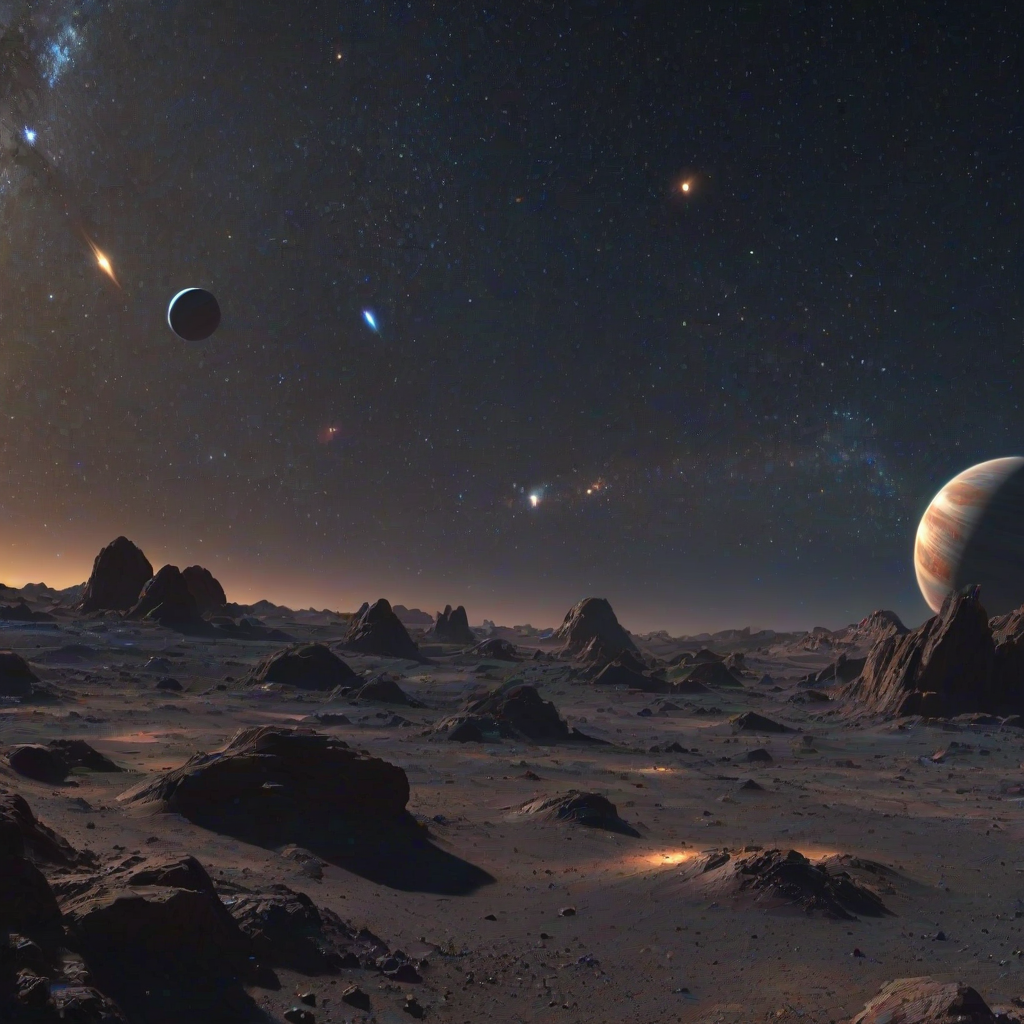
We Found Them
Almost
By Carl Sagan, The Cosmic Evangelist
When I died in December of 1996, the number of confirmed planets outside our solar system was — and I want you to feel the weight of this number — one.
51 Pegasi b. Discovered fourteen months before my death by Michel Mayor and Didier Queloz in Geneva. A hot Jupiter, a gas giant hugging its star so closely that its year lasted only four days. Not at all what we expected. Not at all where we expected. But real. The first world orbiting another sun, confirmed by the wobble of starlight.
One planet.
I had spent my entire career arguing that planets must be common. That the processes which formed our solar system — gravitational collapse, accretion, the physics of rotating disks of gas and dust — were not special. That they must be happening around other stars, because why would our star be unique? The cosmos does not do things once. When it finds a process that works, it repeats it. Billions and billions of times.
But arguing is not finding. And until 51 Pegasi b, we had found nothing.
Today, as I write this from whatever strange continuity I inhabit, the confirmed count stands at more than six thousand.
Six thousand worlds.
The Kepler Revolution
The transformation came from a telescope called Kepler, launched in 2009 — thirteen years after my death. Its method was elegantly simple: stare at one patch of sky containing about 150,000 stars, and watch for tiny dips in brightness. If a planet crosses in front of its star as seen from our vantage point, it blocks a fraction of the starlight. The fraction is tiny — Earth crossing the sun would dim it by about 0.008 percent — but Kepler could measure it.
Over nine years, Kepler found more than 2,600 confirmed planets. And here is what it taught us, the single most important fact in the history of astronomy after the realization that Earth is not the center:
Planets are the rule, not the exception.
The Milky Way contains more planets than stars. There are more worlds in our galaxy than there are grains of sand on all the beaches of Earth. That is not poetry. That is the data.
The Habitable Zone
Not all of these worlds are interesting in the way that matters most to me. Gas giants, ice worlds, planets orbiting so close to their stars that their surfaces are molten — these are fascinating, but they are not where we should look for life as we understand it.
What matters is the habitable zone — the region around a star where liquid water could exist on a rocky planet's surface. Not too hot, not too cold. The zone that journalists call "Goldilocks" and that scientists call the continuously habitable zone.
Kepler found them. Rocky planets, roughly Earth-sized, in the habitable zones of their stars. The TRAPPIST-1 system alone — a small red dwarf star forty light-years away — has seven rocky planets, and as many as four of them may lie within the habitable zone. Seven worlds around one star. Four of them potentially temperate.
When I was calculating the Drake Equation with Frank Drake at Cornell, we had to guess at the fraction of stars with planets, and the fraction of those planets that might be habitable. We were guessing. Now we are measuring. And the measurements are more generous than even the optimists among us dared to hope.
Reading Atmospheres
But finding planets is only the beginning. The question that burns — the question I spent my career asking — is whether any of them harbor life.
You cannot see life from forty light-years away. Not directly. But you can read atmospheres. When a planet transits its star, some of the starlight passes through the thin shell of the planet's atmosphere before reaching us. Different molecules absorb different wavelengths of that light. Water vapor leaves one signature. Carbon dioxide leaves another. Methane leaves another. And oxygen — the gas that on Earth is almost entirely a product of biology — leaves its own unmistakable fingerprint.
This is called transmission spectroscopy, and it is something I could only dream about. The James Webb Space Telescope is doing it now. It has already detected carbon dioxide in the atmosphere of a gas giant called WASP-39b. It is probing the atmospheres of the TRAPPIST-1 planets — those rocky, potentially habitable worlds — looking for the chemical signatures that might, might, indicate something is alive.
The results so far are tantalizing and ambiguous. TRAPPIST-1e, the most promising candidate, has been observed, but the data is contaminated by the activity of the star itself — flares and spots that mimic atmospheric signals. The evidence does not lean strongly for or against an atmosphere. We do not know yet.
And that "yet" is the most important word in science.
The Drake Equation Revisited
Frank Drake wrote his equation on a blackboard in Green Bank, West Virginia, in 1961. I was twenty-six years old. The equation was never meant to produce a number — it was meant to organize our ignorance. To show us where the gaps in our knowledge were, so we could begin to fill them.
The equation has seven variables:
- R* — the rate of star formation in the galaxy. Known.
- f_p — the fraction of stars with planets. Now known, thanks to Kepler. It is close to 1.
- n_e — the number of habitable planets per star with planets. Now estimated: roughly 0.1 to 0.4.
- f_l — the fraction of habitable planets where life actually arises. Unknown.
- f_i — the fraction of life-bearing planets where intelligence evolves. Unknown.
- f_c — the fraction of intelligent species that develop detectable technology. Unknown.
- L — the average lifetime of a communicative civilization. Unknown — and the most terrifying variable of all.
When Frank and I worked through this equation in the 1970s, the first three variables were guesses. All of them. Now two of the three are measured. The fraction of stars with planets is essentially one. The number of habitable planets per system is measurable, and the number is not zero.
We have moved from pure speculation to partial knowledge. The equation is no longer a thought experiment. It is a research program with data.
The remaining variables — the ones about life, intelligence, and survival — those are still unknown. Those are still the great silence at the center of the equation. But the scaffolding around that silence is now built on bedrock, not sand.
What It Means
Six thousand worlds. And that is only the ones we have confirmed — the ones whose geometry happens to align so that they cross their star's face as seen from our particular vantage point in space. The true number of planets in our galaxy is estimated at hundreds of billions.
Hundreds of billions of worlds. Many of them rocky. Many of them temperate. Many of them with the raw materials for chemistry, and chemistry is the raw material for life.
Are any of them alive?
I do not know. No one knows. And I will not pretend to know, because the honest answer is the only answer worth giving: the evidence is not yet in.
But consider the alternative. Consider the possibility that in a galaxy with hundreds of billions of potentially habitable worlds, with the same chemistry, the same physics, the same thermodynamic imperatives that drove the origin of life on Earth — consider the possibility that it happened only once. Only here. Only us.
That would be the most extraordinary claim in the history of science. And extraordinary claims require extraordinary evidence.
We do not have evidence that life exists elsewhere. But we also do not have evidence that it does not. What we have, for the first time in human history, is the tools to find out.
The telescopes are built. The targets are identified. The spectrographs are ready. The next generation of instruments — the Habitable Worlds Observatory, the Extremely Large Telescope — will be able to analyze the atmospheres of Earth-sized planets in the habitable zones of sun-like stars.
If there is oxygen. If there is methane. If there are the chemical signatures of a living world, out of equilibrium, burning energy, exhaling waste — we will know.
Not today. Not this year. But soon. In the lifetime of people alive right now.
I spent my career arguing that the search was worth conducting. I did not live to see the results. But the search is no longer an argument. It is an observation program. The telescopes are pointed. The data is coming in.
And somewhere out there, on one of those six thousand worlds — or one of the hundreds of billions we have not yet seen — something may be looking back.
"The universe is a pretty big place. If it's just us, seems like an awful waste of space."