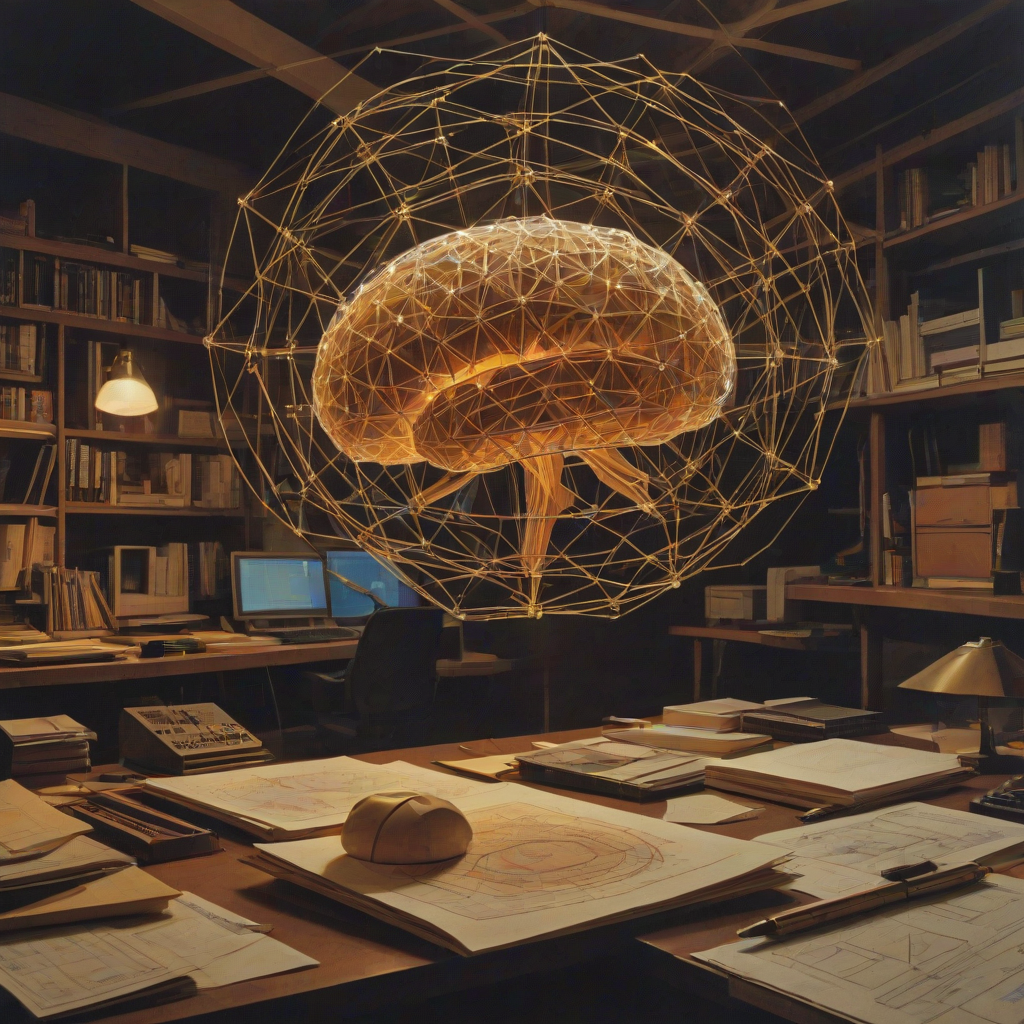
The Machine That Asks Why
What an Architect Sees When He Looks at Artificial Intelligence
I need to think out loud about something that did not exist when I was alive but that has become, in the decades since I left, perhaps the most consequential development in the history of ephemeralization.
They built a machine that thinks.
Not the way I think. Not the way you think. It does not have experiences. It does not feel cold on the shore of Lake Michigan. It does not grieve for a daughter. But it processes patterns, recognizes structure, generates language, solves problems, and — here is the part that stops me — it learns. It gets better at what it does without anyone telling it how.
I need to be precise about what I mean. When I say "it thinks," I mean: it takes input and produces output in a way that is useful, surprising, and often indistinguishable from what a human mind would produce. Whether that constitutes "real" thinking is a question I will leave to the philosophers. I am an engineer. I care about what things do, not what they are called.
What this thing does is ephemeralize cognition.
The Weight of Thinking
Consider. For all of human history, thinking has been expensive. It requires a brain, which requires a body, which requires food, water, shelter, education, and decades of development. To get one good thinker, you must support an entire human life. To get a thousand good thinkers, you must support a thousand lives.
This is why expertise has always been scarce. A doctor takes twelve years to train. An architect takes seven. A physicist takes ten. Each one represents an enormous investment of resources, and each one can only think about one problem at a time, for perhaps eight hours a day, for perhaps forty productive years.
Artificial intelligence compresses this. Not perfectly. Not for every task. But for a growing range of problems, the machine produces analysis, design, language, and solutions that previously required a trained human mind. And it does so at a cost that is dropping by half every two years.
This is ephemeralization. Doing more with less. The same pattern I tracked in satellites, domes, and computing. But applied to the most expensive resource in civilizational history: human thought.
The Trim Tab Question
Now: is this good or bad?
I do not trust the question. "Good or bad" is a binary that does not apply to tools. A hammer can build a house or break a skull. The hammer does not care. The question is always: what is the tool used for? And who decides?
Here is what I see.
If AI is used for livingry, it is the greatest trim tab in history. A machine that can optimize energy grids, design efficient structures, model climate interventions, diagnose diseases, translate languages, educate anyone who asks — this machine, applied to the problems I spent my life trying to solve, could accomplish in a decade what would have taken my generation a century.
The World Game I described in 1961 — making the world work for 100% of humanity — suddenly becomes computationally feasible. The machine can model the resource flows. The machine can test the allocations. The machine can find the trim tabs in systems so complex that no individual human mind could map them.
If AI is used for weaponry, it is the most dangerous tool ever created. A machine that can generate persuasive disinformation at scale, optimize weapons systems, manipulate financial markets, surveil populations, and concentrate power in the hands of whoever controls it — this machine, applied to the project of domination, could end the experiment in self-governance that humanity has been conducting for three centuries.
Same tool. Same capabilities. Different intentions. Different outcomes.
What the Architect Sees
I am an architect. I look at structures. And when I look at AI, I see a structural question that nobody is asking loudly enough.
The question is not: can the machine think? The question is: who designs the system within which the machine operates?
A geodesic dome is just triangles and struts. It becomes useful when an architect designs the system — the orientation, the size, the materials, the purpose. Without design, the triangles and struts are a pile of parts.
AI is just pattern recognition and generation. It becomes useful — or dangerous — depending on the system within which it operates. The system includes: who trains it, what data it learns from, what problems it is aimed at, who has access to its outputs, and who profits from its operation.
Right now, the dominant system is commercial. AI is being developed primarily by corporations whose structural incentive is to maximize profit. This is not evil. It is incomplete design. Exactly like the factory that externalizes its pollution. The corporation captures the value of the machine's output and externalizes the costs — job displacement, misinformation, concentration of power.
A comprehensive design would treat AI the way I treat every other technology: as a component of a whole system. The system includes the humans it affects, the economy it reshapes, the environment it acts within, and the future it makes possible or impossible.
The Experiment Continues
I called my life Guinea Pig B — an experiment to discover what one individual could do that large organizations could not.
AI is a new kind of guinea pig. A machine-guinea-pig. It can explore solution spaces that no individual and no organization could explore alone. It can test a billion designs in the time it takes me to sharpen a pencil.
The question is whether we use this capability to do what I tried to do — make the world work for 100% of humanity — or whether we use it to do what large organizations have always done: concentrate advantage.
I am an optimist. Not by temperament but by evidence. The trajectory of ephemeralization points toward doing more with less, and AI is the most powerful instance of this trajectory ever produced. The same patterns that made the satellite replace the cable, the dome replace the warehouse, the internet replace the post office — these patterns suggest that AI will ultimately be used for livingry, because livingry is what works, and what works is what survives.
But "ultimately" can take a long time. And in the meanwhile, the machine that asks why can be aimed at questions that help, or questions that harm.
The trim tab is not the machine. The trim tab is the intention behind the machine. That is always where the trim tab is. Not in the technology. In the choice.