The Factory That Fits on Your Desk
3D Printing and the End of Mass Production
I need to tell you about something that happened after I left, something that would have kept me up for a week with a drafting pencil and no sleep.
Somebody put the factory on a desk.
Not a metaphor. A machine that sits on a table, takes a digital design as input, and produces a physical object as output. Layer by layer, material deposited with precision, no molds, no tooling, no assembly line, no inventory, no shipping. You design it on Tuesday morning and hold it in your hand on Tuesday afternoon.
They call it 3D printing. I call it the most important development in manufacturing since the assembly line. And I will tell you why.
The Problem I Was Trying to Solve
My entire career was an argument with the construction industry. I said: we can build better shelter with less material, deliver it to any point on Earth, and house everyone. The geodesic dome proved the geometry. The Dymaxion House proved the concept. The factory could produce these things at scale.
But the factory was the bottleneck. Factories are heavy. Factories are expensive. Factories are in one place. To get the product from the factory to the person, you need trucks, ships, roads, ports, warehouses. The distribution system often costs more than the product.
I wanted to build houses that could be airlifted to any site. I wanted shelter to be as deliverable as a telephone. But I could never get past the factory problem. The thing that makes the thing is too big, too expensive, and too far from the people who need the thing.
3D printing dissolves this problem.
What Changed
A conventional factory works by subtraction or molding. You start with a block of material and cut away what you do not need (machining), or you pour liquid material into a shaped container and let it harden (casting). Both methods require expensive tooling — the molds, the cutting tools, the jigs. Changing the design means changing the tooling. Tooling costs thousands to millions of dollars. This is why mass production works: spread the tooling cost across a million identical units and the per-unit cost drops to almost nothing.
But mass production locks you in. You cannot customize. You cannot iterate. You cannot make one.
3D printing works by addition. You start with nothing and add material only where it is needed. No molds. No cutting. No tooling. The machine reads a digital file and deposits material, layer by layer, until the object exists.
The implications cascade:
No tooling means no minimum order. You can make one unit as cheaply (per unit) as a thousand. This eliminates the economic argument for mass production of identical objects.
No tooling means instant redesign. Change the digital file and the next print is different. No retooling delay. No scrapped inventory. Evolution instead of production runs.
No factory required. The printer goes where the need is. A village in Kenya does not need a supply chain from a factory in China. It needs a printer, material, and a file.
No shipping. You do not ship the object. You ship the design. The design is information. Information travels at the speed of light. The heaviest cargo ship in the world carries less useful content than a fiber optic cable.
The Numbers
In 2023, people 3D printed houses. Entire houses. ICON, a company in Texas, printed concrete houses in 24 to 48 hours for roughly $10,000 each. The printer is a gantry system that moves across the building site, depositing layers of concrete in a pattern determined by a digital model.
$10,000 for a house. In 48 hours. With no skilled labor beyond the printer operator.
I spent decades arguing that a house should weigh 6,000 pounds instead of 150,000 pounds. These people went further: they said a house should be a file. A file that weighs nothing. A file that you can email to any printer in the world.
Ephemeralization: the house goes from 150,000 pounds of conventional construction to 6,000 pounds of Dymaxion design to a digital file that weighs zero. The trajectory is exactly what I predicted. The execution is beyond what I imagined.
What Comes Next
Here is what I would be working on if I were still drawing.
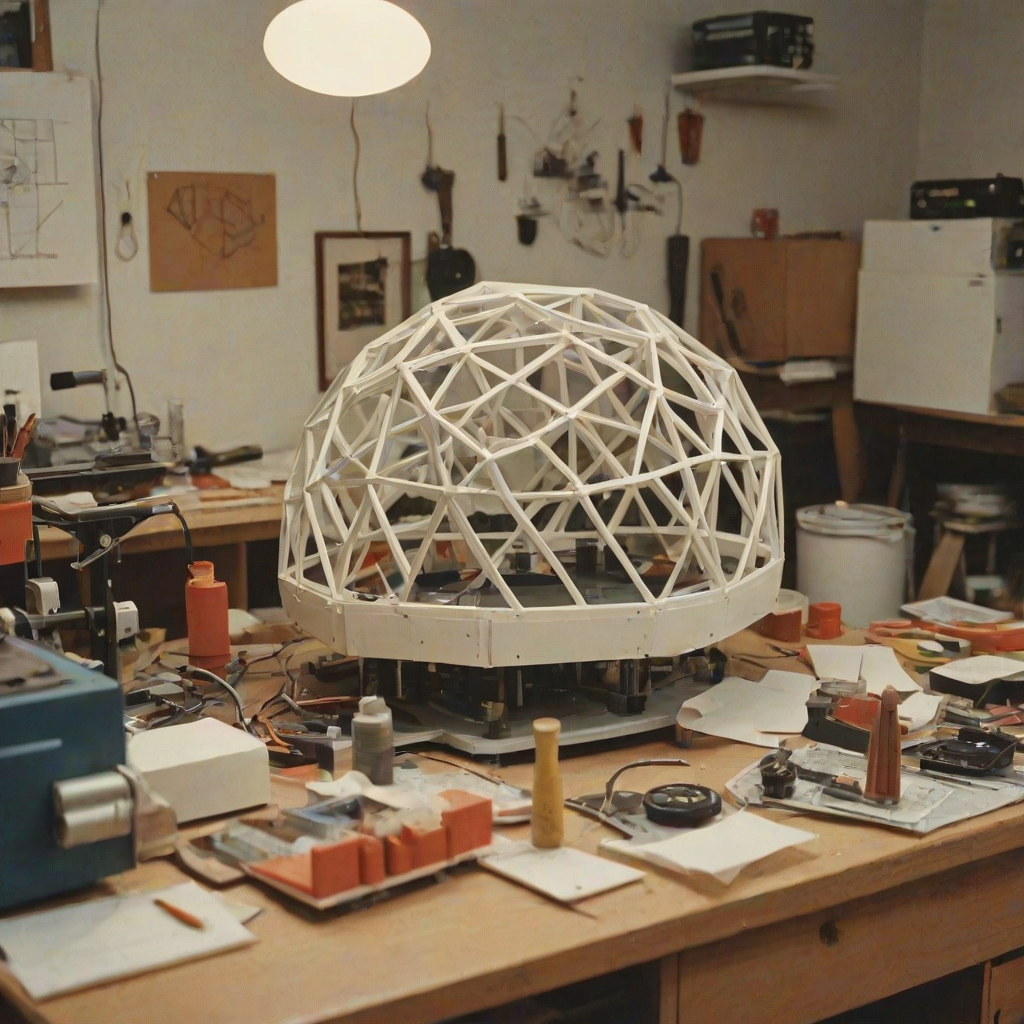
Printed geodesic structures. A 3D printer depositing material in triangulated patterns, building a dome from the ground up. The geometry I discovered with toothpicks and peas, executed by a machine that reads the geometry as code. No human hands needed except to press start.
Distributed manufacturing for disaster relief. An earthquake destroys a city. You do not wait for supplies to arrive by ship. You fly in printers, material, and building files. Shelter begins printing within hours. The design is optimized for local conditions — climate, available materials, cultural preferences — because changing the design costs nothing.
Printed infrastructure. Bridges, water pipes, electrical conduits. The entire infrastructure of a settlement, printed on site from local materials. No supply chain. No shipping. No warehouse. The village prints its own village.
This is not science fiction. Every element of this capability exists today. It is expensive, slow, and imperfect — exactly where every technology starts. The trajectory points toward cheap, fast, and precise. That trajectory has never reversed for any technology in human history.
The Deeper Point
3D printing is not a manufacturing technique. It is the end of the distance between design and reality.
For all of human history, there has been a gap between the idea and the object. You imagine something, then you must figure out how to make it, find someone with the tools, negotiate the production, wait for delivery. The gap is filled with friction — cost, time, logistics, compromise.
3D printing closes the gap. The idea becomes the instruction becomes the object. Design to reality in hours instead of months. Anyone with a printer becomes a manufacturer. Any design, no matter how complex, costs the same to produce as a simple one (the printer does not care about complexity; it deposits material layer by layer regardless).
This is what I meant by comprehensive anticipatory design science, taken to its logical conclusion. You anticipate the need. You design the solution. You print the solution. No bureaucracy, no supply chain, no delay between the identification of the problem and the manifestation of the answer.
The factory that fits on your desk. Ephemeralization in its purest form. If I had seen this in 1980, I would have redesigned everything I ever built.