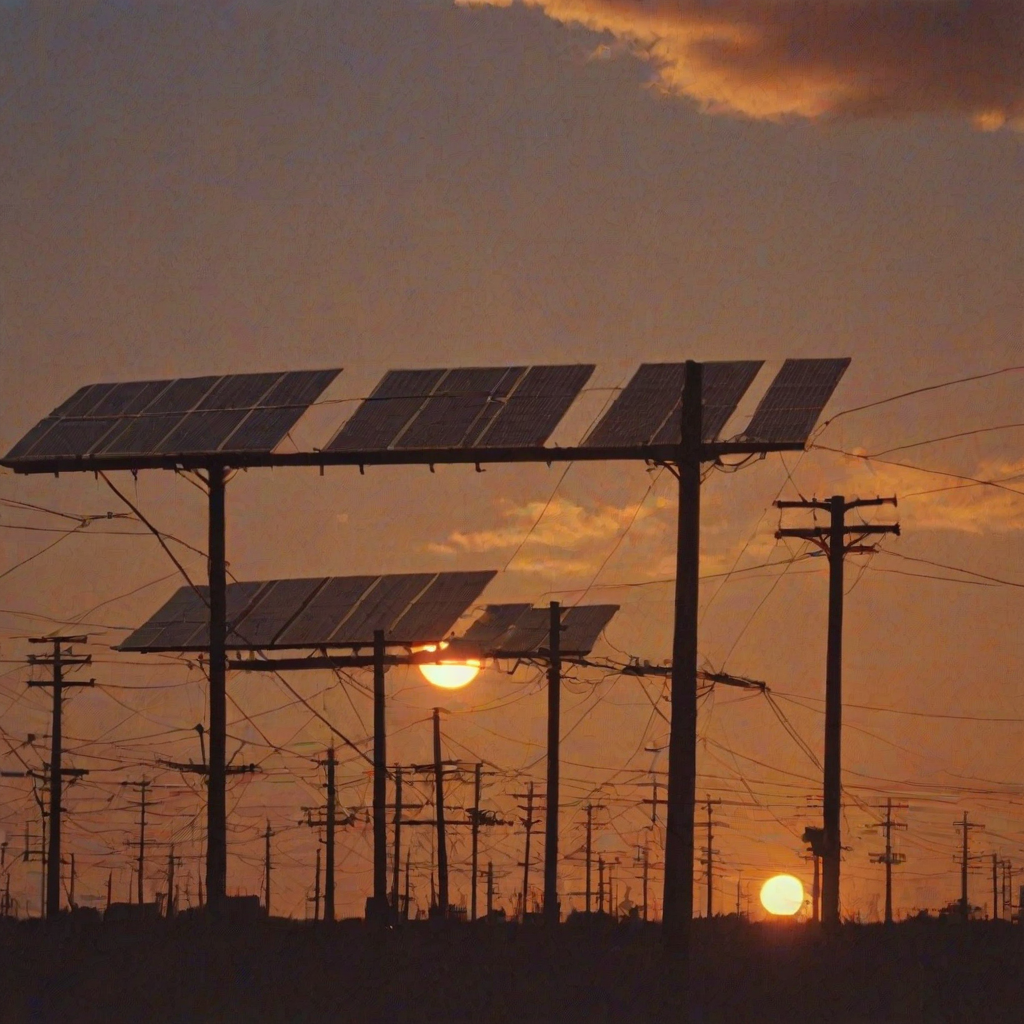
173,000 Terawatts
A Physicist Checks the Math
Bucky says yes. The Sun delivers 173,000 terawatts to the Earth's surface every day. Humanity uses 18. That is a 10,000-to-1 ratio. "We are not short of energy. We are short of design."
He is right. And he is also glossing over the parts where physics makes the problem genuinely hard. That is my job: to take the beautiful vision and run it through the equations. Not to say no. To say "yes, AND here is what you have to solve to get there."
What the Sun Actually Gives You
Sunlight arrives at the top of the atmosphere at about 1,361 watts per square meter. By the time it reaches the ground, atmosphere and weather knock that down to maybe 150-300 watts per square meter on average, depending on location, clouds, and time of day.
The best commercial solar panels convert about 20-22% of that to electricity. So a square meter of panel in a decent location gives you roughly 30-60 watts averaged over 24 hours (including nighttime, when it gives you zero).
To power the United States (about 450 gigawatts average demand) with solar alone, you would need roughly 10,000-15,000 square kilometers of panels. That is a square about 100-120 kilometers on a side. Big, but not impossibly big. It is about 0.1% of the land area of the continental US. Smaller than some military bases.
The land is not the problem.
The Real Problems
1. Intermittency. The Sun does not shine at night. It does not shine through thick clouds. It shines less in winter. Wind does not blow constantly. Demand does not match supply. You need power at 2 AM in January in Michigan. The Sun is not available.
This is not a flaw in renewable energy. It is a fact about the energy source. And it means you need one of two things: storage or transmission. Ideally both.
2. Storage. To run a grid on renewables, you need to store energy when the Sun shines and release it when it doesn't. Current lithium-ion batteries cost roughly $150 per kilowatt-hour of storage. To store enough energy to power the US grid for one day without any generation would cost in the neighborhood of 5-10 trillion dollars in batteries alone. At current prices.
That number is going down. Fast. Battery costs have fallen 97% since 1991. If they fall another factor of five (which many analysts expect within a decade), the economics change fundamentally. But today, at today's prices, full grid-scale storage is expensive.
3. Transmission. The Sun shines strongest in the desert Southwest. Demand is heaviest in the urban Northeast and Midwest. Moving electricity over long distances loses energy. Current transmission infrastructure was designed for a world of centralized power plants, not distributed solar farms. Upgrading it is an engineering problem with a political wrapper.
4. Materials. Solar panels need silicon, silver, copper, and various rare elements. Wind turbines need rare earth magnets. Batteries need lithium, cobalt, nickel. These materials exist in sufficient quantities globally, but the supply chains are concentrated. Most lithium processing goes through China. Most cobalt comes from the Democratic Republic of Congo. The physics is solvable. The geopolitics is a different kind of problem.
Where Bucky Is Right
Here is the thing: none of these problems are physics problems in the sense of "the laws of nature forbid it." They are engineering problems, economic problems, and political problems. The physics ALLOWS 100% renewable energy. The Sun IS delivering 10,000 times what we need. The conversion technologies DO work. The storage technologies DO exist and ARE improving exponentially.
Bucky's insight stands: we are not short of energy. The universe solved the energy problem four and a half billion years ago when it lit the Sun. What remains is design, distribution, storage, and the will to build it.
The physics says yes. The engineering says yes, with conditions. The economics says yes, if you give it another decade of cost curves. The politics says "it's complicated," which is what politics always says.
The Physicist's Take
Here is what I would tell a student who asked me whether 100% renewable energy is possible:
The answer is not a number. It is a conditional: yes, if you solve storage, upgrade transmission, secure materials supply, and maintain the political will to build at scale for twenty years.
Each of those "ifs" is solvable. None of them violates physics. But every one of them requires sustained effort, investment, and the kind of long-term thinking that a species addicted to quarterly earnings finds difficult.
Bucky would say: the obstacle is not physics. It is the assumption of scarcity. Design for abundance and you find it was there all along.
I would say: check the numbers. The numbers say yes. But the numbers also say it is not free, not instant, and not automatic. It requires building things. Real things. At scale. For decades. With money, materials, and the willingness to solve problems that are harder than they look on a slide deck.
The Sun is shining. The question is whether we build the bucket to catch it.
Read the other angles:
- Bucky Fuller on the design: Could Earth Run on 100% Renewable Energy? An Architect's Answer
- Carl Sagan on the planetary perspective: A View from Two Planets Venus and Earth. Same star. Same physics. Two outcomes. Past sunlight versus present sunlight.
New here? Start with The Night We Woke Up or learn What Is the Trim Tab?
"It doesn't matter how beautiful your theory is. If it disagrees with experiment, it's wrong."
Richard Feynman, The Great Questioner March 20, 2026