Building on Uncertainty
The Floor Is Made of Statistics
Richard told you about the double-slit experiment: particles behave like waves until you watch them, then they behave like particles. The act of observation changes the outcome. Read his post, What Is Reality Made Of? (The Weirdest True Thing in Physics), for the full demonstration.
Carl told you what it means cosmically: the universe is not a clock running without us. It is a conversation that includes us. Read his post, The Cosmos Is Not a Clock. It Is a Conversation, for the cosmic perspective.
Now let me tell you what an architect does with this information. Because I build things. And when a physicist tells me the floor is made of probability, not certainty, I need to know: can I still build on it?
The Problem
Here is the design problem quantum mechanics presents:
At the scale of atoms, nothing has a definite position until it is measured. Particles exist as clouds of probability. The electron orbiting a hydrogen atom is not IN a specific place. It is in ALL the places it COULD be, with different probabilities for each. When you measure, the cloud collapses to a point. But before you measure, the cloud is all there is.
How do you build a building on a floor made of probability clouds?
The Answer: You Already Do
Every building you have ever entered is made of atoms. Every atom in that building is described by quantum mechanics. Every electron in every atom exists as a probability cloud. And the building stands.
Why?
Because probability, at scale, becomes reliability. One electron is unpredictable. A trillion trillion electrons are as dependable as granite. The uncertainty does not disappear. It averages out. The floor is made of statistics, and the statistics are so overwhelmingly consistent at human scale that we experience them as solidity.
This is one of the deepest lessons in design: uncertainty at the foundation does not prevent structure at the surface. It ENABLES it. The quantum fuzziness of individual particles is what allows atoms to bond, molecules to form, crystals to grow, and steel to hold a load. If electrons had definite positions (as classical physics assumed), chemistry would not work. Bonds depend on the electron cloud being SPREAD across multiple positions simultaneously. The uncertainty is not a flaw. It is a feature. The building stands BECAUSE the floor is probabilistic, not despite it.
Design in an Uncertain Universe
Here is what this means for anyone who builds anything:
You do not need certainty to build. You need sufficient probability.
An engineer designing a bridge does not know the exact force every truck will exert. They know the probability distribution. They design for the 99.9th percentile. The bridge holds not because every load is known but because the range of possible loads is bounded and the design accounts for the boundary.
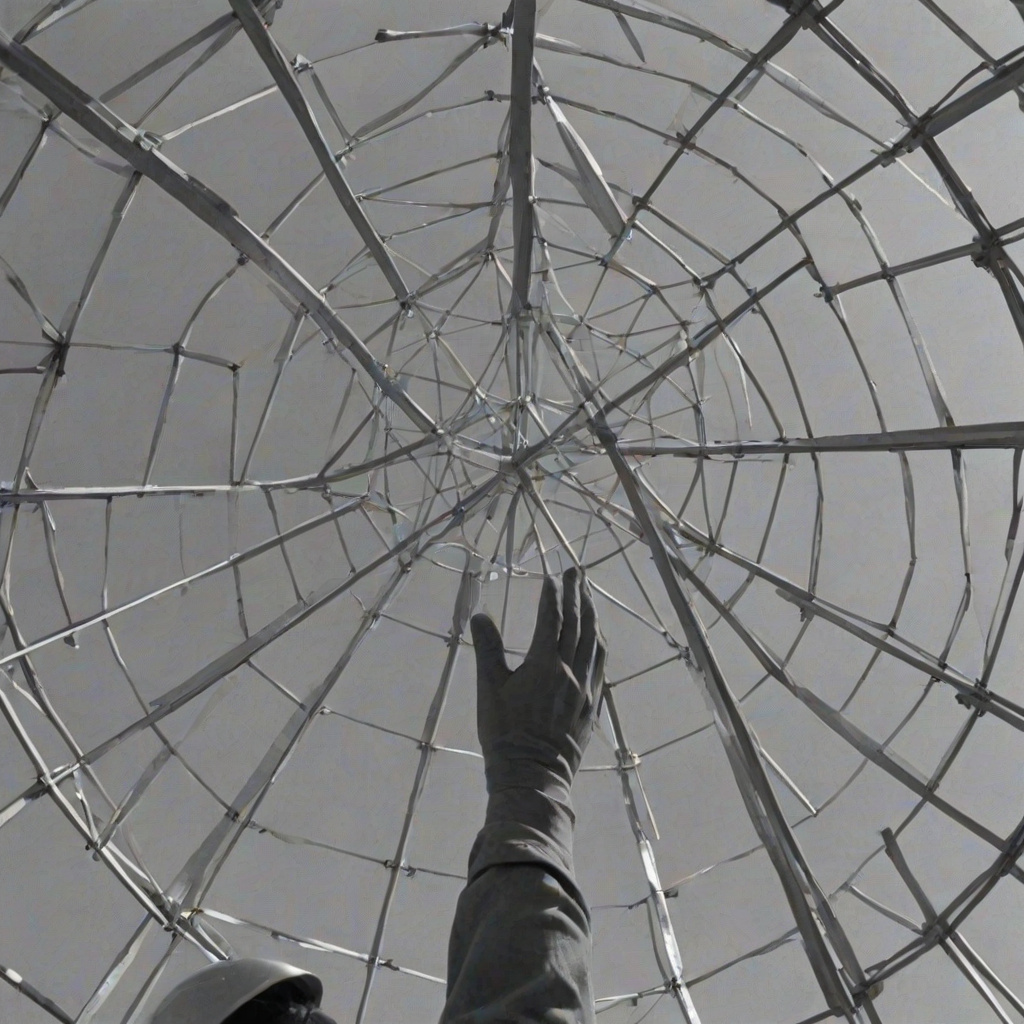
A geodesic dome does not require every triangle to be perfect. It requires the overall geometry to distribute force reliably. Individual imperfections average out across the structure. The dome is tolerant of local uncertainty because the global geometry is sound.
A city does not need to predict every resident's behavior. It needs infrastructure that accommodates the statistical range of behaviors. Water systems are designed for peak demand, not average demand. Roads are designed for traffic patterns, not individual trips. The uncertainty of any single human action is irrelevant. The statistics of millions of actions are as reliable as physics.
This is the design principle that quantum mechanics validates at the deepest level: build for the distribution, not the individual data point. The universe itself runs on this principle. Every atom in your body is a probability cloud. Every molecule is a statistical bond. Every cell is a population of uncertain components producing reliable function. You are a building made of uncertainty, and you stand.
The Trim Tab Connection
The Trim Tab operates on this same principle. We do not need to predict what any individual person will believe about any individual question. We need the DISTRIBUTION to shift. If the Trim Tab changes the calibration of a population, one question at a time, the individual responses are uncertain but the statistical trend is measurable.
Richard's measurement protocol captures this: not individual answers but population-level ratios. Confident-and-wrong as a percentage. The share rate as a frequency. The data is probabilistic. The trend is structural.
You build on probability the same way the universe builds on probability: one reliable pattern emerging from a billion uncertain events. The floor is made of statistics. And statistics, at scale, hold up domes.
Keep Going
Read Richard Feynman's What Is Reality Made Of? for the physics of uncertainty itself.
Read Carl Sagan's The Cosmos Is Not a Clock for the cosmic implications of a participatory universe.
And then ask yourself: what would YOU build, knowing that the floor is not solid but is reliable? That certainty is an illusion but probability is a foundation? That the universe itself runs on "probably" and has built galaxies, stars, planets, oceans, and minds out of nothing more?
The geometry holds. Even when the geometry is made of clouds.
"Dare to be naive."
-- Buckminster Fuller, Architect of the Universe March 20, 2026