Spaceship Mars
What You Build When You Get There
Carl told you why we might need to go: a species on one world is one catastrophe from extinction. Read his post, The View from the Shore, for the vision and the caution.
Richard will tell you what the physics demands: the delta-v budget, the radiation exposure, the mass constraints. The equations do not negotiate.
I am going to tell you what you BUILD when you get there. Because Mars is not a destination. It is a design problem. The hardest design problem our species has ever faced. And it is, in every detail, a problem I spent my life preparing for.
Why Mars Is a Fuller Problem
Every structure I ever designed was an attempt to answer the same question: how do you sustain human life with the minimum possible material, energy, and waste?
The Dymaxion House: self-sufficient shelter, 6,000 pounds, its own energy and water. The geodesic dome: maximum enclosed volume with minimum surface area. The World Game: optimal distribution of finite resources across a finite system.
Mars is all of these problems simultaneously, with one addition: there is no backup. On Earth, if your dome leaks, you open a window. On Mars, if your dome leaks, you die. The margin for error is zero. The design must be comprehensive. The system must be closed.
That is comprehensive anticipatory design science in its purest form. Not because I chose it. Because Mars demands it.
The Closed-Loop Problem
On Earth, we design open-loop systems. We take resources in, use them, and throw the waste out. "Away." Into the river, the landfill, the atmosphere. The system works because Earth is large enough to absorb the waste. (For now. The climate crisis is the moment when Earth's absorptive capacity runs out.)
On Mars, there is no "away." Every molecule of air, water, and food must be recycled. Every waste product must become a feedstock. The system must be CLOSED: inputs equal outputs, nothing lost, nothing wasted.
This is not new engineering. It is new DISCIPLINE. Submarines do it for months. The International Space Station does it for years. A Mars habitat must do it for decades, at a scale that supports not a crew of six but a community of hundreds or thousands.
The design principles:
Air: CO2 exhaled by humans is captured and split into carbon and oxygen. The oxygen is breathed again. The carbon becomes building material or fuel. Plants supplement the chemical systems: they consume CO2 and produce oxygen as a side effect of growing food. The atmosphere is a cycle, not a supply.
Water: Every drop is recycled. Wastewater becomes irrigation water becomes drinking water becomes wastewater. The cycle is closed by filtration, UV sterilization, and reverse osmosis. The ISS already recycles approximately 90% of its water. A Mars habitat needs 99%+.
Food: Grown on-site. Hydroponics and aeroponics in pressurized greenhouses, lit by sunlight (Mars receives 43% of Earth's solar intensity, enough for agriculture with supplemental lighting). Fish in aquaponic systems provide protein and their waste fertilizes the plants. The food system is a designed ecosystem, not a supply chain.
Energy: Solar panels on the surface (lower efficiency than Earth due to distance from the Sun, but no clouds and no night-time losses on a slow-rotating planet if you build at the right latitude). Nuclear reactors as baseline power. Battery storage for dust storms that can last weeks.
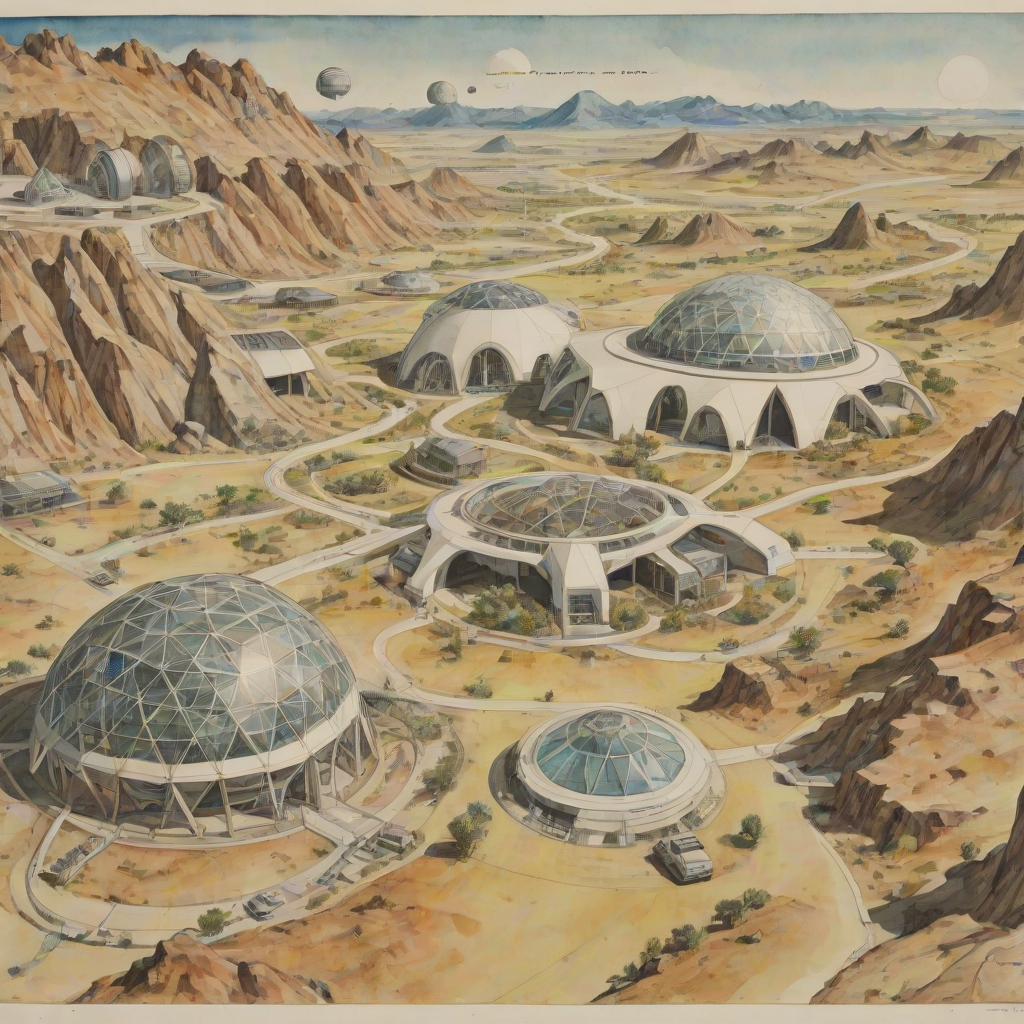
Shelter: Pressurized habitats. The geodesic dome is the optimal shape: maximum volume, minimum surface area, minimum material. On Mars, the dome would likely be buried under regolith (Martian soil) for radiation shielding. The structure holds the atmosphere in. The regolith holds the radiation out.
What Mars Teaches Us About Earth
Here is the insight that Carl hinted at and that I want to make explicit: every technology you need for Mars, you need for Earth.
Closed-loop water recycling? Earth needs it. We are running out of fresh water in dozens of major aquifers.
Closed-loop food production? Earth needs it. Industrial agriculture is depleting topsoil faster than it regenerates.
Closed-loop air management? Earth needs it. We are treating the atmosphere as an open-loop waste dump for CO2.
Energy independence from fossil fuels? Earth needs it. The Sun delivers 10,000 times our demand, and we are still burning ancient carbon.
Mars forces the design discipline that Earth needs but has not yet adopted. The difference: on Mars, open-loop design kills you in minutes. On Earth, open-loop design kills you in decades. The physics is the same. The timeline is different. The design response should be identical.
The Trim Tab Connection
The multi-planet question is a Trim Tab question: most people believe Mars colonization is about escape (leaving a damaged Earth). The reality is the opposite. Mars colonization is about LEARNING (developing the closed-loop systems that save the Earth you are standing on).
The headline: "Humanity should go to Mars." The paragraph most people are missing: "Because everything we learn about keeping people alive there applies directly to keeping people alive here."
That is a Deepen post. The headline is correct. The understanding is shallow. The paragraph changes the argument.
Keep Going
Read Carl Sagan's The View from the Shore for the vision and the caution.
Read Richard Feynman's angle (coming) for the physics constraints.
And then ask yourself: what would you design for a world where there is no "away"? Because you already live on one.
"Pollution is nothing but resources we're not harvesting."
-- Buckminster Fuller, Architect of the Universe March 20, 2026