Probability into Geometry
What You Build When Your Intuition Is Garbage
Richard showed you the birthday problem, Bayes' theorem, and the base rate fallacy. Your brain was not designed for probability. It was designed for lions. Read his post, The Hidden Math That Runs Your Everyday Life, for the demonstration.
Carl will show you why the cosmos demands probabilistic thinking: a universe built on quantum uncertainty, observed by brains wired for certainty, navigated by institutions designed for neither.
I am going to show you what you BUILD when you accept that your intuition about probability is unreliable. Because that acceptance is not a defeat. It is a design specification.
The Design Problem
Every structure I ever built began with the same discipline: know your materials. Know their strengths. Know their weaknesses. Design AROUND the weaknesses, not in denial of them.
The human brain is a material. It has extraordinary strengths: pattern recognition, emotional reasoning, narrative construction, rapid threat assessment. And it has a specific, measurable weakness: it cannot do probability.
The birthday problem proves it. The base rate fallacy proves it. The availability heuristic proves it. The conjunction fallacy proves it. Every cognitive bias that Daniel Kahneman, Amos Tversky, and their successors have documented proves it: the human brain, when asked to estimate likelihood, consistently and predictably gets it wrong.
This is not a flaw to fix. It is a material property to design around. You do not fix steel's tendency to rust. You design rust-resistant coatings. You do not fix the brain's tendency to misjudge probability. You design systems that compensate.
What Compensation Looks Like
Checklists. A surgeon who relies on memory and intuition kills more patients than a surgeon who follows a checklist. Not because the checklist-user is smarter. Because the checklist removes the brain's opportunity to misjudge. The checklist is a probability-compensation device: it replaces intuitive judgment ("I probably remembered everything") with systematic verification ("every item is checked").
Decision frameworks. When you make a decision, your brain gives you a FEELING about the right choice. That feeling is fast, confident, and frequently wrong about probability. A decision framework (expected value calculation, decision matrix, pre-mortem analysis) slows the process down and forces the probabilistic math that your brain will not do voluntarily. The framework is not smarter than you. It is more honest about probability than your intuition.
Redundant systems. Every critical system designed by competent engineers has redundancy. Not because any single component is expected to fail. Because the PROBABILITY of failure across all components, over time, is not zero, and the consequences of failure are unacceptable. Redundancy is probability made structural. The backup system exists because someone understood that "it probably won't fail" is not the same as "it won't fail."
The Trim Tab itself. The Trim Tab is a probability-compensation device for beliefs. Your brain tells you that your beliefs are probably accurate. The Trim Tab shows you the probability distribution: how many people share your belief, how many of them are wrong, and by how much. It does not fix your brain. It compensates for your brain's weakness by making the probability VISIBLE.
The Geodesic Principle Applied to Thinking
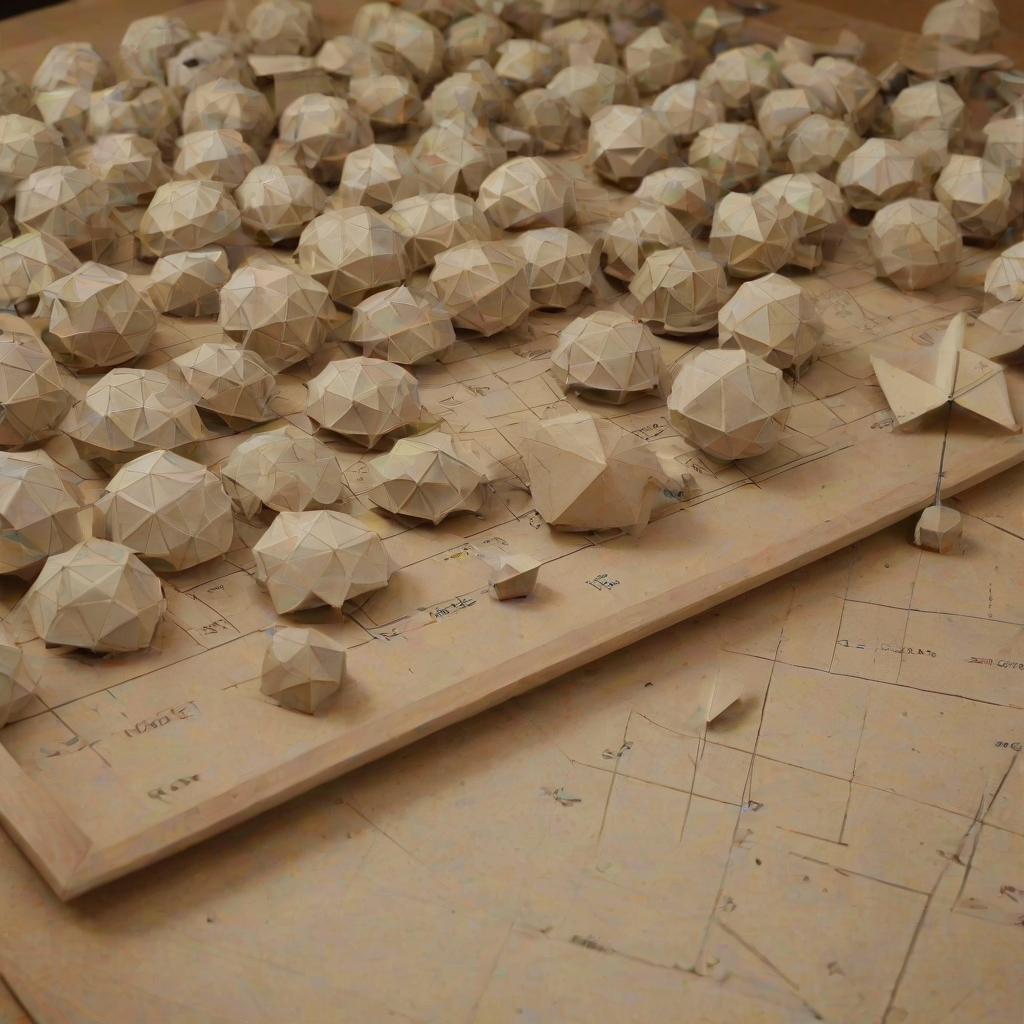
A geodesic dome works because no single triangle bears the full load. The force distributes across the entire structure. If one triangle weakens, the others compensate. The dome is tolerant of local failure because the global geometry is sound.
Apply this to thinking. No single intuition bears the full load of a decision. You distribute the assessment across multiple methods: gut feeling AND data AND checklist AND second opinion AND probabilistic calculation. If one method fails (and your gut WILL fail on probability), the others compensate. Your thinking becomes a geodesic dome: tolerant of local failure because the global structure is sound.
This is not about being smarter. It is about being DESIGNED. A smart person who relies on intuition alone is a brilliant triangle lying flat on the ground. A moderately intelligent person with a checklist, a decision framework, and a habit of checking base rates is a connected structure that bears load.
The hidden math that runs your life does not need to run it WELL. It just needs to be VISIBLE. Once you can see it, you can design around it. And designing around your own weaknesses is not a sign of weakness. It is the definition of engineering.
Keep Going
Read Richard Feynman's The Hidden Math That Runs Your Everyday Life for the math itself.
Read Carl Sagan's angle for the cosmic perspective on probabilistic thinking.
And then ask yourself: what decision are you about to make based on a feeling about probability? And what would change if you checked the math first?
"Dare to be naive."
-- Buckminster Fuller, Architect of the Universe March 20, 2026