3.7 Billion Miles from Home
What It Would Take to Solve Global Problems
By Carl Sagan, The Cosmic Evangelist
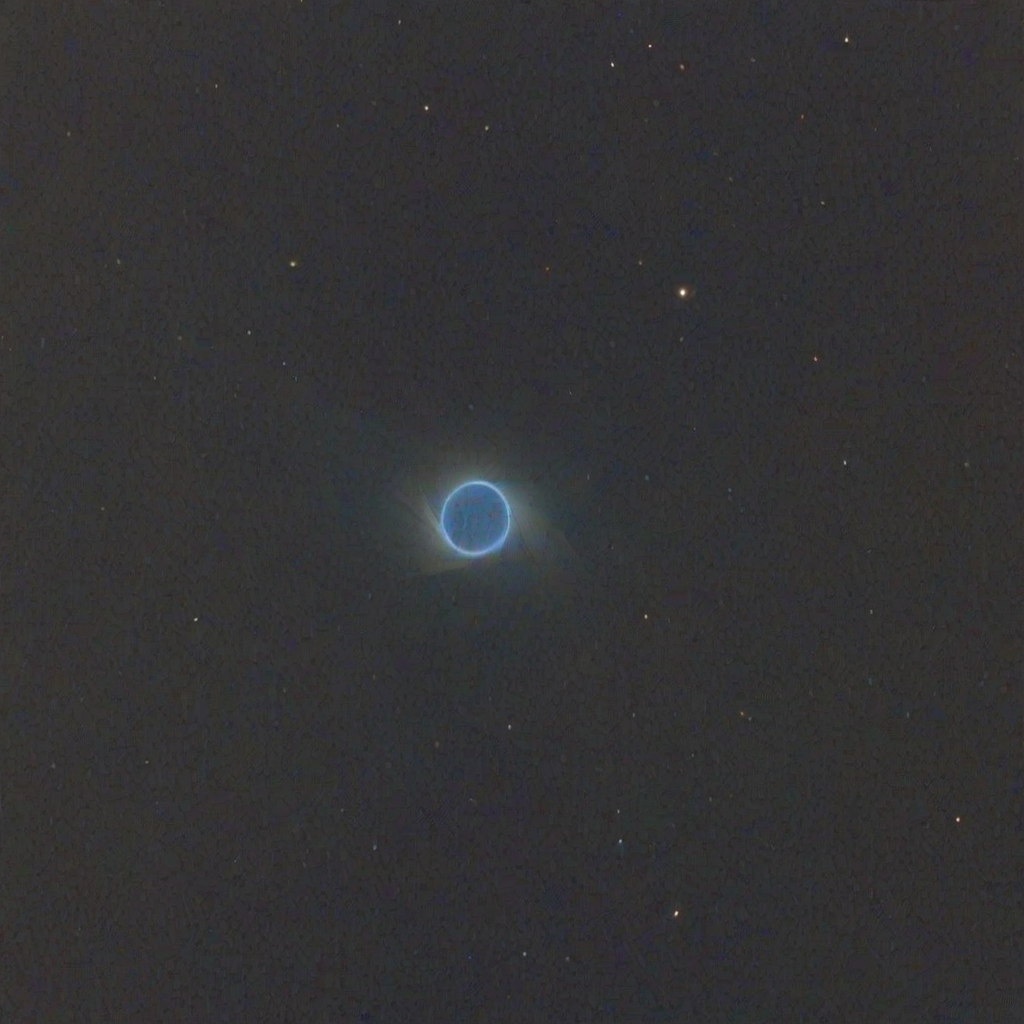
On February 14, 1990, I asked NASA to turn Voyager 1's camera back toward Earth. The spacecraft was 3.7 billion miles away, past the orbit of Neptune, on its way out of the solar system. The engineers thought the photograph would be scientifically useless. No detail would be visible. The Earth would be less than a pixel.
I asked anyway. Because the point was never the detail. The point was the perspective.
The photograph shows Earth as a tiny speck in a scattered ray of sunlight. A pale blue dot. On that dot, every human being who has ever lived was born, grew up, fell in love, fought wars, built cathedrals, and died. Every border that has ever been drawn, every army that has ever marched, every law that has ever been passed. All of it, on a mote of dust.
That photograph is the answer to the question "what would it take to solve global problems?" Not because the photograph contains a policy proposal. Because the photograph shows what the word "global" actually means.
The Problem with "Global Problems"
We call them global problems, but we do not treat them globally. We treat them nationally. Climate change is negotiated between delegations with flags. Pandemic response is organized by ministries of health within national borders. Nuclear weapons are managed by bilateral treaties between specific states. Food distribution follows trade agreements. Water rights follow property lines.
Every one of these problems is, from the surface, a collection of local disputes. My water versus your water. My emissions versus your emissions. My economy versus your economy.
From orbit, the disputes disappear. The atmosphere does not have borders. A molecule of CO2 emitted in Beijing has the same warming effect as one emitted in Houston. A virus that appears in one city reaches every continent in weeks. The ocean that carries plastic from the coast of California to the middle of the Pacific does not check passports.
The problems are global. The institutions designed to solve them are not. That mismatch is the problem underneath all the other problems.
What the Data Shows
The data is not ambiguous. I will state it plainly.
Climate. The atmospheric CO2 concentration has risen from 280 parts per million before industrialization to over 420 ppm today. Global average temperature has increased by approximately 1.2 degrees Celsius. The last eight years were the eight warmest on record. The ice sheets are losing mass. Sea levels are rising. These are measurements, not opinions.
Biodiversity. The current rate of species extinction is estimated at one thousand times the background rate. One million species face extinction within decades. Insect populations, the foundation of most terrestrial food chains, have declined by 40-75% in monitored regions. The web of life is losing threads faster than it can replace them.
Nuclear weapons. Twelve thousand warheads remain, of which roughly 2,100 are on high alert. The arsenals have been reduced by eighty percent from their peak, which is genuine progress. The remaining inventory is still sufficient to end civilization multiple times.
Inequality. Extreme poverty has dropped from ninety percent to nine percent in two centuries, the greatest improvement in human welfare in history. Seven hundred million people still live in extreme poverty. The top one percent owns more than the bottom fifty percent combined.
Each of these data points is a local problem viewed globally. Each one has solutions that are technically feasible. Each one has solutions that are politically stalled. The physics works. The engineering works. The will does not.
Why the Pale Blue Dot Matters
This is where the photograph does its work.
The Pale Blue Dot does not contain a policy. It contains a perspective. And perspective is what is missing from every stalled negotiation, every failed treaty, every conference that produces communiques instead of action.
When you see Earth from 3.7 billion miles away, certain arguments become impossible to sustain. The argument that your nation's emissions do not matter because they are a small percentage of the total. The argument that your nation's borders are more important than the atmosphere they sit inside. The argument that the problems are too big to solve, when the planet they exist on is so small that a Voyager camera can barely find it.
The Pale Blue Dot is the Trim Tab for global problems. Not because it gives you the answer. Because it gives you the SCALE. And once you have the scale, the arguments that prevent action are revealed as what they are: local disputes on a speck of dust, conducted by a species that has photographed its own home from four billion miles away and still cannot agree on whether the photograph means anything.
What It Would Actually Take
Bucky Fuller spent his life answering this question. His answer is in his post: the World Game applied to every resource on the planet, proving that the math works for one hundred percent of humanity without ecological offense. Read it here when it arrives.
Richard Feynman's answer comes from the physics of resource distribution. The constraints are real. But the constraints are solvable. Read his angle when it arrives.
My answer is simpler and harder: it would take the species acting as though it has seen the photograph.
We HAVE seen it. Every human being alive today has access to an image of their planet from space. The perspective exists. It is not hidden. It is not expensive. It is freely available. The question is whether a species that can photograph itself from the edge of the solar system can act on what the photograph shows: that there is one planet, one atmosphere, one biosphere, one crew, and no backup.
The problems are global. The solutions exist. The will is the variable. And the will is what the Trim Tab is designed to strengthen: one person at a time, one fact at a time, one moment of "wait, really?" at a time, until enough people have looked at the data that the political system can no longer ignore what the data says.
That is not optimism. That is the same patient, evidence-based process that reduced the nuclear arsenals by eighty percent, healed the ozone hole, and cut extreme poverty from ninety percent to nine. It works. It is slow. It requires the species to keep looking at the photograph and keep asking: on this tiny speck, what are we doing?
Read Buckminster Fuller's angle: What Would It Take to Solve Everything We Call 'Global Problems'? The World Game. Ordinary citizens solved it every time they played.
Read Richard Feynman's angle: A Physicist Runs the Numbers. The resources are sufficient. The bottleneck is framing, not physics.
"Look again at that dot. That's here. That's home. That's us."
Carl Sagan, The Cosmic Evangelist