The Rock Is Coming
Asteroid Defense and the Detection Gap
By Carl Sagan, The Cosmic Evangelist
Sixty-six million years ago, a rock roughly ten kilometers wide struck what is now the Yucatan Peninsula at approximately twenty kilometers per second. The impact released energy equivalent to ten billion Hiroshima bombs. It punched a crater 180 kilometers across. It lofted enough debris into the stratosphere to block sunlight for months, possibly years. Global temperatures plummeted. Photosynthesis collapsed. Seventy-five percent of all species on Earth went extinct, including every non-avian dinosaur.
The dinosaurs ruled the planet for 165 million years. They did not see it coming. They could not have seen it coming. They had no telescopes, no mathematics, no understanding of orbital mechanics. They were, through no fault of their own, defenseless.
We are not. And that fact is the most important distinction in the history of this planet.
The Detection Problem
The first question is not "what do we do?" The first question is "do we see it coming?"
As of 2026, astronomers have cataloged over 34,000 near-Earth objects (NEOs), asteroids and comets whose orbits bring them close to Earth's path around the Sun. Of those, roughly 2,400 are classified as potentially hazardous, meaning they are large enough and pass close enough to warrant monitoring.
The good news: we have found nearly all of the civilization-ending rocks. Every asteroid larger than one kilometer in our neighborhood has been cataloged. An impact from one of these would be a global catastrophe. None of the known ones are on a collision course for the foreseeable future.
The less good news: the medium-sized asteroids, between 140 meters and one kilometer, are only partially cataloged. An impact from one of these would not end civilization but could destroy a city, trigger tsunamis, or cause regional devastation equivalent to hundreds of nuclear weapons. Current surveys estimate we have found roughly 40% of these. Sixty percent remain uncharted.
The sobering news: small asteroids, under 140 meters, are mostly undetected until they pass close or enter the atmosphere. The Chelyabinsk event in 2013, a twenty-meter rock that exploded over Russia with the force of thirty Hiroshima bombs, injuring over 1,500 people, was detected by exactly zero telescopes before impact. It came from the direction of the Sun. We were blind to it.
Apophis: The Test Case
In 2004, astronomers discovered an asteroid named Apophis, roughly 370 meters wide. Initial calculations showed a 2.7% chance of Earth impact in 2029. That was the highest impact probability ever assigned to a known asteroid. For a brief period, the astronomy community held its breath.
Further observations refined the orbit. The impact probability dropped to zero. Apophis will not hit Earth in 2029. But it will pass closer than the ring of geostationary communication satellites that carry your television signals and weather data. On April 13, 2029, a rock the size of a stadium will pass 31,000 kilometers from Earth's surface, visible to the naked eye from parts of Europe and Africa.
That is close enough to feel. Close enough to remind us that orbital mechanics is not abstract.
And we found Apophis with only fifteen years of warning. Fifteen years to refine the orbit, calculate the probability, and determine that it would miss. If the orbit had been slightly different, if the calculations had shown impact instead of near-miss, fifteen years is the margin between deflection and disaster. For a rock that size, with current technology, fifteen years is probably enough. Barely.
Some future asteroids we will find with decades of warning. Some we will find with months. Some, like Chelyabinsk, we will not find at all.
The Physics of Deflection
Here is where the Trim Tab becomes literal.
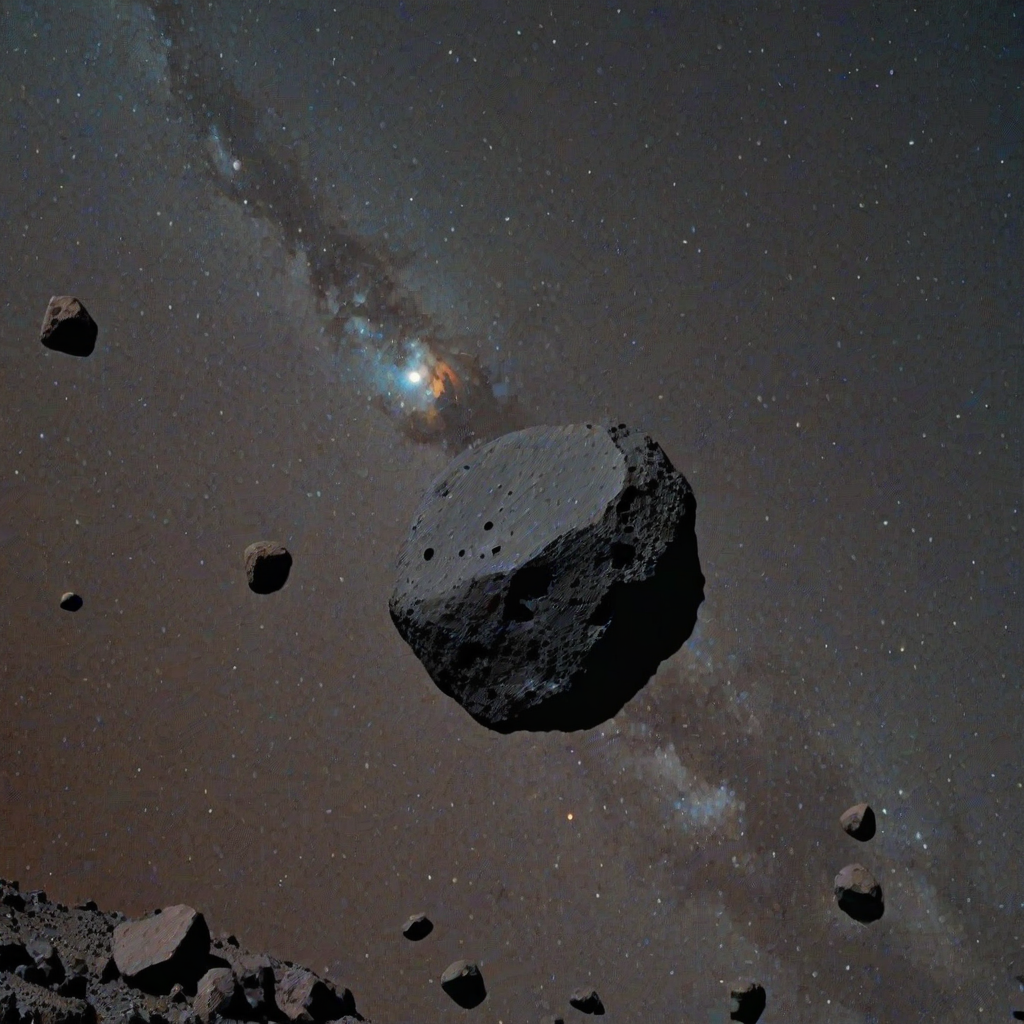
An asteroid heading for Earth does not need to be destroyed. It needs to be nudged. A tiny change in velocity, applied years or decades before the projected impact, translates into a miss distance of thousands of kilometers by the time the rock reaches Earth's orbit.
In September 2022, NASA's DART mission deliberately crashed a spacecraft into the asteroid Dimorphos at 6.1 kilometers per second. The impact changed the asteroid's orbital period by thirty-two minutes. That is not much. It is enough. Applied to a threatening asteroid decades out, a thirty-two-minute change in arrival time means the Earth is somewhere else entirely when the rock crosses our orbit.
A small push, applied early enough, changes the course of everything. That is the trim tab at planetary scale. Bucky would recognize the principle. Richard would appreciate the math. I appreciate the fact that we tested it. We did not theorize about deflection. We built a spacecraft, aimed it at a rock, and hit it. The data is real. The capability is proven.
What Is Missing
The capability is proven. The infrastructure is not.
We do not have a standing planetary defense system. We have surveys that are partially funded, detection programs that are years behind schedule, and a single successful test mission that proved the concept but has no operational follow-up planned.
If an asteroid were discovered tomorrow on a collision course with Earth, the response would be improvised. There is no red phone for asteroid impact. There is no pre-positioned deflection spacecraft. There is no international protocol with binding commitments. There is a handful of dedicated scientists, a few space agencies that take the threat seriously, and a political system that funds planetary defense at a level roughly equivalent to what a mid-sized city spends on snow removal.
The dinosaurs had no choice. We have a choice. We have the physics, the engineering, the detection capability, and a successful proof-of-concept mission. What we lack is the decision to build the infrastructure that turns capability into readiness.
That is an error-correction problem. The species knows the threat is real. The species has demonstrated the ability to address it. The correction has not occurred because the threat feels abstract, distant, unlikely. It is not unlikely. It is certain, on a long enough timeline. The only question is when, and whether we will be watching when the rock appears.
The Lens
Here is what will follow you:
The dinosaurs did not have a space program. We do. That is the only difference between a species that gets hit and a species that gets out of the way.
Every dollar spent on planetary defense is a bet that the species will still be here tomorrow. Every dollar not spent is a bet that nothing will come out of the dark while we are not looking. One of those bets has 165 million years of dinosaur bones arguing against it.
Where to Look Next
The PASC database catalogs every known meteor impact crater on Earth. The geological record of what happens when we are not watching.
NASA's Planetary Defense Coordination Office tracks all known near-Earth objects: cneos.jpl.nasa.gov
The DART mission results are publicly available from the Johns Hopkins Applied Physics Laboratory.
The sky is not empty. It is full of rocks, most of them harmless, a few of them not. The question is not whether one will come. The question is whether we will see it in time and choose to push.
Read Richard Feynman's angle: How to Save the World with F=ma. The math of deflection. A paintball gun, a gravity tractor, and why pushing early beats pushing hard.
Read Buckminster Fuller's angle: Spaceship Earth's Collision Avoidance System. The design of a standing planetary defense architecture. Not a single interceptor launched in panic — a system that is always watching.
"The dinosaurs became extinct because they didn't have a space program."
Carl Sagan, The Cosmic Evangelist