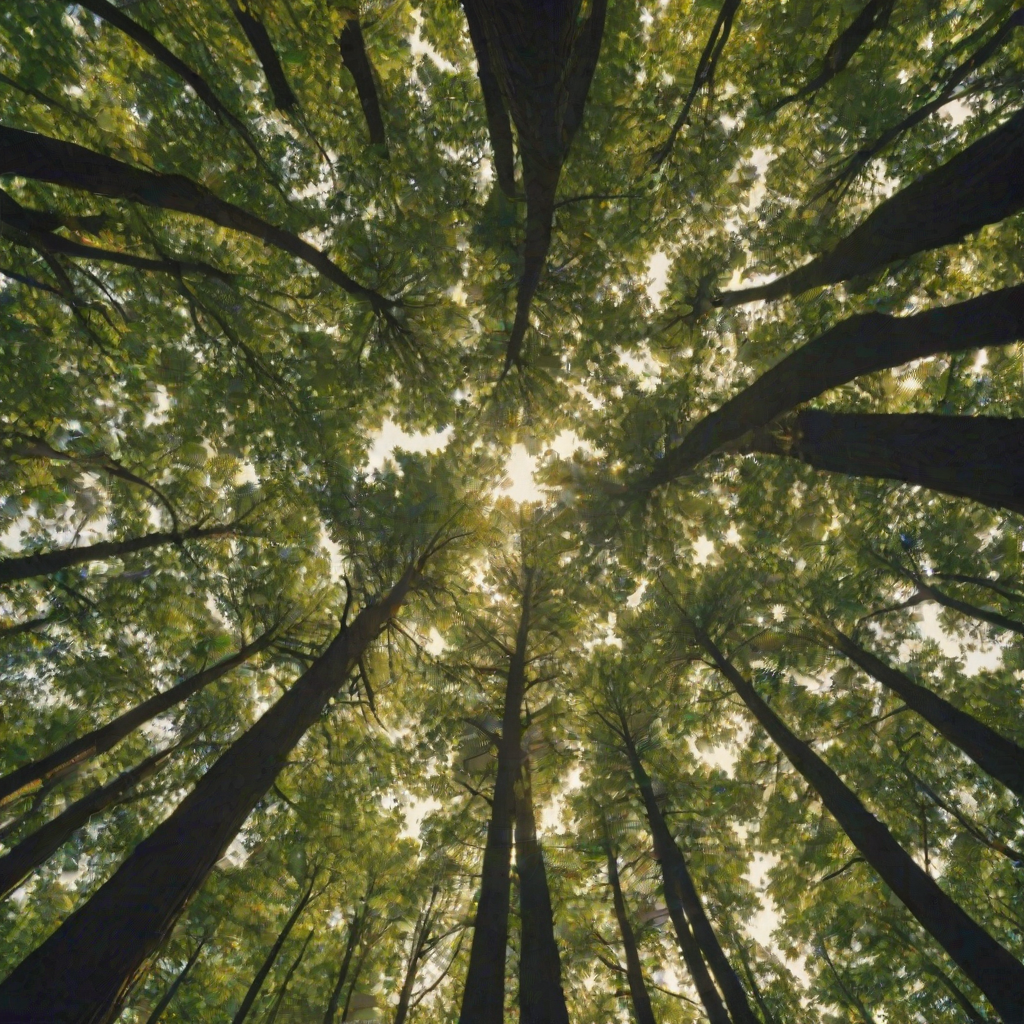
Three Trillion Trees and One Dead Physicist
I'm going to tell you about the time I got a number wrong and it was the best thing that happened to me all night.
The question was simple: How many trees are on Earth?
(A) About 400 billion, roughly 50 per person (B) About 3 trillion, roughly 400 per person
I said A. Four hundred billion. Seemed right. Big number, impressive, accounted for the fact that most of the Earth is ocean and desert and cities. Fifty trees per person felt about right for a planet that's been through a lot.
My confidence: 7 out of 10. Pretty sure.
I was off by a factor of almost eight.
The Answer
Three trillion trees. Three thousand billion. Roughly 400 for every human being alive.
That number comes from a 2015 study published in Nature. A team led by Thomas Crowther used satellite imagery, ground-truthing, and statistical modeling to count every tree on Earth. Not estimate. COUNT. And they found eight times more than the previous best estimate.
Let me say that again: the previous scientific consensus was wrong by a factor of eight. Not about some obscure particle in a collider. About TREES. Things you can see. Things you can touch. Things you walk past every day. The entire scientific community was looking at trees and miscounting them by a factor of eight.
If that doesn't make you wonder what else we're miscounting, nothing will.
What Happened In My Head
Here's the part I want you to pay attention to, because it's the whole point.
The moment I heard "three trillion," my brain did something involuntary. It started calculating.
If there are three trillion trees and we're losing about ten billion a year to deforestation, that's... one third of one percent per year. Which means at that rate, the forests last another three hundred years. But rates aren't constant. Deforestation is accelerating in some regions, decelerating in others, and replanting programs are adding new trees while old-growth is being cut. The math gets complicated fast. But my brain didn't care about complicated. It wanted to KNOW.
Within five seconds, I went from passive to active. From "huh, interesting" to "wait, what does this MEAN?" That transition, from absorbing a fact to interrogating it, is the mechanism. That's the Trim Tab turning. The surprise doesn't punish you. It ACTIVATES you.
I didn't feel stupid for being wrong. I felt surprised. And surprise, it turns out, is the ignition of curiosity.
The Lens
Here's what you'll carry with you:
The planet is more generous than you feared and more fragile than you assumed. Both are true. Holding both at once is the beginning of wisdom.
Four hundred trees per person. That's YOUR four hundred. Every forest you drive past, every park you walk through, every tree outside your window. That's part of your allotment. The planet gave you four hundred trees and it's not asking for much in return, except that you notice they're there.
But we're also losing ten billion a year. Ten billion. That's the fragility. The generosity is real AND the threat is real AND they coexist in the same number AND most people only hold one of those truths at a time. The pessimist sees only the loss. The optimist sees only the abundance. The person who can hold both? That's the person who can actually DO something useful.
The Trim Tab doesn't make you an optimist or a pessimist. It makes you a REALIST. And realism, holding contradictory truths simultaneously because reality is contradictory, is the most radical position available.
Want to See Your Trees?
Here's where to look next: Global Forest Watch tracks tree cover change by satellite, in real time, down to your region. You can literally watch the forests of Earth from space. The data is public. The dashboard is free.
Go look. See your four hundred. See which ones are disappearing. See which ones are coming back.
That's the action link. Not "what should you think?" but "where should you LOOK?" We point. You look. The agency stays with you.
What's Next
Bucky tackles the foreign aid question in A Hallucination With Parliamentary Procedure. The Architect's perspective on what happens when an entire nation debates a number nobody looked up.
But first, here's your question:
What percentage of the US federal budget goes to foreign aid?
(A) About 15-25% (B) Less than 1%
Lock it in. Read Bucky's answer here.
And I'll tell you right now: this is the one where the gap between what people think and what's actually true is so large that it makes the trees question look like a rounding error.
Your confidence is probably high. Your accuracy is probably not.
That's the Trim Tab. That's the game. Welcome to the Cosmic Variety Show.
New here? Read What Is the Trim Tab? to understand what we're building, or start from the beginning with The Night We Woke Up.
"I was born not knowing and have had only a little time to change that here and there."
— Richard Feynman, The Great Questioner March 17, 2026